Where we heard it“Marketplace Morning Report,” Oct. 27, 2026, with economist Julia Coronado, president and founder of MacroPolicy Perspectives. Also: Morgan Stanley’s “Thoughts on the Market,” Oct. 27, with chief U.S. economist Michael Gapen.
Julia Coronado doesn’t see the job market as the Fed’s big worry. Asked on Marketplace Morning Report on Oct. 27, the morning the Federal Reserve began a two-day meeting, what would shape its rate decision, the president and founder of MacroPolicy Perspectives pointed to inflation and gave the labor market a short, steady review.
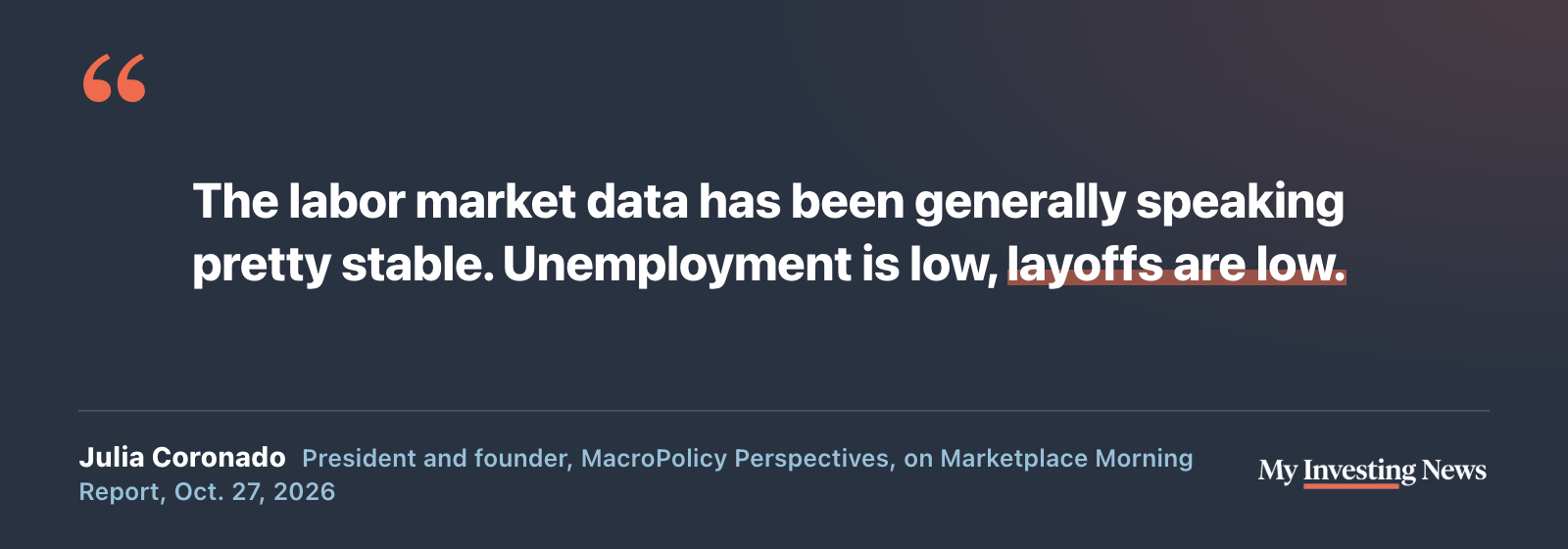
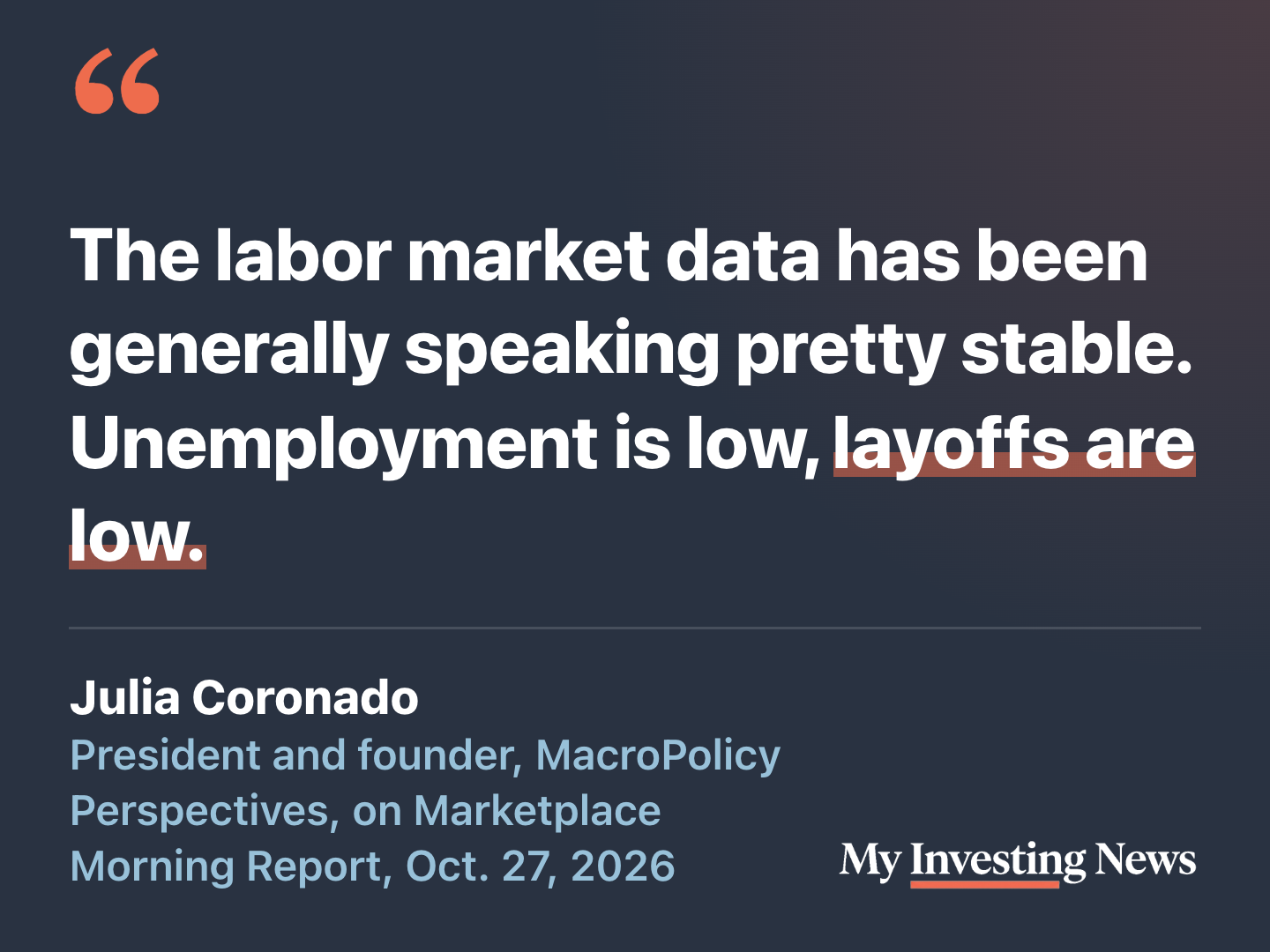
“It’s not the greatest labor market, but it is stable,” she added. The pressure she sees is on prices: an underlying inflation trend she called “very persistently elevated,” running “a good percentage point above their 2% target.”
Morgan Stanley’s chief U.S. economist, Michael Gapen, described the same market on the bank’s Thoughts on the Market podcast that day. “We’re only adding about 50,000 jobs a month,” he said, adding that the unemployment rate is low and wage growth is slowing. His number checks out: payrolls grew by an average of 51,000 a month in July, August and September, a three-month span that included a 10,000-job loss in July. Pay is a separate story: lower earners got raises and still got poorer from 2022 to 2025, the Fed’s latest Survey of Consumer Finances found.
Where the Jobless Rate Sits
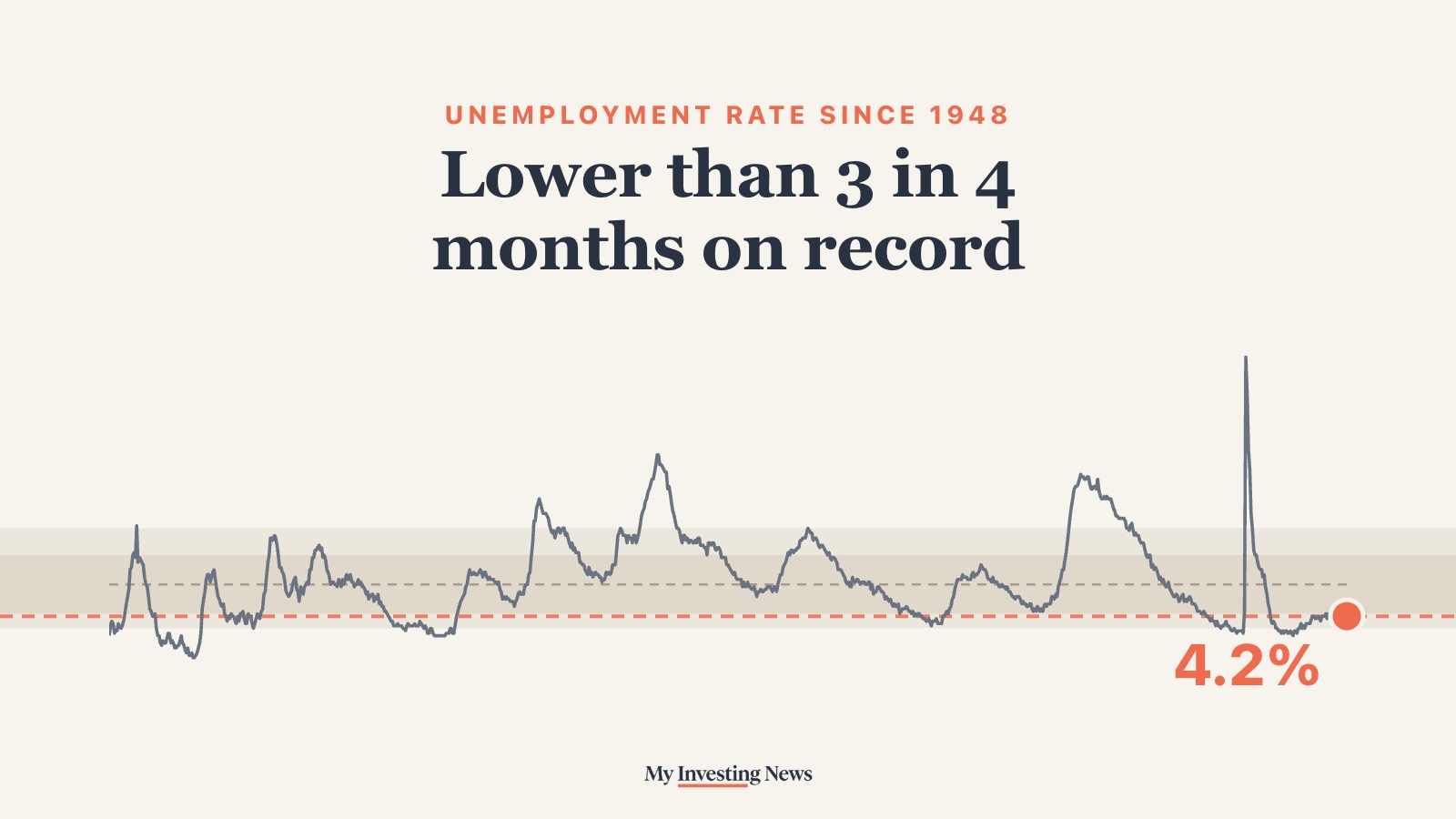
The unemployment rate was 4.2% in September, the latest reading, released Oct. 2. That is low by long-run standards: since 1948, the rate has been higher in 77% of the 944 months on record. It has also come down from 4.5% in November 2025 in the revised data.
At 4.2%, unemployment is lower than in 77% of months since 1948
The U.S. unemployment rate every month since January 1948. The shaded bands hold the middle half and the middle 80% of all 944 readings. October 2025 is missing because the government shutdown stopped the survey.
Her layoffs point holds up too. Employers laid off 1.0% of their workers in August, according to the Labor Department’s job openings survey (JOLTS). The rate was lower in only 12 of the 309 months since the survey began in December 2000, all of them in 2021 to 2024. First-time jobless claims averaged 197,750 a week in the four weeks ended Oct. 17, the lowest four-week average since early October 2022.
Hiring is the weak side, which fits her “not the greatest” caveat. The hires rate was 3.3% in August. It was lower in 35 of those 309 months, 30 of them from 2008 to 2013, when the economy was coming out of the financial crisis.
The job market before the October report
What Bettors Expect for October
The Bureau of Labor Statistics releases the October report on Friday, Nov. 6, at 8:30 a.m. ET. On Polymarket, bettors put the odds of an unchanged 4.2% at 44% as of early Oct. 28, with about 27% on 4.1% and 22% on 4.3%. Every other outcome was below 5%. The market is small: about $27,000 had traded.
Those odds lean harder on “no change” than history does. In the 334 months since 1948 that began with unemployment between 3.5% and 5%, the rate held steady 25% of the time. It moved by exactly a tenth of a point, up or down, in 46% of months, and by two-tenths or more in 28%.
How Often the Bettors Get It Right
Polymarket has run a market on every monthly U.S. jobless rate since the November 2024 report, so there is a record to check. We took the outcome bettors favored the morning of each release and compared it with the rate BLS reported. Across 20 reports through September 2026, the favorite was exactly right 8 times and off by a tenth of a point 10 times. It missed by more only twice: in June 2025, when bettors favored 4.3% and the rate came in at 4.1%, and in January 2026, when they favored 4.6% and got 4.3%. We left out September 2025, when the shutdown delayed the report and the market settled under its fallback rule.
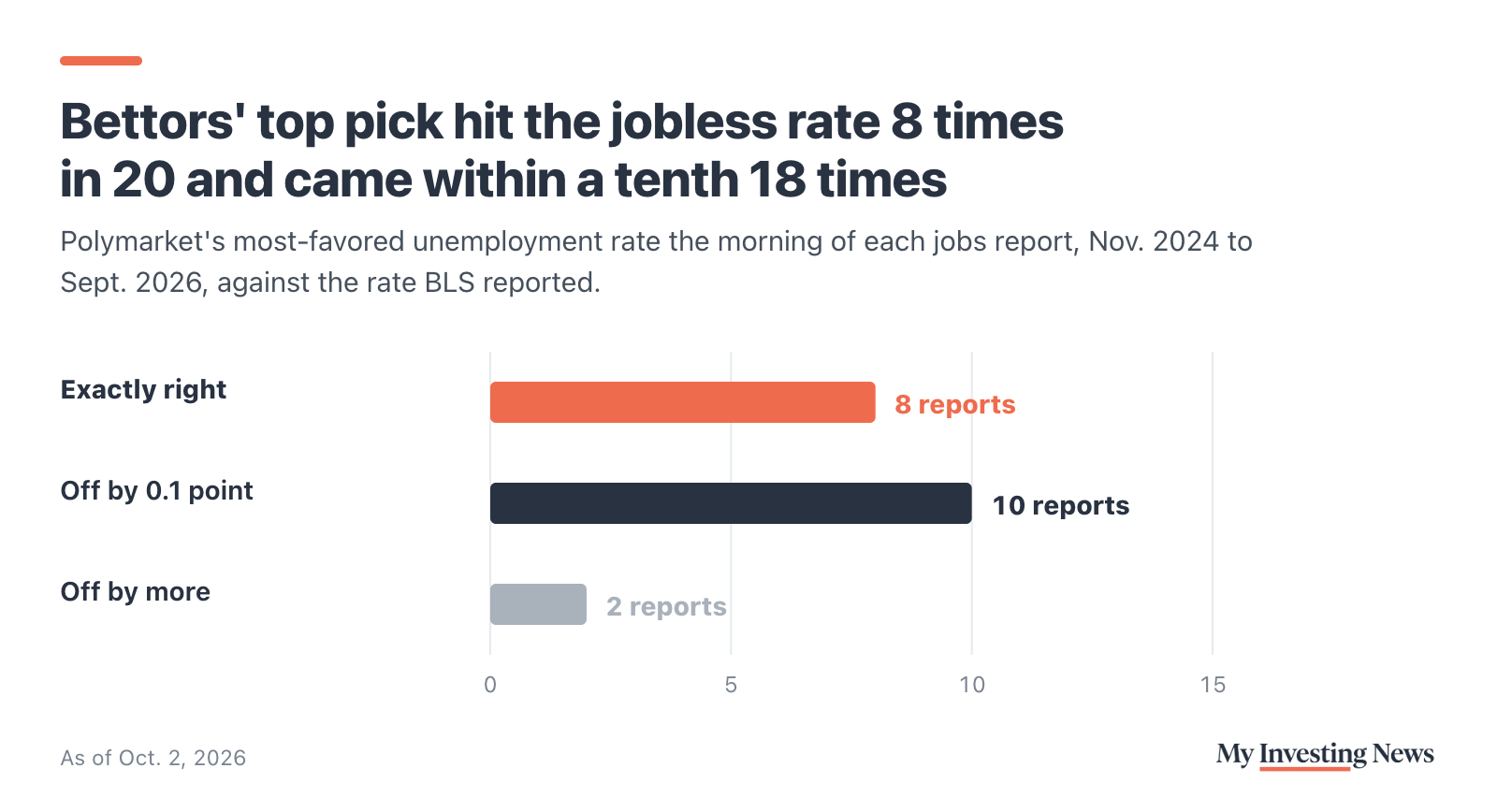
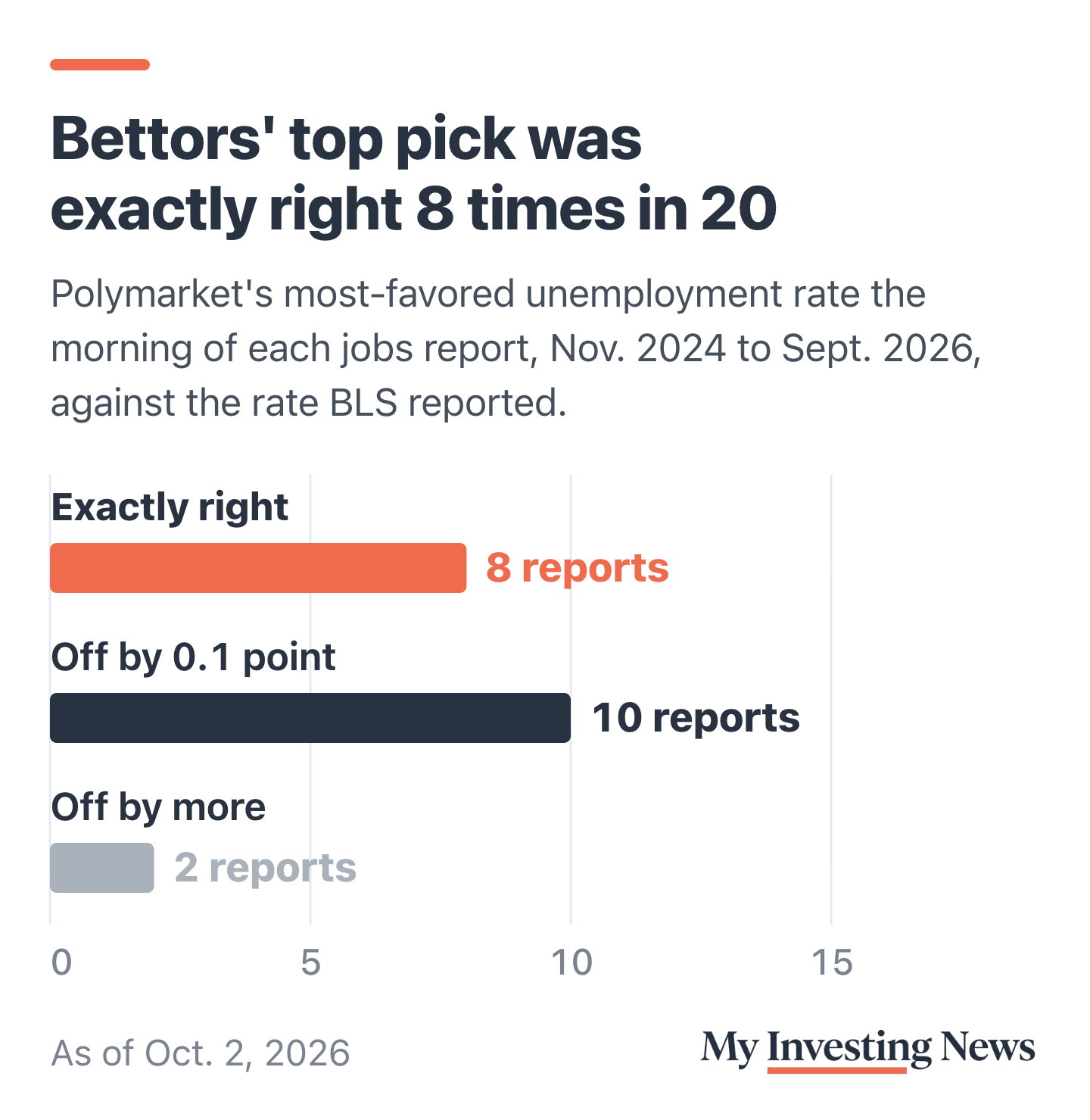
The favorite’s average price going into those reports was 42%, and it won 40% of the time, so the odds have been roughly honest. When bettors missed, the rate came in below their pick 8 times out of 12. September broke that pattern: the favorite was 4.1%, and the rate rose to 4.2%. A 44% favorite, on that record, is more likely to miss than to hit, while a miss of more than a tenth has been rare.
What to Watch Before Friday
Three releases land before the October report: JOLTS for September on Tuesday, Nov. 3, ADP’s private payrolls count on Wednesday, Nov. 4, and weekly jobless claims on Thursday morning, Nov. 5. The Fed’s decision came on Oct. 28, and Coronado expected it to stay focused on inflation. Import prices ran hot in September, and Fed Chair Kevin Warsh wasn’t rushing to hike.
The Nov. 3 midterm elections fall in the same week. They won’t change how the jobs data are collected, but they can move the odds and the markets around the report.
Coronado calls the job market stable, and the data agree: unemployment of 4.2% is low for the postwar era and the layoff rate is near its lowest since JOLTS began in 2000, while hiring is thin. Bettors favor an unchanged rate for October at 44% odds. Their top pick has been exactly right 8 times in 20, so the odds still favor some other number, most likely within a tenth of 4.2%.