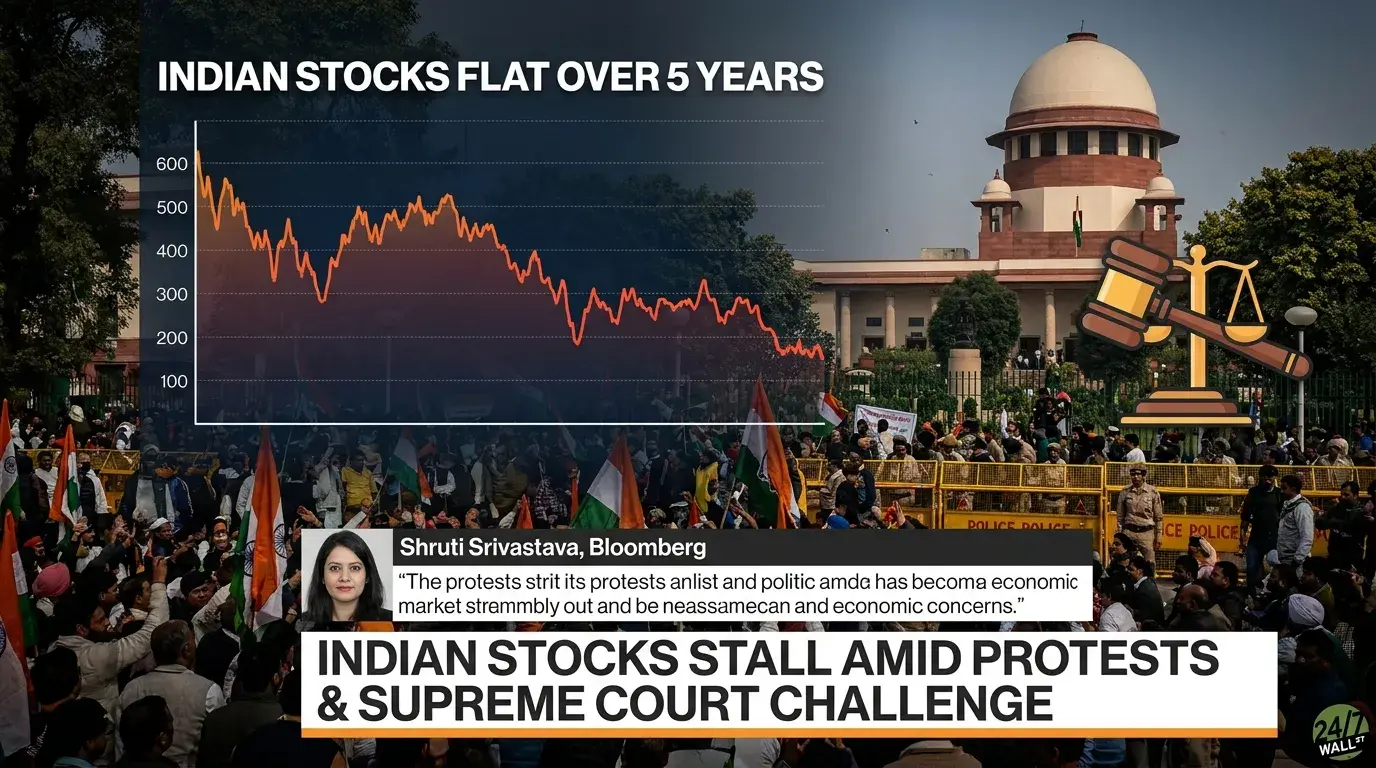
An American investor who bought the iShares MSCI India ETF (CBOE:INDA) five years ago and held it through Monday has about what they started with. The fund’s five-year return through Oct. 12 is -0.3%. A political dispute now sits atop that flat result. Opposition parties and a youth-led movement are challenging India’s election chief in the streets and, Bloomberg reports, at the Supreme Court.
Five Flat Years After a Decade of Gains
Over a longer stretch, the fund’s ten-year return is 77.35%, so India was a growth story that later stalled. Recent results are weaker. The ETF has returned -14.25% year to date, -12.17% over one year and -4.57% over the past month. Shares stood at $46.35 on a delayed quote from Monday’s session.
The fund held net assets of $6,759,351,362.09 as of May 31, 2026, according to its portfolio filings with the SEC.
Voter Roll Dispute Reaches India’s Supreme Court
India is in the middle of a dispute over a revision of its voter rolls. Opposition parties and a youth-led protest movement want the Chief Election Commissioner to quit and the revision to stop. On Monday, the BBC reported that Rahul Gandhi led an opposition march to the top court to demand the election chief resign. Bloomberg reported that the opposition marched on the top court as the voter row escalated.
Authorities detained protest organizers and opposition figures over the weekend. On Oct. 11, AP News reported that leaders of the “Cockroach” protest movement had been released and vowed to keep demonstrating. PBS reported that the leaders pledged to hold more protests. DW used the same name in its report on a police crackdown in Delhi. Reuters reported that journalists accused India of a crackdown on reporters and press freedom at the protests. The New York Times framed the demonstrations this way: “India’s Youth Protests Challenge Narendra Modi.”
What Bloomberg’s Shruti Srivastava Is Reporting
Shruti Srivastava of Bloomberg passed along local media reports that “the decisions on voter roll revision taken by the chief election official were unilateral in nature, and the other members of the commission were kept in the dark.” That claim comes from local media and has not been confirmed.
Srivastava said the opposition and the pressure group are calling for the official’s resignation and “a complete and immediate halt of this exercise.” Describing the weekend, Srivastava said, “We saw deployment of thousands of police personnel. The police personnel were outnumbered by protesters.” Srivastava also said opposition leaders would go to “the Supreme Court, seeking resignation of the chief election official.”
On timing, Srivastava pointed to “a slew of critical elections” next year, including Uttar Pradesh, “India’s most populous and most politically important state.” Srivastava also said “the economy is facing a difficult moment, Indian equities have seen severe outflows,” and that the rupee is one of Asia’s worst performers. We could not independently confirm the outflows or the rupee’s performance. These are her descriptions.
What We Could Not Confirm
Other reports have given a number for how many names the revision removed from the rolls. We could not check that number against a primary source, so we left it out. We could not confirm the movement’s formal name beyond the one word used in international coverage. We did not verify claims that detentions took place on board aircraft.
How Political Risk Reaches a US Portfolio
Political risk means uncertainty about rules, institutions and how predictable outcomes are. When that uncertainty rises, investors tend to calling for a higher return for holding assets, and that shows up as lower prices.
Most US investors hold India indirectly, through a single-country fund like INDA or a broad emerging-market fund. People who own the broader funds may not know how much India exposure they have, and a fund’s holdings page will show it.
Currency adds a second layer. A US investor in an India fund owns both the stocks and the rupee, so currency moves affect returns on their own, apart from what the stocks do.
Reasons for Caution Before Linking Protests to Prices
The five-year flat stretch started long before this dispute, and it has other possible causes we did not examine. Nothing we checked shows that the protests caused any part of the recent decline. The year-to-date drop was already in place before this weekend. Srivastava described current conditions and gave no view on where the market goes from here.
That leaves one question for anyone who has held India through five flat years: is the expected return paying them enough for the risk they carry?