Where we heard itBloomberg Businessweek, “Midterms Notch Records on Early Voting, Ad Spending,” Nov. 3, 2026. Speaker: Bloomberg News campaign finance reporter Bill Allison.
On election night, Bloomberg’s campaign finance reporter Bill Allison singled out one new kind of money in the 2026 midterms: the AI super PACs. Crypto’s groups had all followed one bipartisan playbook, he said. The AI industry split into two camps, one aligned with OpenAI that wants a single federal rulebook and one aligned with Anthropic that wants stricter rules. “That money kind of canceled each other out,” Allison said, adding that “sometimes they would be on opposite sides in a single primary.”
We checked that against the record. Using every independent expenditure the two networks reported to the Federal Election Commission through Nov. 9, we matched each candidate they backed or opposed to the outcome of the race they spent in, primary or general, as of Nov. 10. For comparison, we scored the crypto industry’s Fairshake group and Elon Musk’s America PAC the same way.
Two Camps, One Real Collision
The pro-industry camp is Leading the Future, funded by Andreessen Horowitz’s founders and OpenAI president Greg Brockman among others. It spent $34.9 million through two super PACs, Think Big for Democrats and American Mission for Republicans. The other camp is Public First, whose nonprofit arm received $20 million from Anthropic in February. It spent $24.4 million through Jobs and Democracy PAC and Defending Our Values PAC. Together that is $59.3 million.
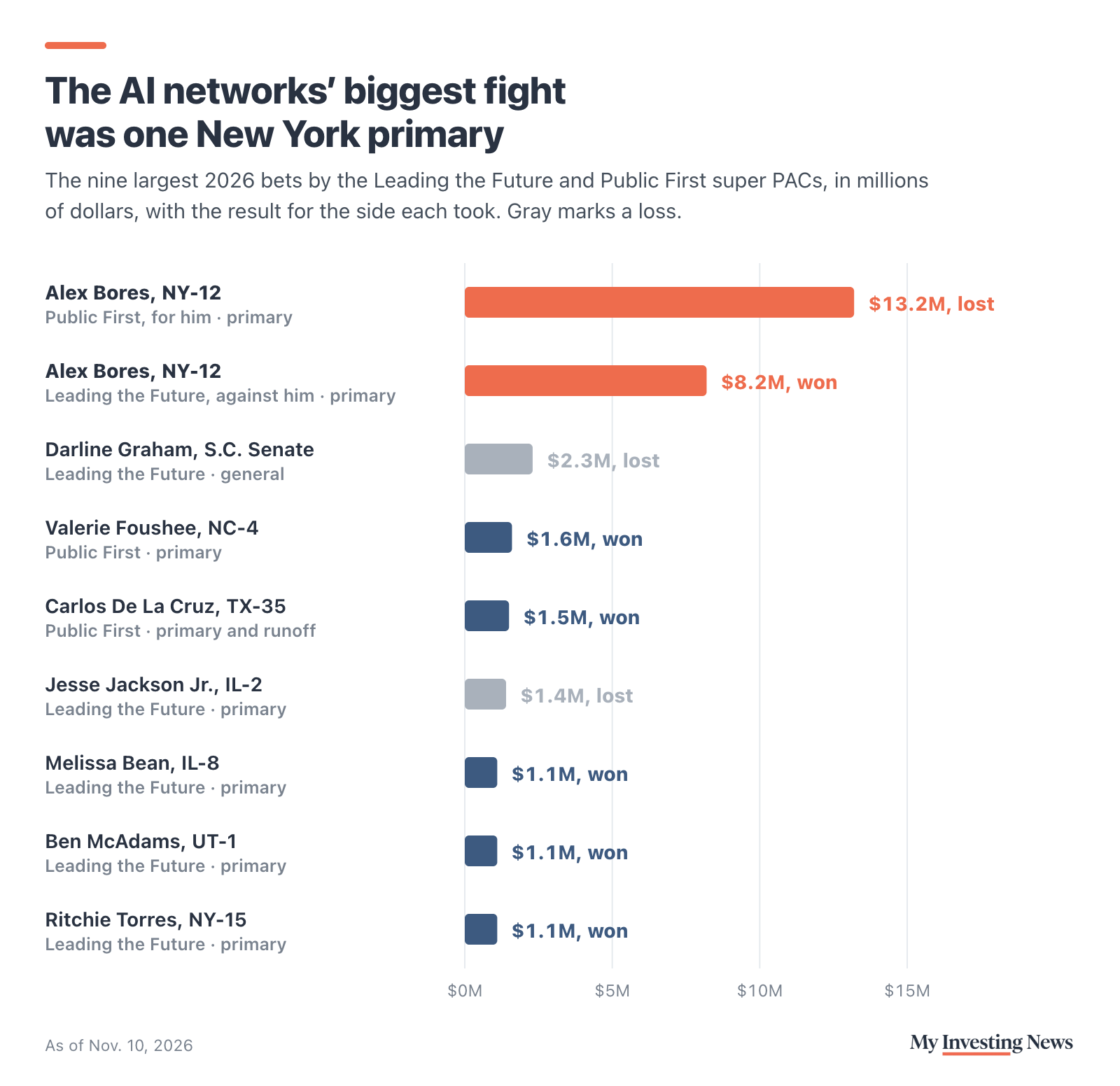
The two networks met head-on in one race. In the June Democratic primary in New York’s 12th District, Public First spent $13.2 million backing state Assemblyman Alex Bores, an AI safety advocate, and Leading the Future spent $8.2 million against him. That single primary took 36% of everything both networks spent all cycle. Bores lost to Micah Lasher. Public First outspent its rival there, and the result still went Leading the Future’s way. Outside New York, the networks crossed paths only twice in our data: both backed Kevin Hern in Oklahoma’s Senate primary, and they spent in different parties’ primaries in Florida’s 25th District.
The Record: 69 Wins in 74 Races
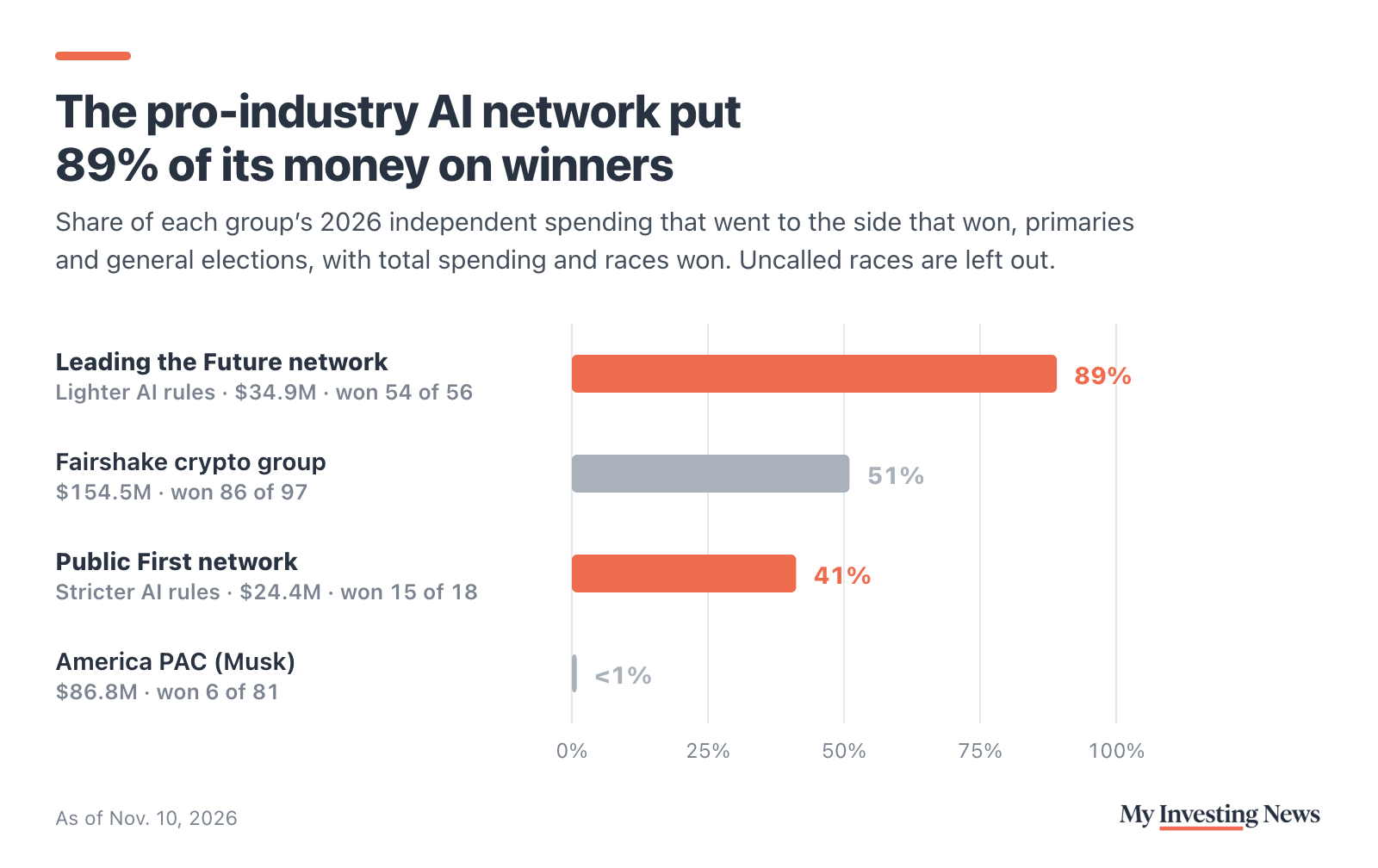
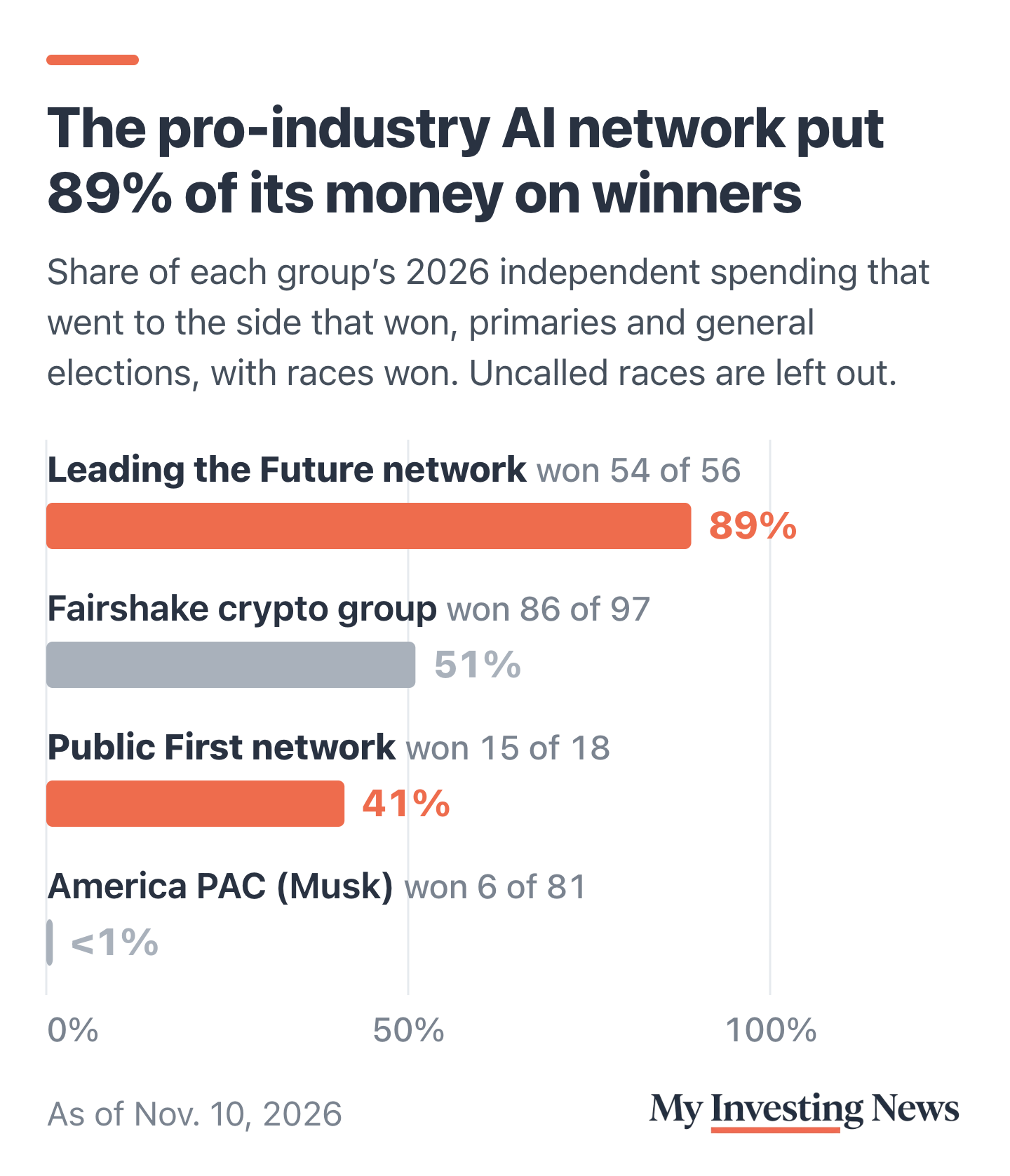
Counted race by race, the AI money looks like a winner. Leading the Future’s side won 54 of the 56 races it spent in, and 89% of its dollars went to the winning side. Public First’s side won 15 of 18, but only 41% of its money landed on a winner, because more than half of it went to Bores. Two races Leading the Future spent in, the Mississippi Senate race and California’s 23rd District, were still uncalled as of Nov. 10.
The high win rate mostly reflects where the money went. Most of it went into primaries, where 35 of Leading the Future’s 36 bets paid off. Apart from one Senate race, its general-election money ran about $200,000 to $500,000 per candidate, mostly for sitting members of Congress, and every one of those races called so far went its way. The exception was its biggest general-election bet: $2.3 million for Republican Sen. Darline Graham in South Carolina, who lost to Democrat Annie Andrews. The Democratic wave also caught candidates the networks had carried through primaries: Leading the Future’s picks Jay Feely, Aaron Flint and Laurie Buckhout all lost in November, as did four Republicans Public First backed in primaries: Carlos De La Cruz, Rhett Marques, Scott Singer and Alex Mealer.
Outside spending in the 2026 midterms, FEC filings through Nov. 9
Crypto and Musk Spent More and Missed More
Crypto spent far more. Fairshake and its two affiliates spent $154.5 million, more than twice both AI networks combined, and won 86 of 97 races. But only 51% of its money went to winners, mostly because of Ohio, where it put $56.6 million into backing Sen. Jon Husted and opposing Sherrod Brown. Brown won.
Musk’s America PAC had the worst record of the four. It spent $86.8 million, nearly all in general elections, and its side won 6 of 81 races. $47.3 million of that went to the Texas Senate race, against Democrat James Talarico and for Republican Ken Paxton. Talarico won.
The pattern fits what Stanford political scientist Brandice Canes-Wrone said before the vote: outside money has the most sway in primaries, where fewer voters know the candidates. In general elections the groups that bet on close races mostly lost with the tide, and the ones that bet on favorites mostly won, much as the favorites in prediction markets did.
What to Watch
Super PACs file their post-general reports with the FEC by Dec. 3, which will show any spending in the final days that the 24- and 48-hour notices missed. Leading the Future has said it will keep spending into 2028. The more direct test of Allison’s point comes in the new Congress, where Democrats will control both chambers and the two camps’ fight over a single federal AI standard moves from campaign ads to legislation.
Allison is right that the two AI camps spent against each other, but it happened mostly in one race: 36% of their $59.3 million went into a single New York primary, and the OpenAI-aligned side won it. Elsewhere both networks mostly backed favorites and won 69 of 74 races between them. The money that truly missed this year was the bigger outside spending in close general elections, from crypto in Ohio to America PAC in Texas.