Where we heard itCNBC, Mad Money, Oct. 27, 2026. Speaker: Rich Tobin, chairman, president and CEO of Dover, interviewed by Jim Cramer.
Rich Tobin has a sports metaphor for the company he runs. Asked on CNBC’s Mad Money on Oct. 27 whether investors should focus on the faster-growing businesses at DoverDOV, such as data center cooling and parts for power-plant turbines, the CEO pointed to the 35 to 40 companies under its roof and to an old Ohio State coach.
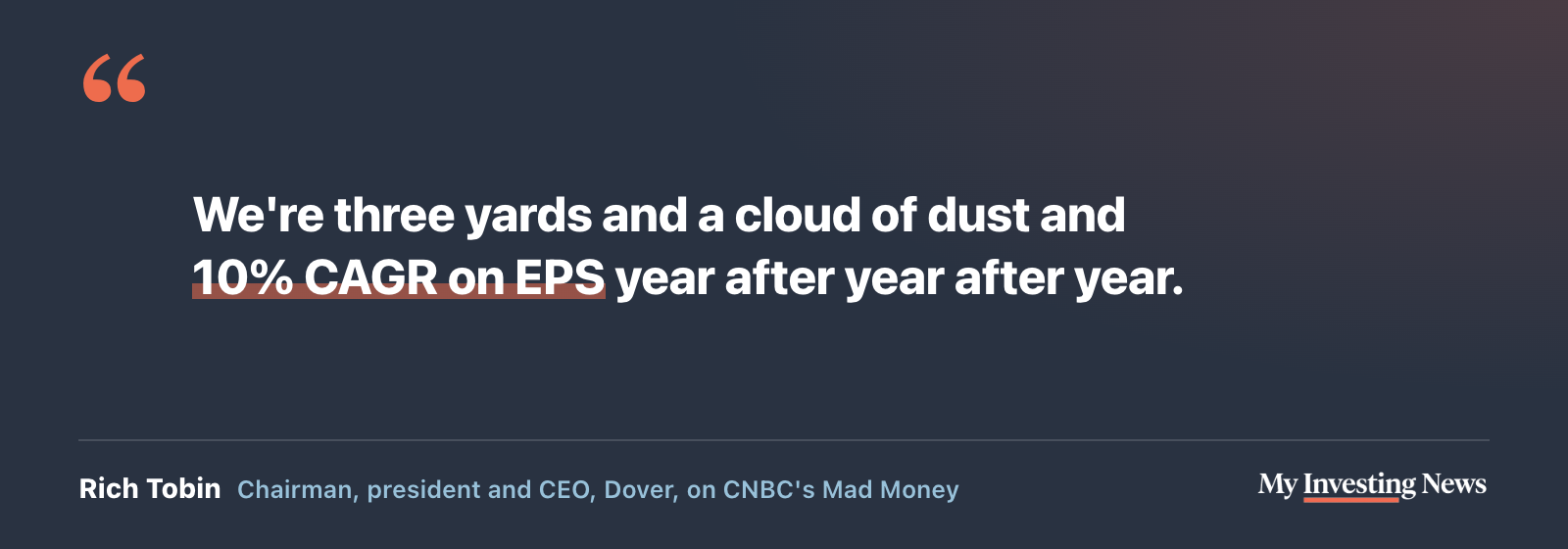
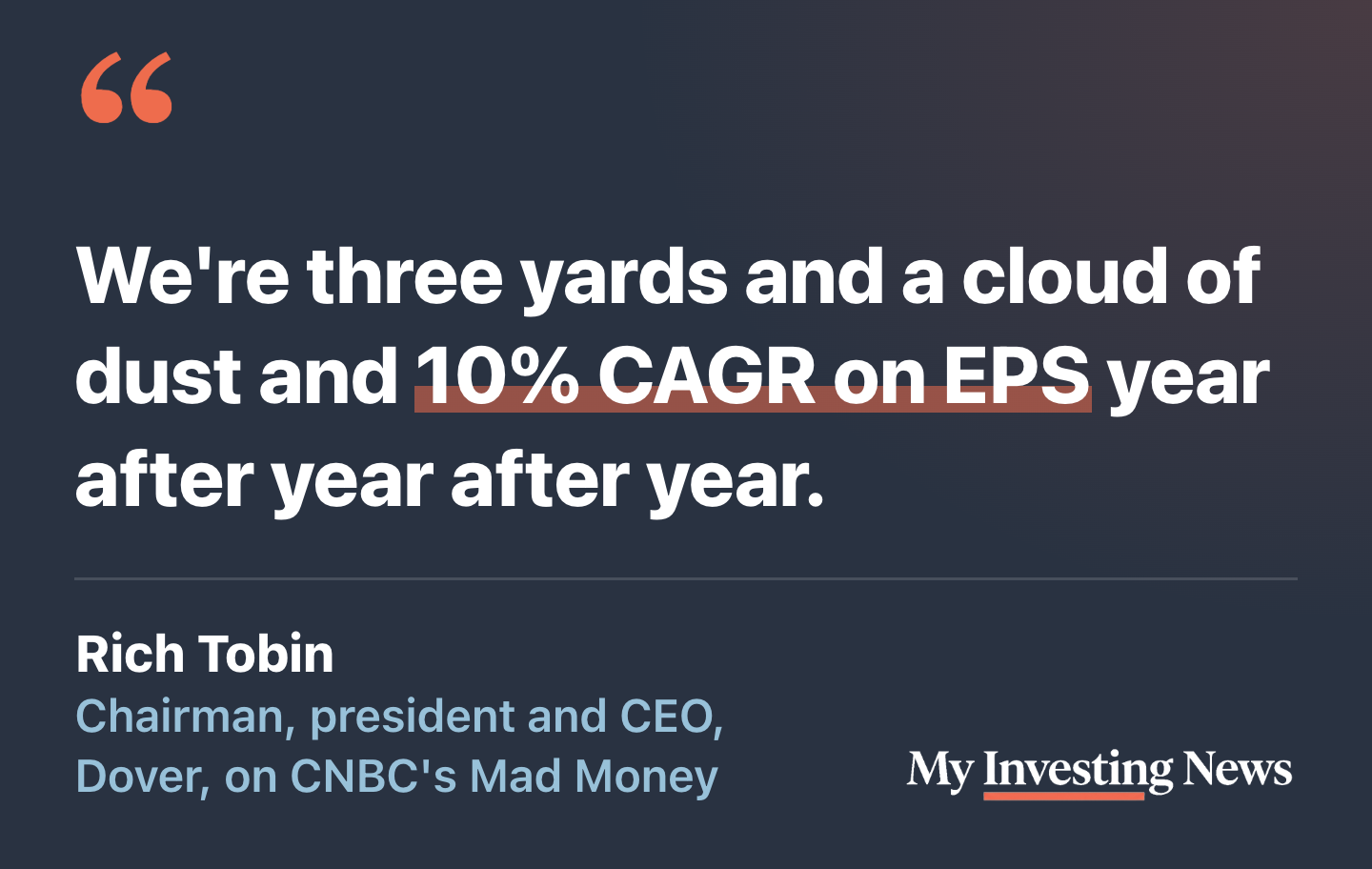
“You’re old enough to remember Woody Hayes at Ohio State. That’s us,” Tobin told Jim Cramer. “We’re three yards and a cloud of dust and 10% CAGR on EPS year after year after year.” CAGR is the compound annual growth rate, and Hayes’s teams were known for grinding out short runs instead of throwing deep.
Tobin, a Dover director since 2016, became CEO on May 1, 2018. Dover’s earnings releases since then make it possible to check the claim year by year.
Checking 10% a Year Against the Filings
Dover’s adjusted earnings per share from continuing operations rose from $4.15 in 2017, the last full year before Tobin, to $9.61 in 2025. Measured year by year on the basis Dover used in each January release, that is growth of 12.5% a year, and earnings per share ended up 2.56 times their 2017 level. The like-for-like measure matters because Dover sold its Environmental Solutions Group in 2024, which cut its restated 2023 figure from $8.80 to $7.95. Taking the two reported endpoints at face value gives 11.1% a year. Either way, the average beats 10%.
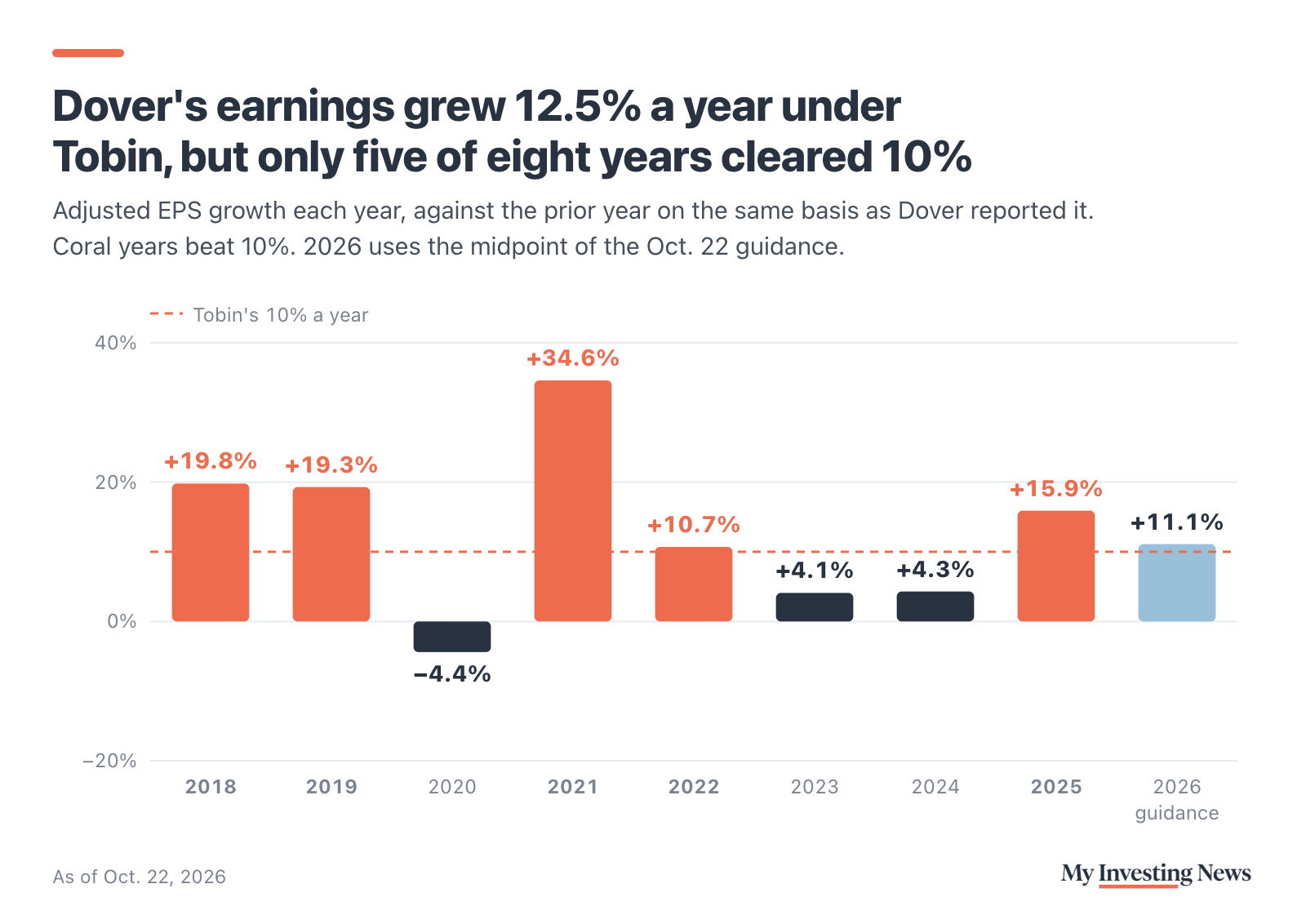
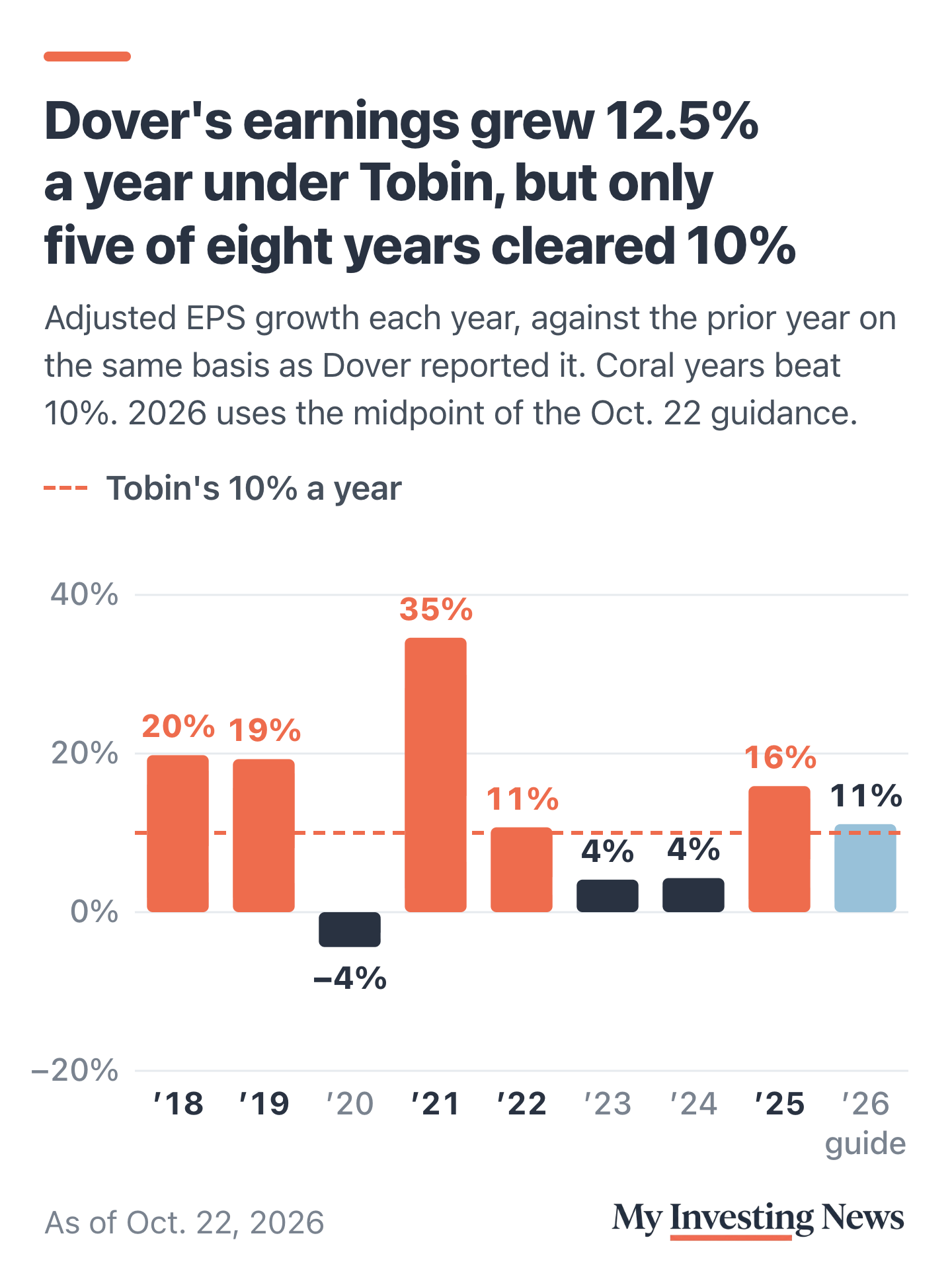
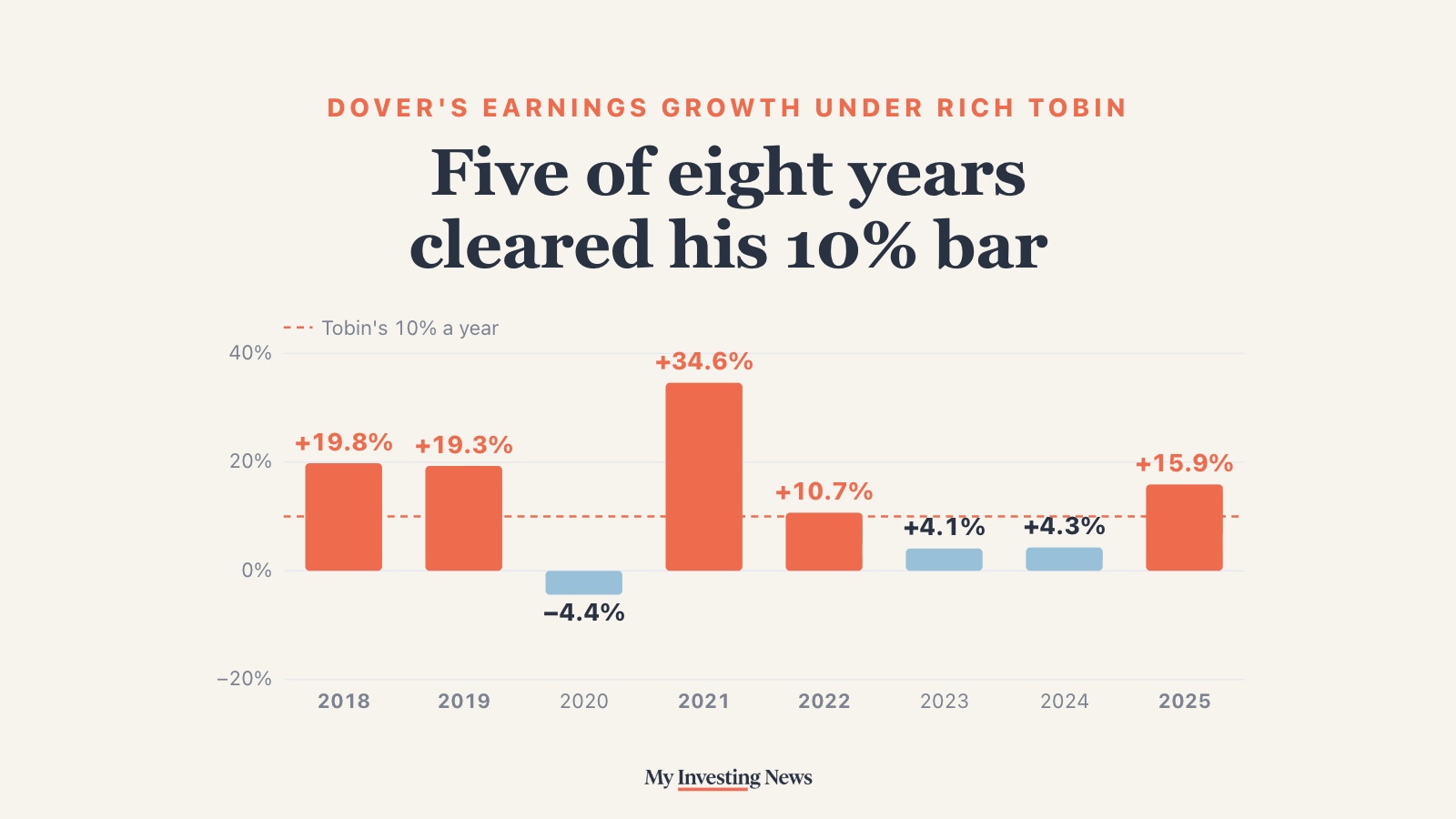
The “year after year” part is looser. Five of the eight years cleared 10%, led by a 34.6% jump in 2021 as demand came back from the pandemic. Adjusted EPS fell 4.4% in 2020 and grew about 4% in both 2023 and 2024. So the record looks more like a few long gains carrying some flat stretches than a steady three yards a carry.
How Dover Did Against Its Own Forecasts
Dover gives a full-year adjusted EPS range each January. In the seven years we could compare on the same basis, it finished above the top of the range four times (2018, 2019, 2021 and 2025), at the low end once (2022) and below it twice: 2020, when the pandemic hit, and 2023, when it earned $8.80 against a $8.85 to $9.05 forecast. We left out 2024, because the January range still included the business Dover sold that year.
This year is on track. Dover started 2026 at $10.45 to $10.65 and has raised it twice, most recently to $10.60 to $10.75 in its Oct. 22 third-quarter release. The midpoint would be growth of 11.1% over 2025. Third-quarter adjusted EPS was $2.88, up 10%, on 7% organic revenue growth, and bookings rose to $2.31 billion from $2.00 billion a year earlier. Dover also bought back more than $330 million of its stock in the quarter.
On air, Tobin said backlog had “gone up 16%.” On the Oct. 22 earnings call, Dover put order growth at 16% and said backlog was 35% higher than a year earlier, with roughly half of it scheduled to ship in 2027. That backlog is the basis for his other big claim, that the visibility into Dover’s 2027 “is better than it’s been in my nine years at the company.”
Dover in four numbers
What the Stock Has Done
The shares have lagged the earnings this year. Dover closed at $206.18 on Oct. 27, up 5.6% for 2026, against 12.9% for the SPDR S&P 500 ETF and 8.3% for the Industrial Select Sector SPDR Fund. It is 11.6% below its Feb. 20 closing high of $233.31 and slipped 2.2% on the day of the third-quarter report. At the Oct. 27 close it traded at about 19 times the midpoint of its 2026 guidance. Hightower’s Stephanie Link sold Dover on Oct. 23 to raise cash for stocks she thinks are cheaper.
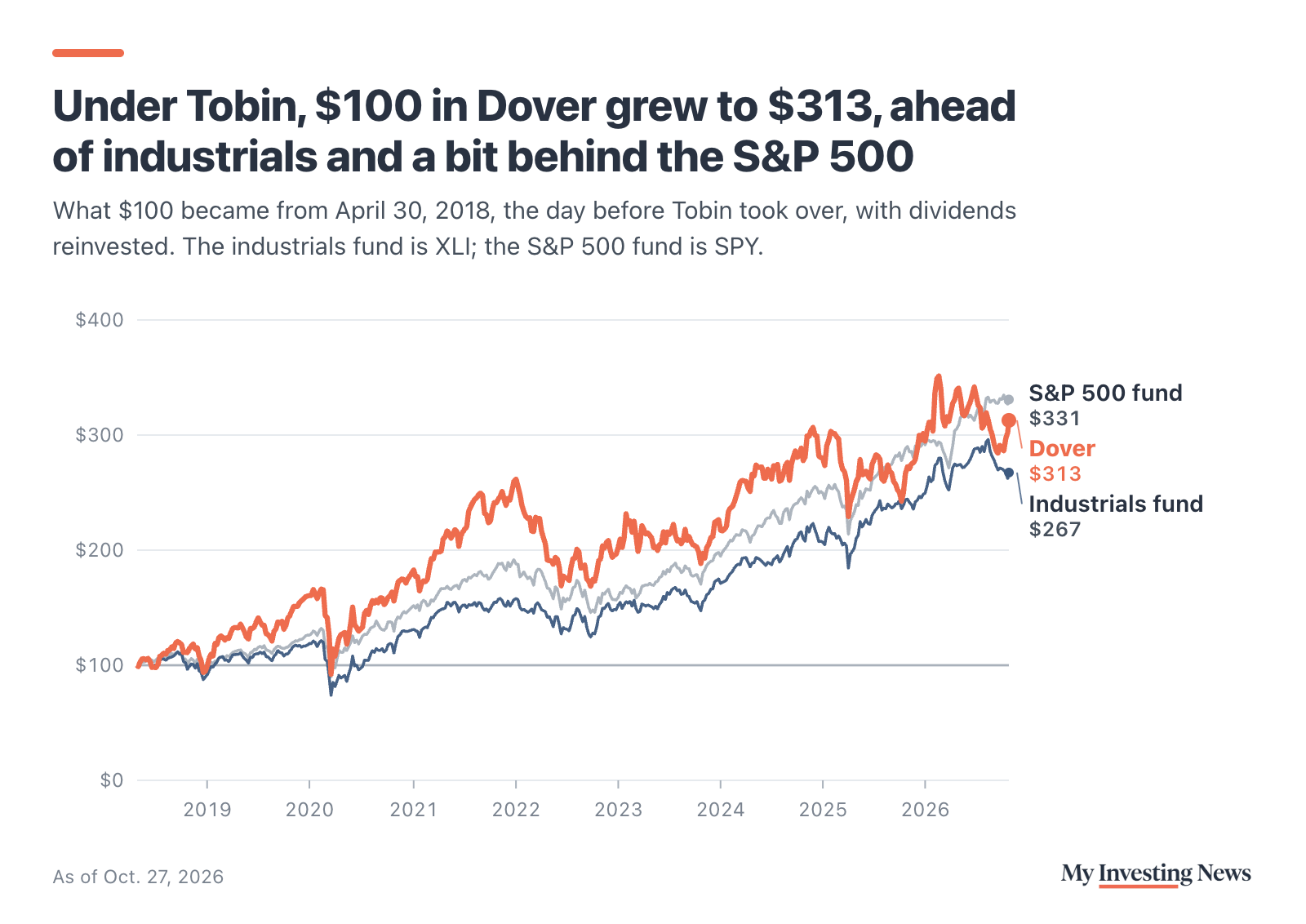
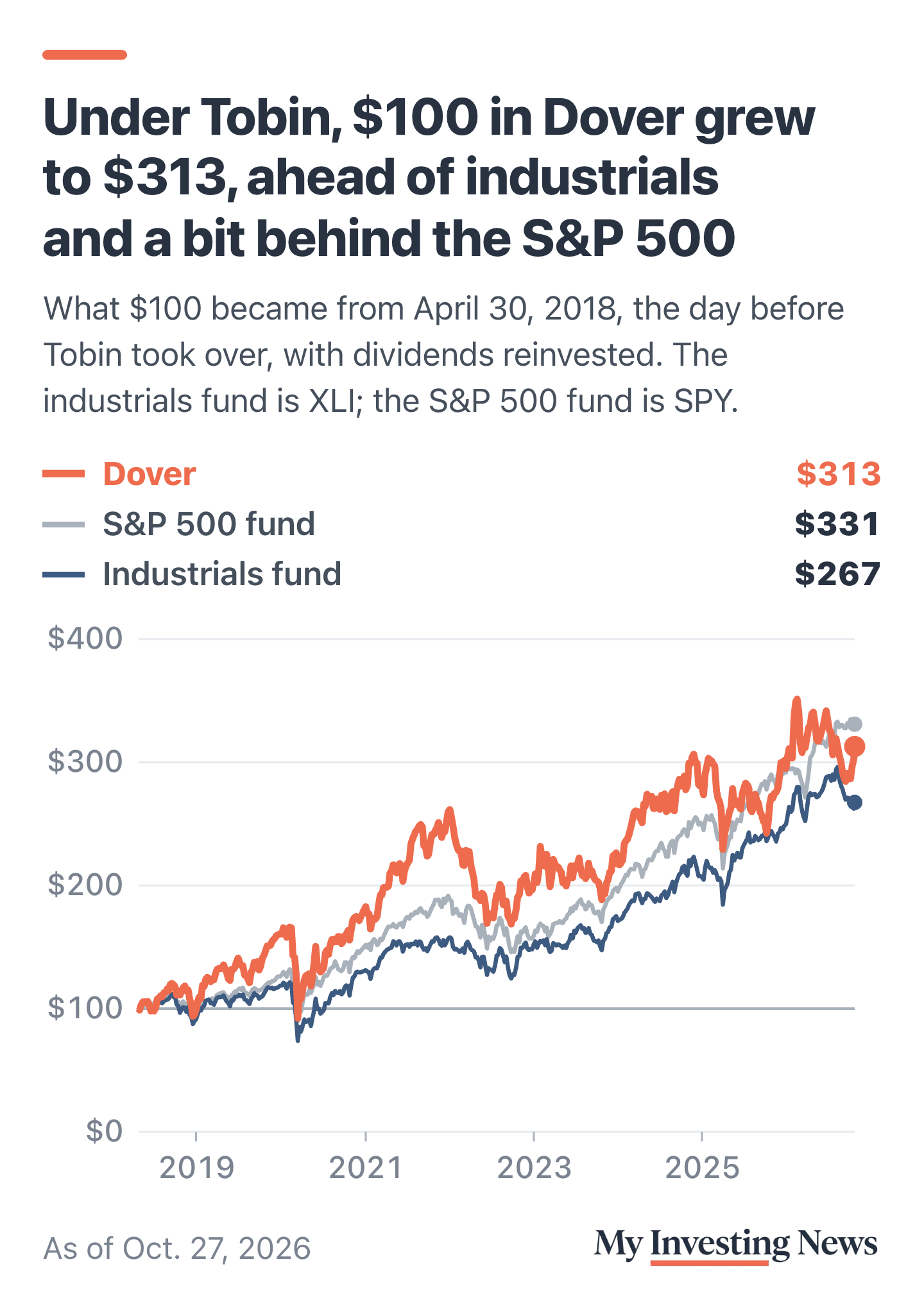
Over Tobin’s whole run, the stock has roughly kept pace with the market. From April 30, 2018, the day before he took over, through Oct. 27, Dover returned 14.4% a year with dividends reinvested. That beat the industrials fund’s 12.3% and trailed the S&P 500 fund’s 15.1%.
What to Watch
Dover usually gives its next-year guidance in late January, and that range is the first test of the 2027 visibility Tobin described. A midpoint at least 10% above this year’s result would keep his 10% claim on track for another year.
The backlog is the second test. Tobin said Dover’s CO2 refrigeration systems, which had no revenue three years ago, will bring in more than $300 million this year, and he named GE Vernova, Siemens and Caterpillar as customers for its turbine parts. He also said Dover had looked at $2 billion to $3 billion of possible acquisitions this year and closed a few smaller deals.
Tobin says Dover grows earnings about 10% a year, and the filings back him on average: adjusted EPS grew 12.5% a year from 2017 to 2025. The path was bumpier than three yards a carry, with three years well under 10%. The January 2027 guidance will show whether the bigger backlog turns into another double-digit year.