Where we heard itMatthew Hornbach, global head of macro strategy at Morgan Stanley, on CNBC’s Squawk Box, Nov. 10, 2026, minutes after the October inflation report.
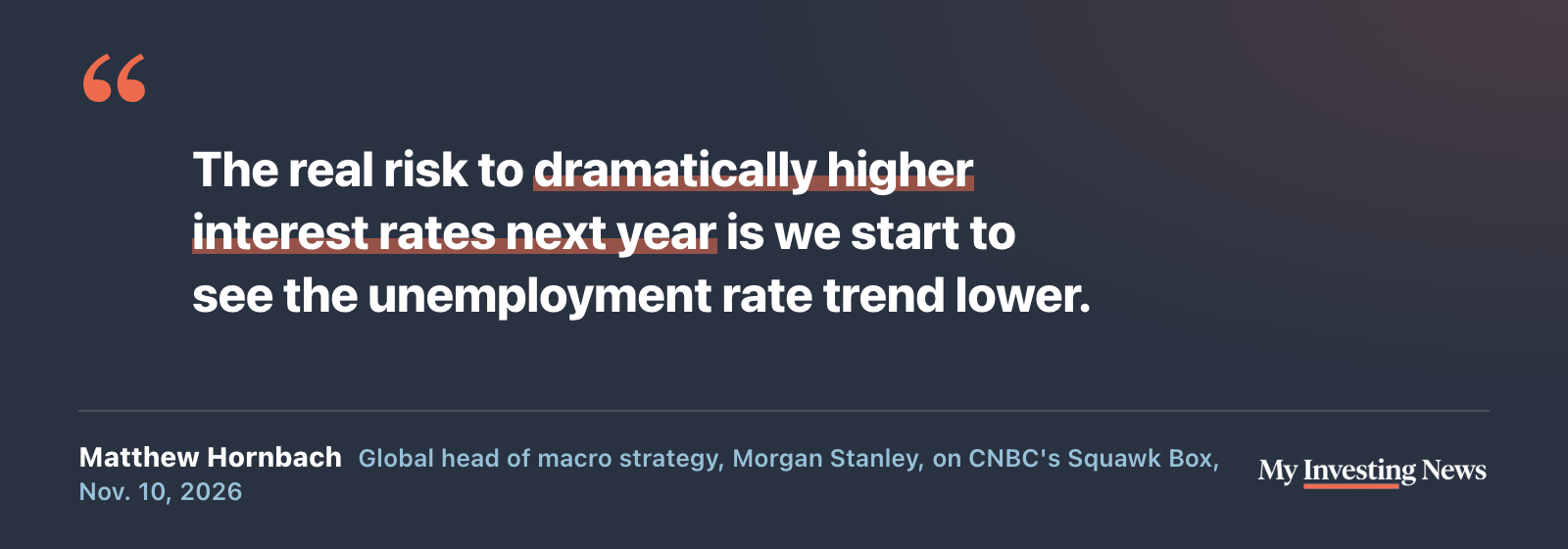
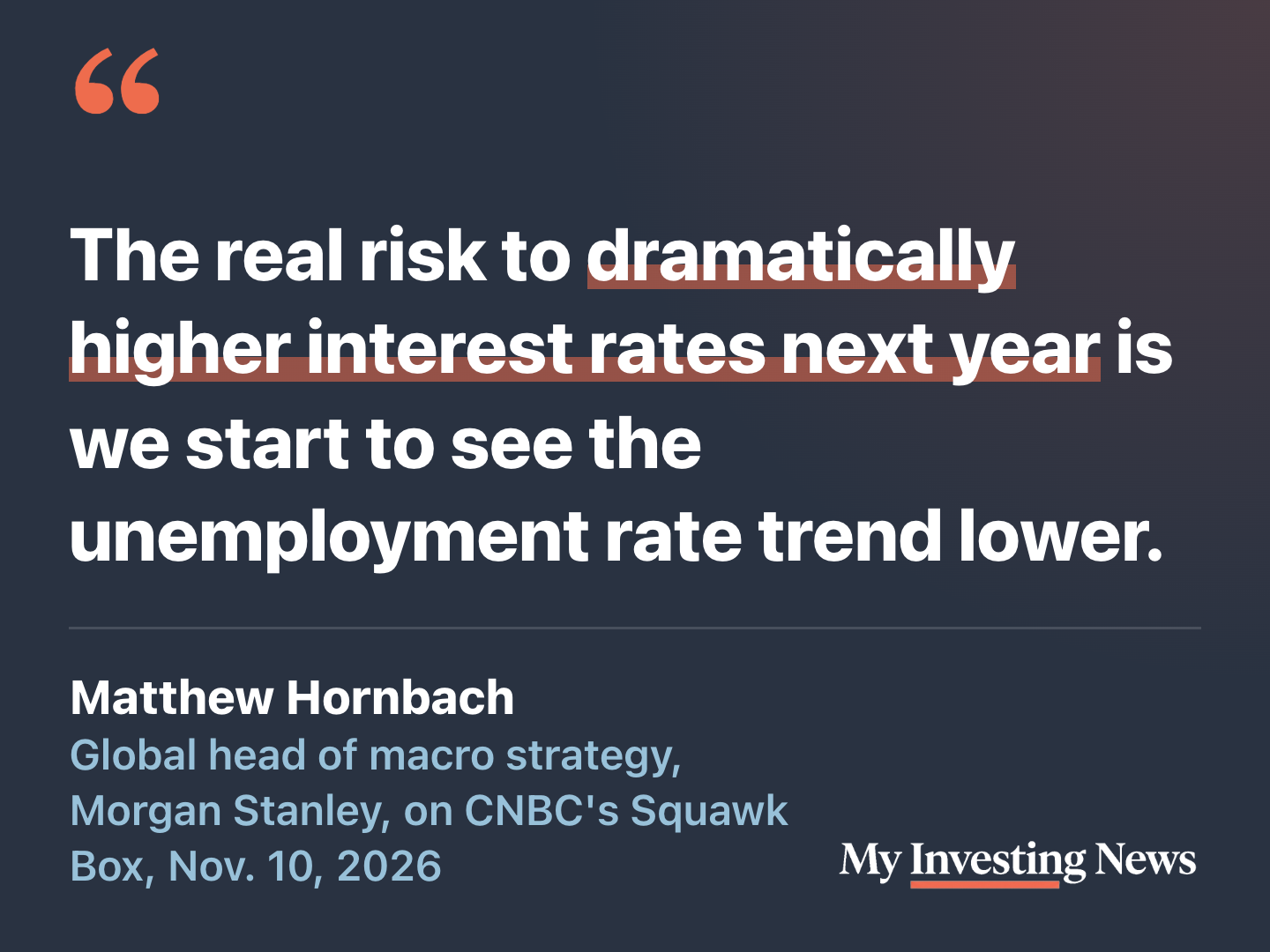
Matthew Hornbach spent the morning of Nov. 10 on CNBC explaining why interest rates could keep climbing. The October consumer price report had just come in hotter than expected, and Morgan Stanley’s global head of macro strategy said the next push higher depends on the job market:
He also asked whether the Fed will move from hiking “once a quarter” to “once a meeting,” and whether it is enough “to take back the insurance cuts that we received in 2025.” A year ago, Wall Street was planning for the opposite. Big banks are about to publish their outlooks for 2027, so we pulled the forecasts they made for 2026 and checked each one against the record.
Nine of 10 Banks Called for Cuts
The Fed ended 2025 with its target range at 3.50% to 3.75%, after three cuts. In a Reuters roundup on Dec. 11, 2025, the day after the last of them, most big brokerages still expected two more cuts in 2026. Citigroup penciled in January and March, Morgan Stanley January and April, and Goldman Sachs, Wells Fargo and Barclays March and June. JPMorgan and UBS Global Wealth Management expected one more. Bank of America had June and July. Deutsche Bank’s economists, in late November, expected two more cuts counting December’s, which left one for 2026.
Only Standard Chartered expected no cuts. The Fed’s own officials were in between: their December 2025 projections put the median rate at 3.4% for the end of 2026, one cut away. JPMorgan was the first big bank to turn. On Jan. 12, it dropped its January cut and forecast that the Fed’s next move would be a hike, in the third quarter of 2027.
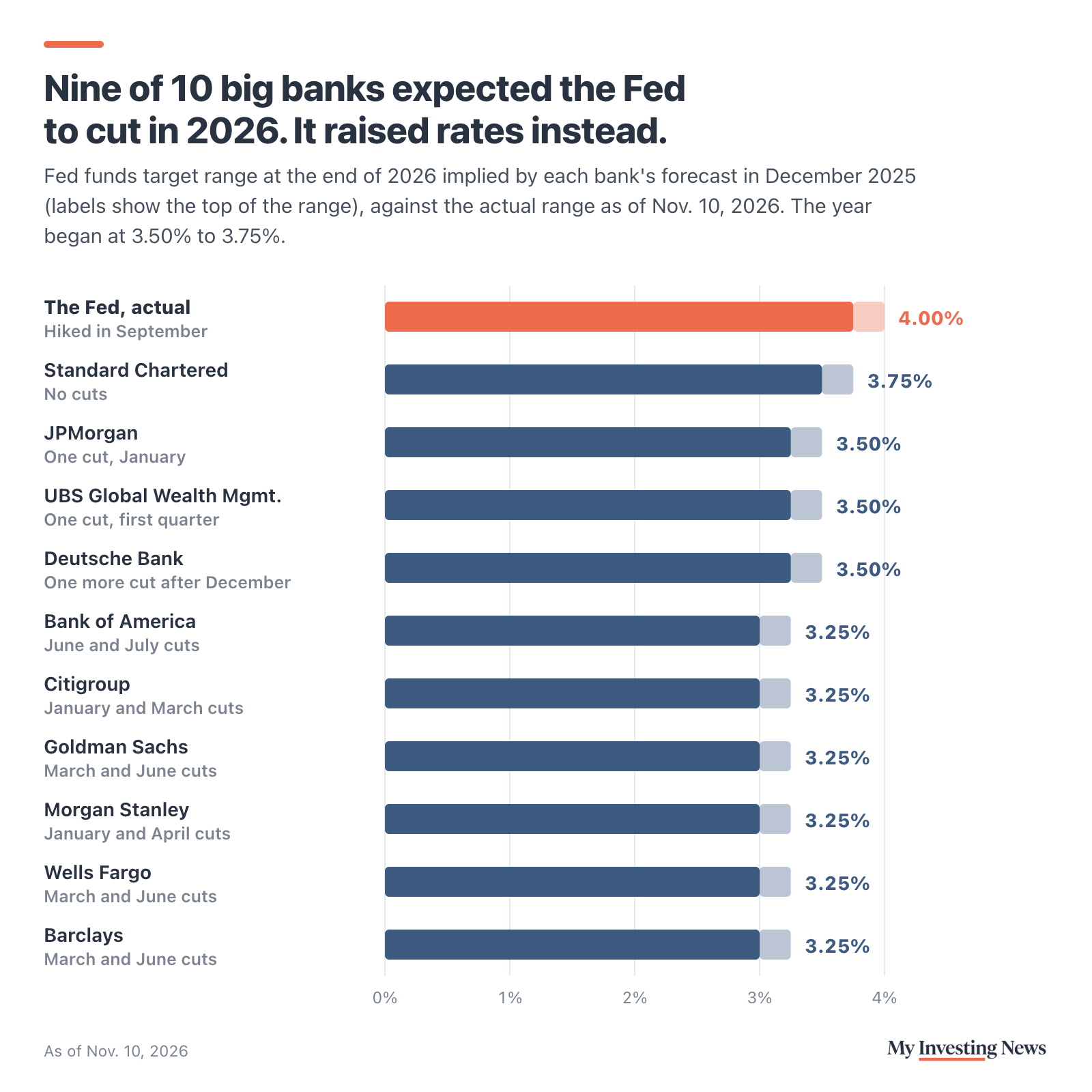
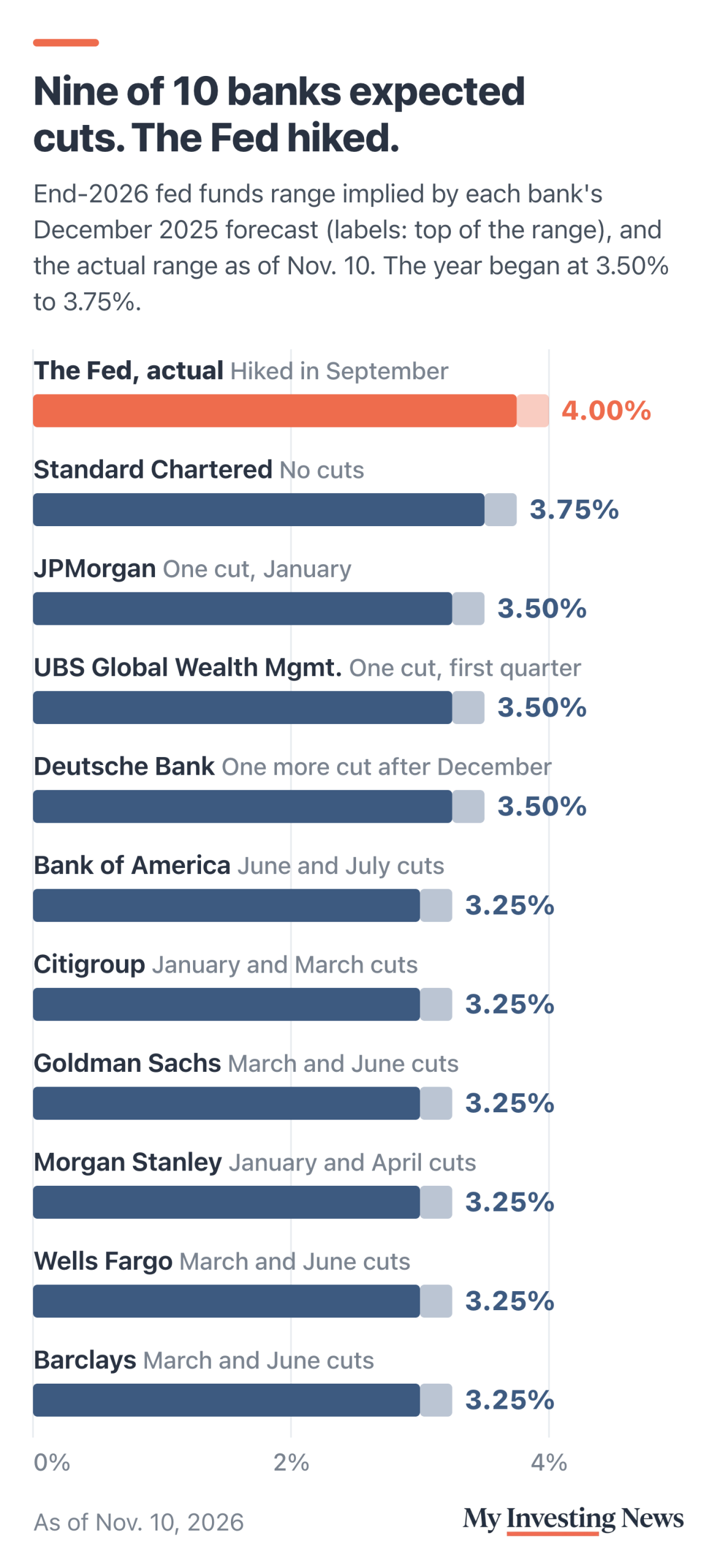
The Fed never cut. On Sept. 16 it raised its range to 3.75% to 4.00%, its first hike in three years and the first move under Chair Kevin Warsh. That left the median bank call three-quarters of a point too low, and Standard Chartered, the most hawkish of the group, a quarter point too low. Bettors expect the gap to grow: on Kalshi, the odds of a hike at the Dec. 8 to 9 meeting stood at 96% as of Nov. 10.
Bond Yields and Inflation Missed the Same Way
The rate strategists made the same mistake with long-term yields. Morgan Stanley’s 2026 outlook had the 10-year Treasury yield falling into midyear “before rebounding just above 4% at yearend.” JPMorgan forecast 4.35%, Goldman Sachs 4.40% and Deutsche Bank 4.45%, the highest call we found. Bank of America’s strategists projected 4% to 4.25%. The median of six banks’ calls was 4.30%.
The 10-year closed at 4.88% on Nov. 9, according to the Treasury Department, up from 4.18% at the end of 2025. It reached 5.31% on Oct. 5. Morgan Stanley’s Hornbach has tied much of that climb to energy prices and the Fed.
Inflation ran hot, too. Goldman Sachs, in a January update, expected core PCE prices, the Fed’s preferred gauge, to rise just 2.1% in the 12 months through December. Morgan Stanley and Wells Fargo’s economists said 2.6%, and Bank of America 2.8%. The latest reading, for September, was 3.1%.
2026 forecasts against the record
Growth and Stocks Came Closer
The banks did better on the economy and the stock market. In a Reuters factbox from Dec. 24, 2025, 11 brokerages’ forecasts for U.S. growth in 2026 ran from 1.7% to 2.4%, with a median of 2.0%. Through the third quarter, the economy was 2.3% larger than in the same months of 2025, and it grew at a 3.4% annual rate in the third quarter alone. Goldman expected unemployment to settle at 4.5%. It was 4.1% in October.
That stronger economy is the reason the rate calls missed. Cuts were supposed to support a soft job market. Instead, job growth held up and inflation climbed to about 3%, which is what Hornbach says could still push rates “dramatically higher.”
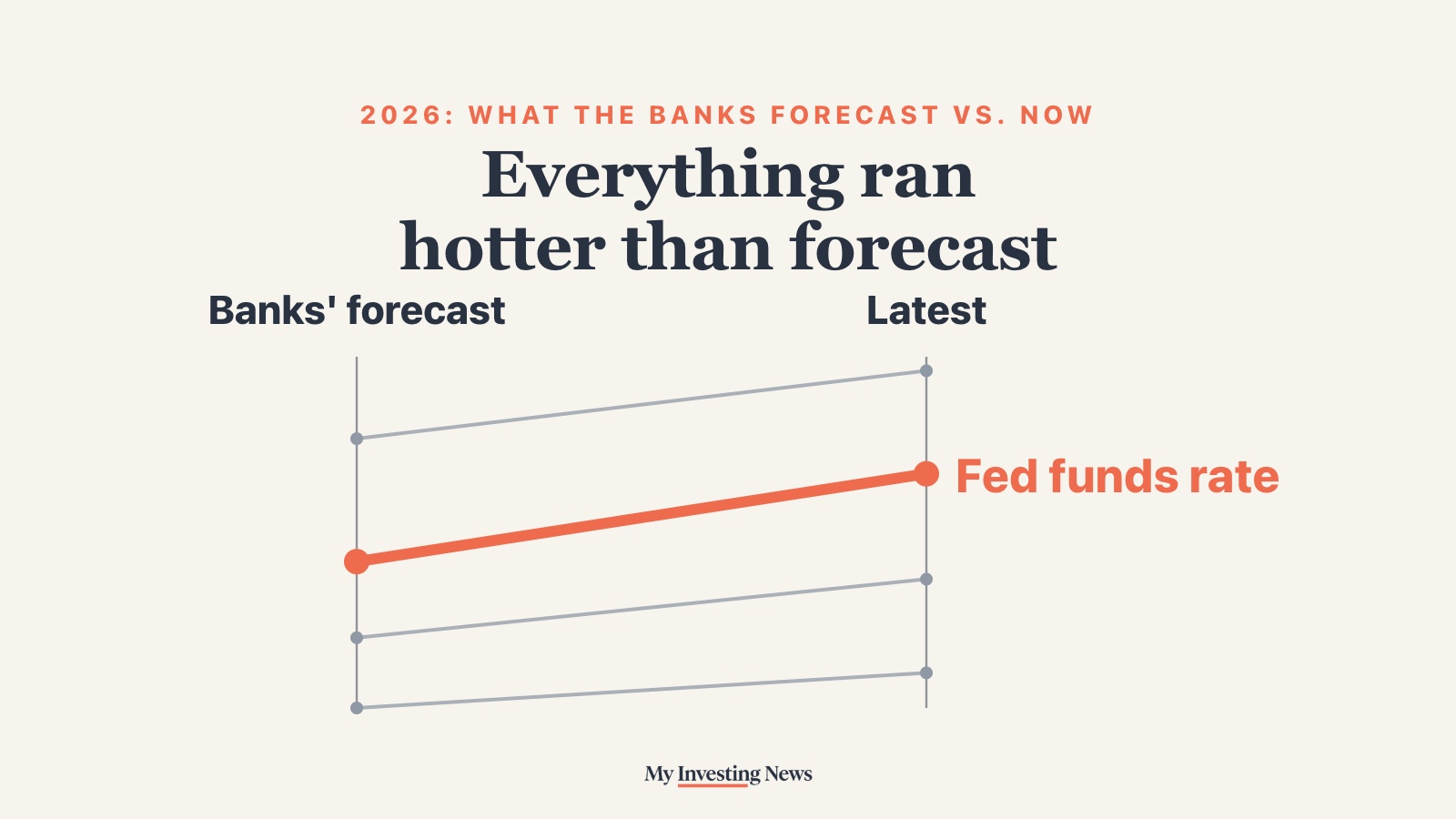
Rates, inflation and growth all ran above what the banks expected for 2026
Median of big banks’ forecasts for the end of 2026, made in November 2025 to January 2026, against the latest reading: fed funds as of Nov. 10, 10-year yield Nov. 9, core PCE prices September (12-month change), GDP the first three quarters against a year earlier.
Stock strategists came closest. The same factbox listed 18 year-end targets for the S&P 500, from 7,100 at Bank of America to 8,100 at Oppenheimer, with a median of 7,500, about 9.6% above where the index ended 2025. The S&P 500 closed at 7,549.94 on Nov. 9, up 10.3% for the year and above 10 of the 18 targets. It peaked at 7,818.93 on Oct. 6 and fell 4.4% on Nov. 5, after the midterms. In late October, Dan Ives said the index would reach 8,000 this year.
What to Watch as the 2027 Calls Arrive
The new forecasts are starting to land. Goldman Sachs strategist Ben Snider set an end-2027 target of 8,700 for the S&P 500 in an Oct. 19 note, and UBS said on Nov. 10 it was keeping its 8,900 target. As of Nov. 10, Morgan Stanley, JPMorgan, Bank of America and Citigroup had not published their full 2027 outlooks.
When they do, check the rate path first. That is where last year’s calls went furthest wrong, and the Fed’s own projections missed too. Benn Steil has argued the Fed forecasts worse than private economists, and in 2026 neither group saw the hike coming. The Fed meets Dec. 8 to 9, and Kalshi bettors gave a second hike in January 44% odds as of Nov. 10. Watch whether the 2027 outlooks build in more hikes or go back to forecasting cuts.
Nine of 10 big banks expected the Fed to cut in 2026, and it raised rates instead. Their 10-year and inflation calls missed in the same direction, while growth and stock forecasts landed close. Hornbach now sees the risk running the other way, toward higher rates if unemployment falls, so the 2027 outlooks deserve the same check a year from now.