Where we heard it“The Real Eisman Playbook,” episode 81, released Oct. 26, 2026 (recorded Oct. 14), with Benn Steil, director of international economics at the Council on Foreign Relations, and host Steve Eisman.
Benn Steil wants the Fed to stop telling markets what it plans to do, and his reason is its forecasting. Speaking with Steve Eisman on an episode released Oct. 26, the Council on Foreign Relations economist said “the empirical evidence is absolutely overwhelming that the Fed is not good at predicting the future.” When Eisman countered that nobody is, Steil went further.
He added, “including according to the findings of Fed studies.” If the Fed’s information is no better than everyone else’s, Steil argued, officials who signal future votes risk locking themselves in. That is why he backs the one part of Fed Chair Kevin Warsh’s agenda he likes, getting rid of formal forward guidance. Steil also said, “My personal opinion is that FOMC members love the rock star status.”
Scoring the Fed Against the Forecasters
The cleanest public test is the Fed’s own Summary of Economic Projections. At its last meeting of each year, the Fed publishes its officials’ forecasts for the next year. We compared their inflation call, measured by the price index for personal consumption expenditures (PCE) from the fourth quarter to the fourth quarter, with the outcome and with the median forecast in the Philadelphia Fed’s Survey of Professional Forecasters, which polls private economists each November. We used the median of the officials’ projections for 2016 onward and, for 2012 to 2015, the middle of their central range, the measure available in the Fed’s data for those years.
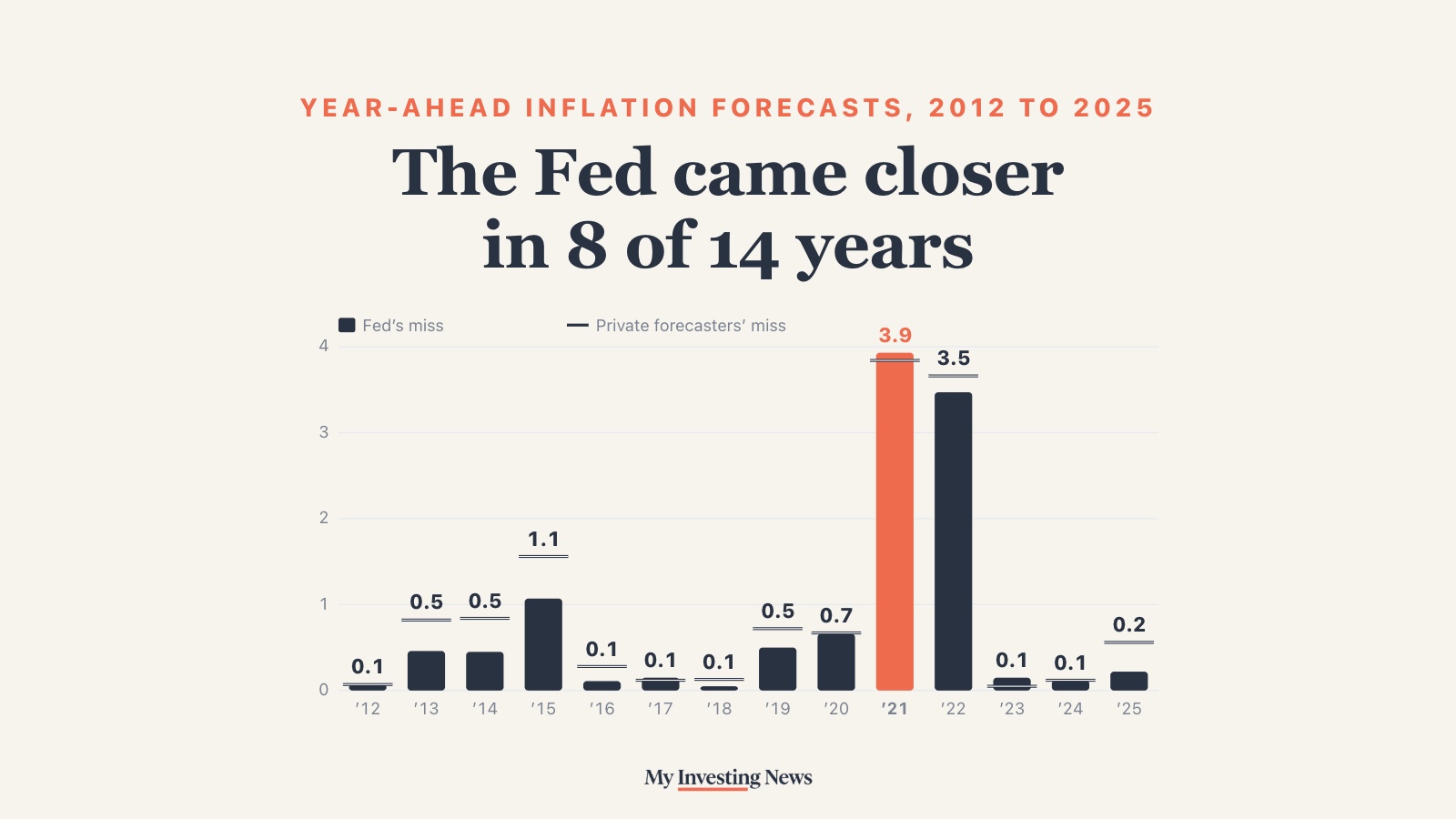
For the 14 years from 2012 through 2025, the Fed’s projection came closer in 8. The private forecasters came closer in 2, 2021 and 2023, and 4 years were too close to call (within 0.05 point, smaller than the Fed’s rounding). The Fed missed by 0.82 point on average, the forecasters by 0.96.
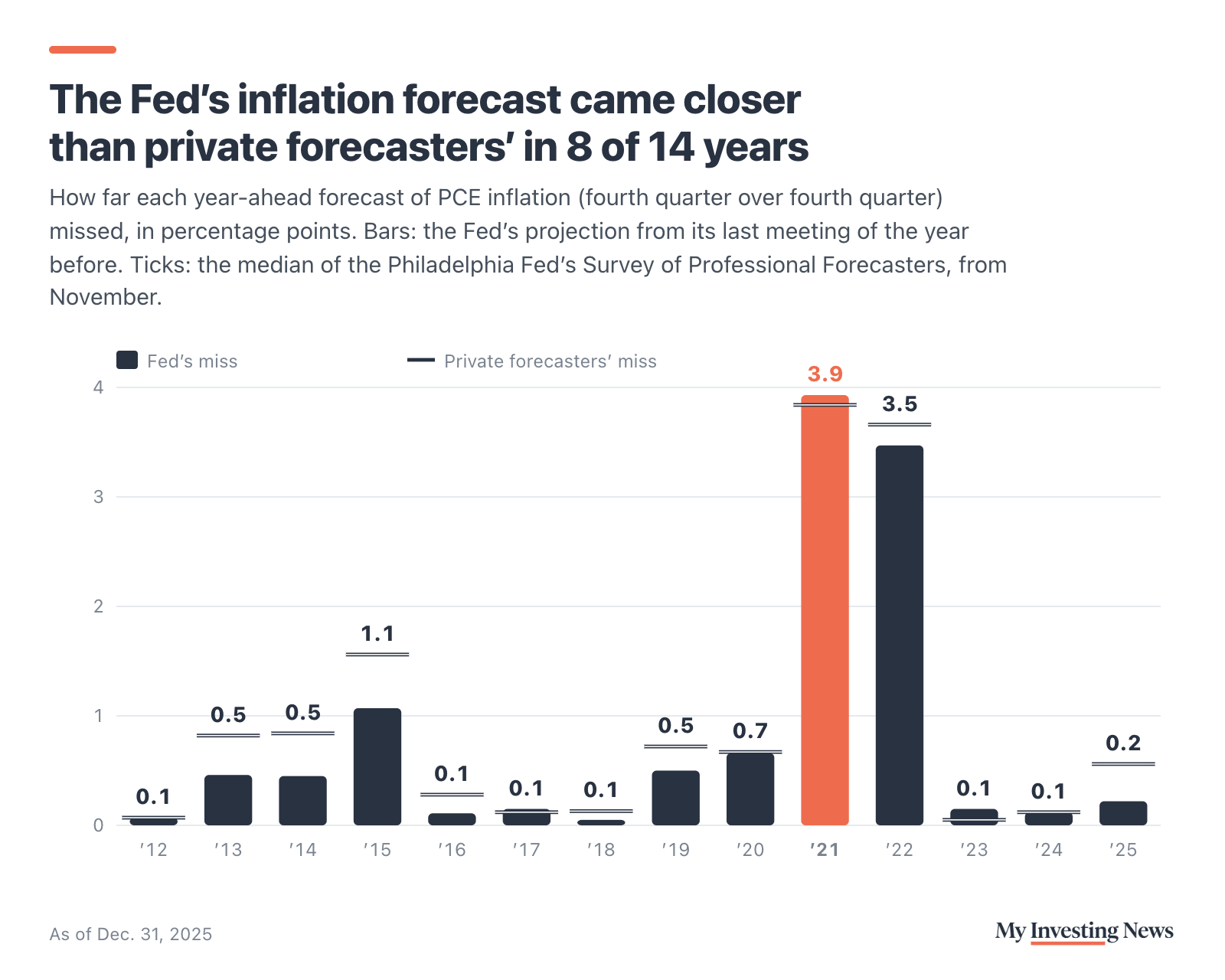
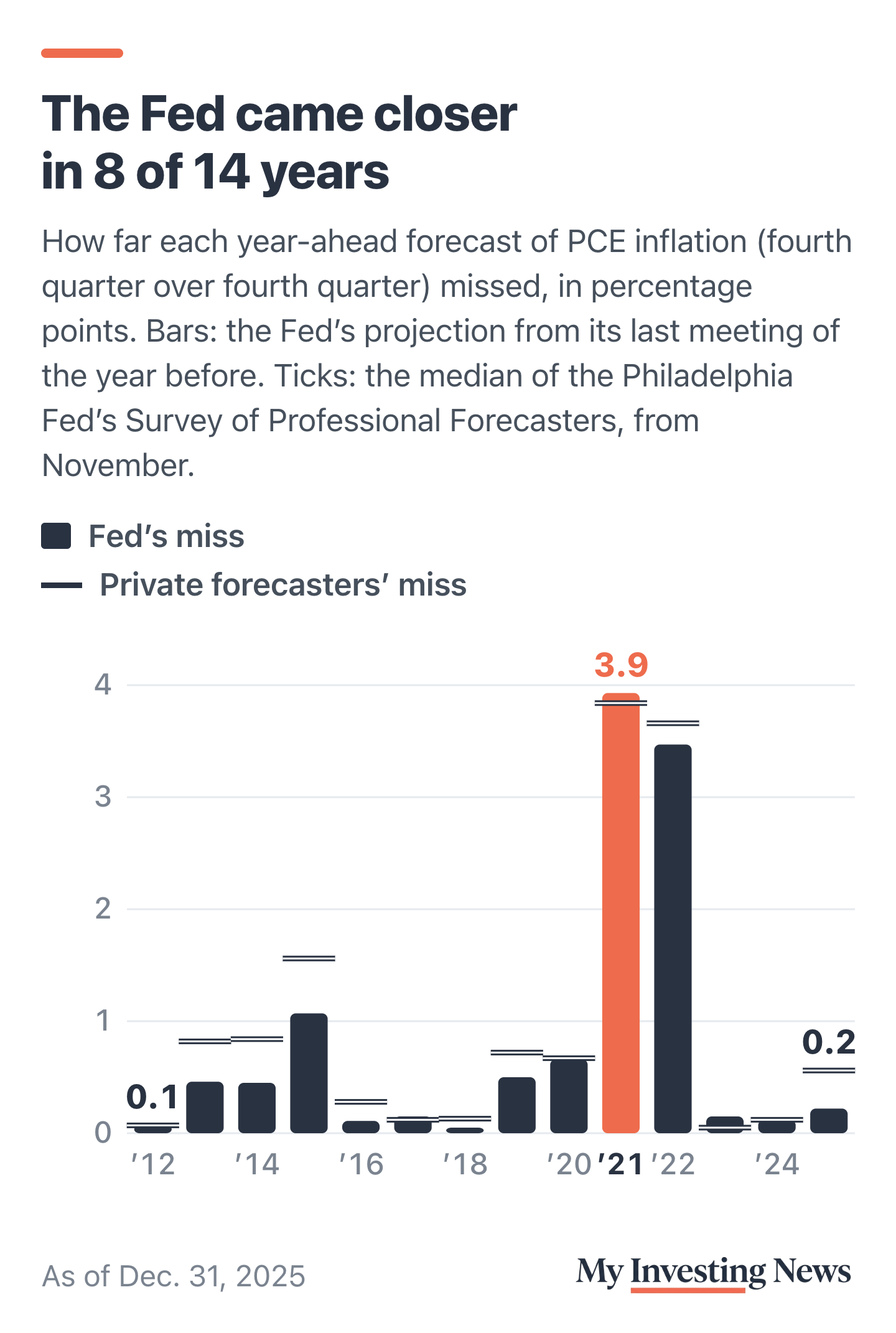
The worst year backs Eisman’s quip that nobody is good at predicting the future. In December 2020, Fed officials projected 1.8% inflation for 2021. It came in at 5.7%, a miss of 3.9 points. The private forecasters had said 1.9%, a miss of 3.8. For 2022, the Fed said 2.6% and the forecasters 2.4%; inflation ran 6.1%. Leave out those two years and the average misses shrink to 0.33 point for the Fed and 0.49 for the forecasters.
Year-ahead inflation forecasts, 2012 to 2025
Does the Result Hold Up?
The Fed’s December projection comes about a month after the November survey, so it has a little more data. To account for that, we also checked the survey taken each February, two months after the Fed’s. Against those later forecasts, the average misses were about equal, 0.82 point for the Fed and 0.80 for the forecasters, with the Fed closer in 6 years and the forecasters in 3. On unemployment, the Fed’s year-ahead projection was closer in 8 years and the forecasters’ in 3.
Steil’s claim covers a longer stretch than this, and the projections only began in 2007, so “many, many decades” can’t be checked with them. Fed research doesn’t settle it in his favor, either. A 2017 Federal Reserve Board study of historical forecast errors, written to calibrate these same projections, concluded that “different forecasters have similar accuracy.” That matches what the scorecard shows: the Fed and the private forecasters tend to miss together.
Where His Point Lands: Rates
Steil’s real target is forward guidance, which is about rates. From 2016 through 2025, the median projection for the year-end federal funds rate, made the December before, was off by 0.8 point on average, about the same as the inflation calls. The big misses came at turning points. For 2022, officials projected 0.9%; they ended the year at a range of 4.25% to 4.5% after seven increases. For 2019, they projected more hikes and cut three times instead; for 2020, they projected no change, then cut to near zero when the pandemic hit.
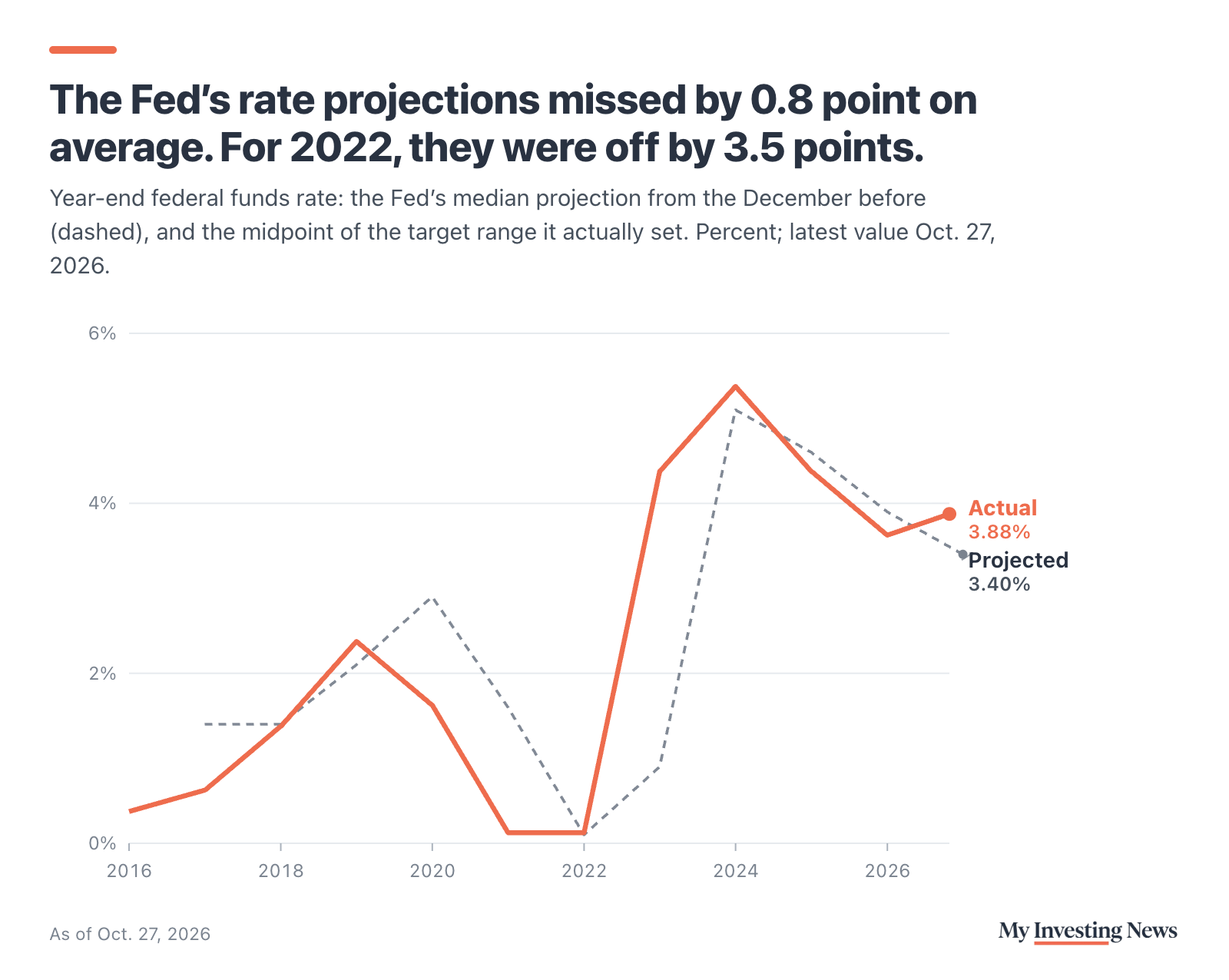
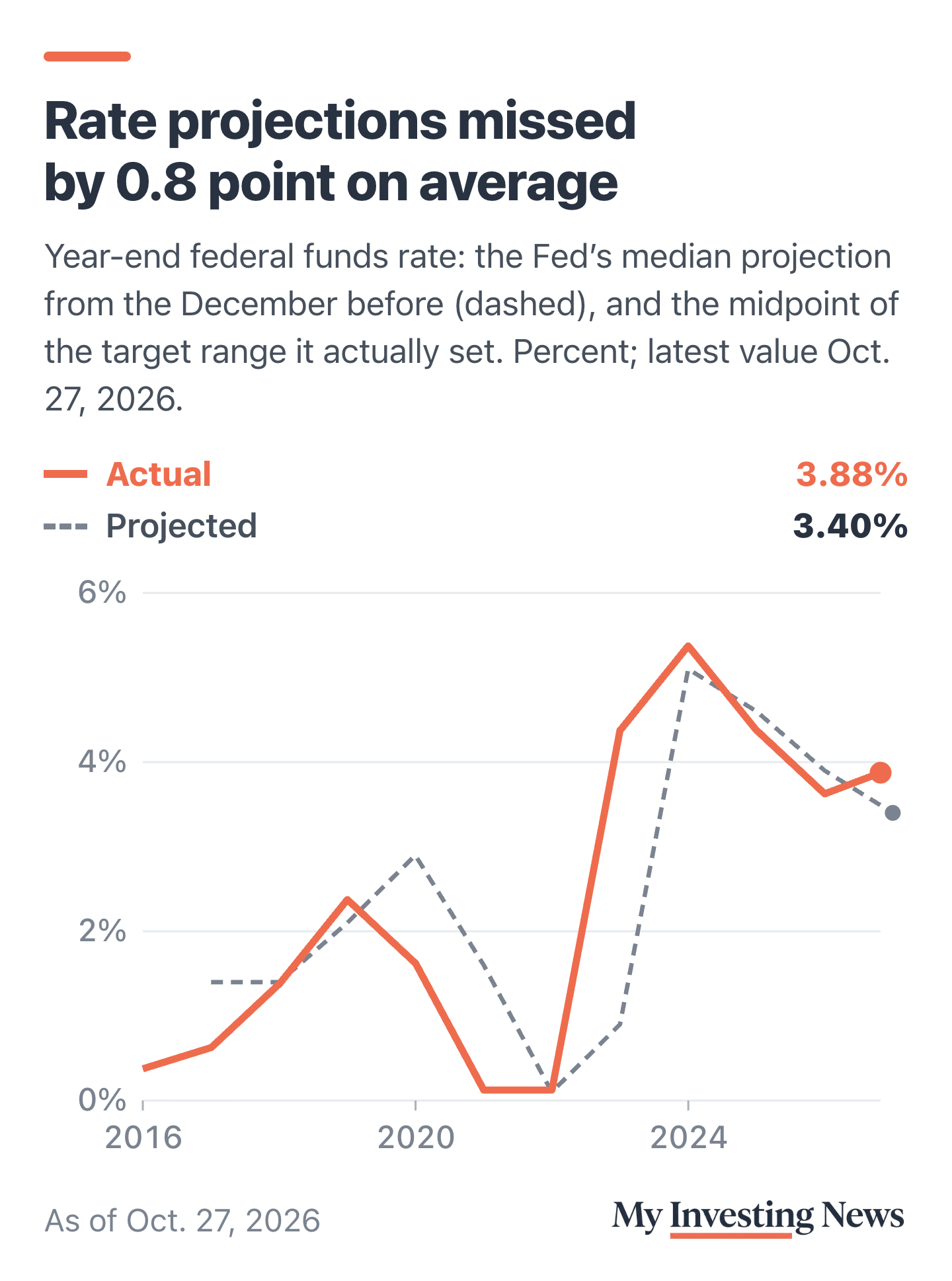
The same is happening this year. Last December the median official projected a year-end rate of 3.4%. The Fed’s target range stood at 3.75% to 4% before its Oct. 28 meeting, after a hike in September. Inflation has run hotter than officials expected. They projected 2.4% PCE inflation for 2026; the PCE price index was up 3.4% in the year to August, and September’s consumer price index rose 3.7% from a year earlier, the report Steil and Eisman discussed when they recorded on Oct. 14. Warsh said in mid-October that the economy had broadly conformed to the Fed’s expectations.
What to Watch
The next scorecard entries come soon. The Fed publishes fresh projections, including an updated call for 2027, after its December meeting. The Oct. 28 rate decision and the October jobs report, due Nov. 6, are the last big readings before then. Last December, Fed officials projected unemployment of 4.4% for the fourth quarter of 2026; it was 4.2% in September.
Steil says the Fed forecasts worse than private economists and should stop offering forward guidance. Its year-ahead inflation projections since 2012 don’t back the first part: they beat the forecasters’ median in 8 of 14 years and trailed in 2. His case is stronger on rates, where the Fed’s projections missed badly at turning points and are off again this year.