Where we heard it“The Economic Outlook and Some Thoughts on Labor Market Dynamism,” a speech by Fed Governor Christopher Waller at King’s College London, Nov. 10, 2026, and his answers to questions afterward as reported by Nick Timiraos of The Wall Street Journal.
Fed Governor Christopher Waller set his trigger before the numbers came out. Speaking in London early on Tuesday, Nov. 10, a few hours before the October consumer price index, he said he leaned toward a quarter-point rate increase in December even if inflation improved. Then he named the reading that would change his mind. If the October data looked like the two months before, “with core CPI inflation around 0.3 percent or even higher,” he said, “a stronger policy move may be needed. In that case, I believe a 50 basis point hike in the policy rate should be considered at the December meeting.”
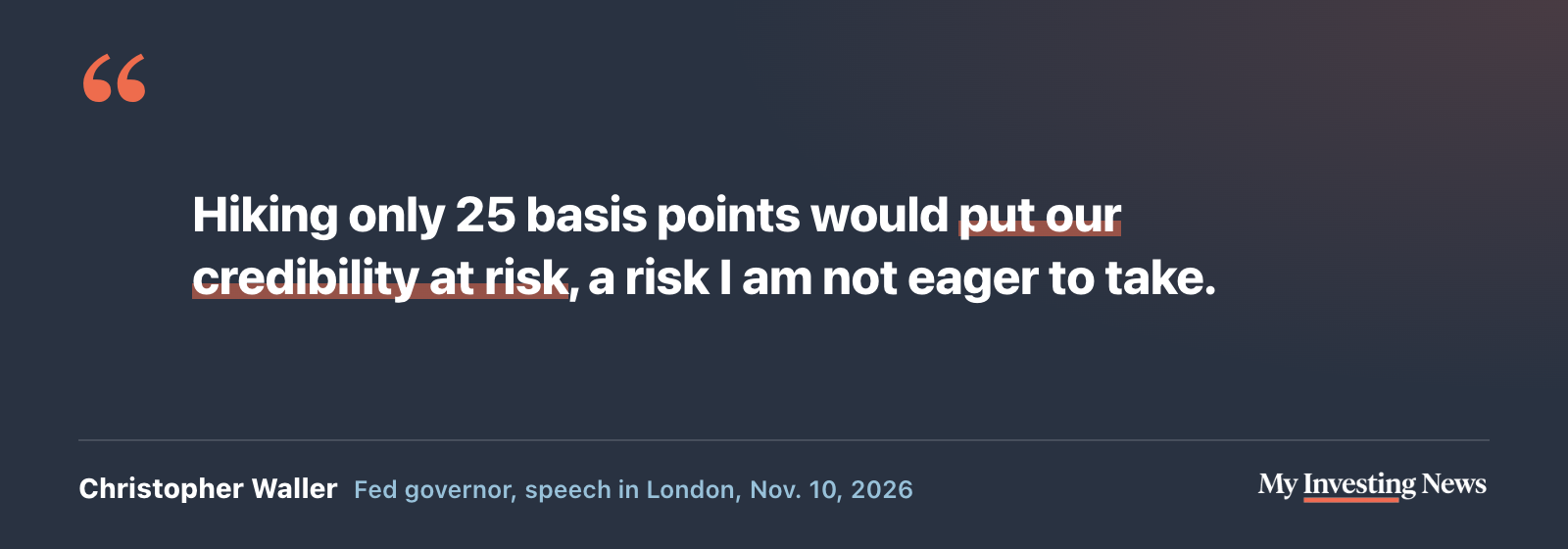
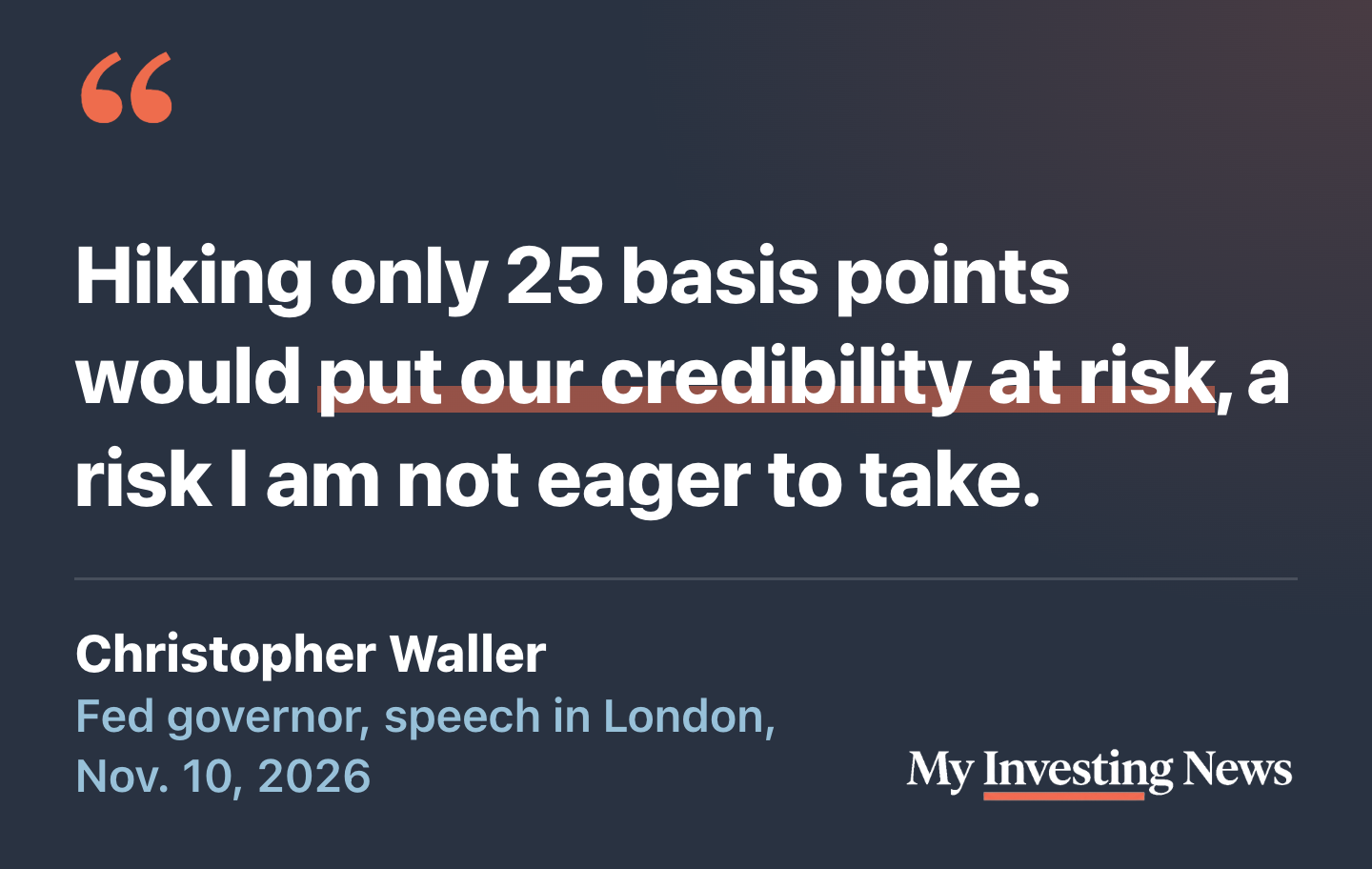
At 8:30 a.m. Eastern time, the Bureau of Labor Statistics delivered that reading. Its report said the index excluding food and energy “rose 0.3 percent in October, as it did in September and August.” Economists had expected about 0.22%, according to a tally Timiraos posted on Nov. 9. In the question-and-answer session after the speech, Waller said a third straight 0.3% rise would mean core inflation running at an annualized 3.5%, and that the lack of progress would argue for moving anticipated hikes sooner, Timiraos reported. He quoted Waller: “You can’t just keep sitting there and staring at it.” We could not find a recording of the questions to check that line, so it stays attributed to the report.
Checking Waller’s Math
Waller’s rule of thumb was conservative. Three 0.3% months compound to an annual rate of 3.66%. The unrounded index rose 0.29% in August, 0.34% in September and 0.30% in October, which works out to 3.75% a year over the three months. The pace that adds up to the Fed’s 2% goal is about 0.17% a month. Every month this year except June ran above it.
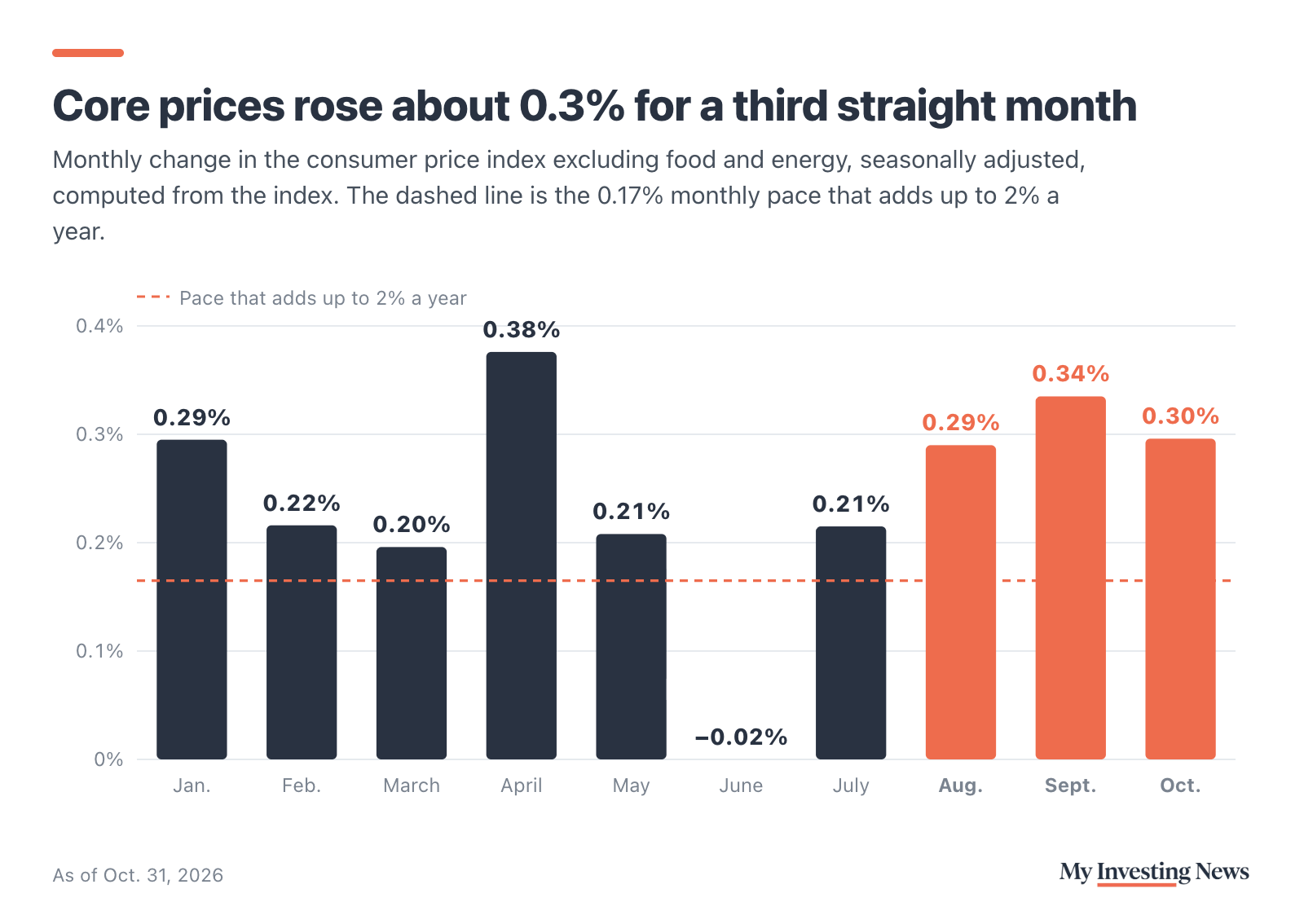
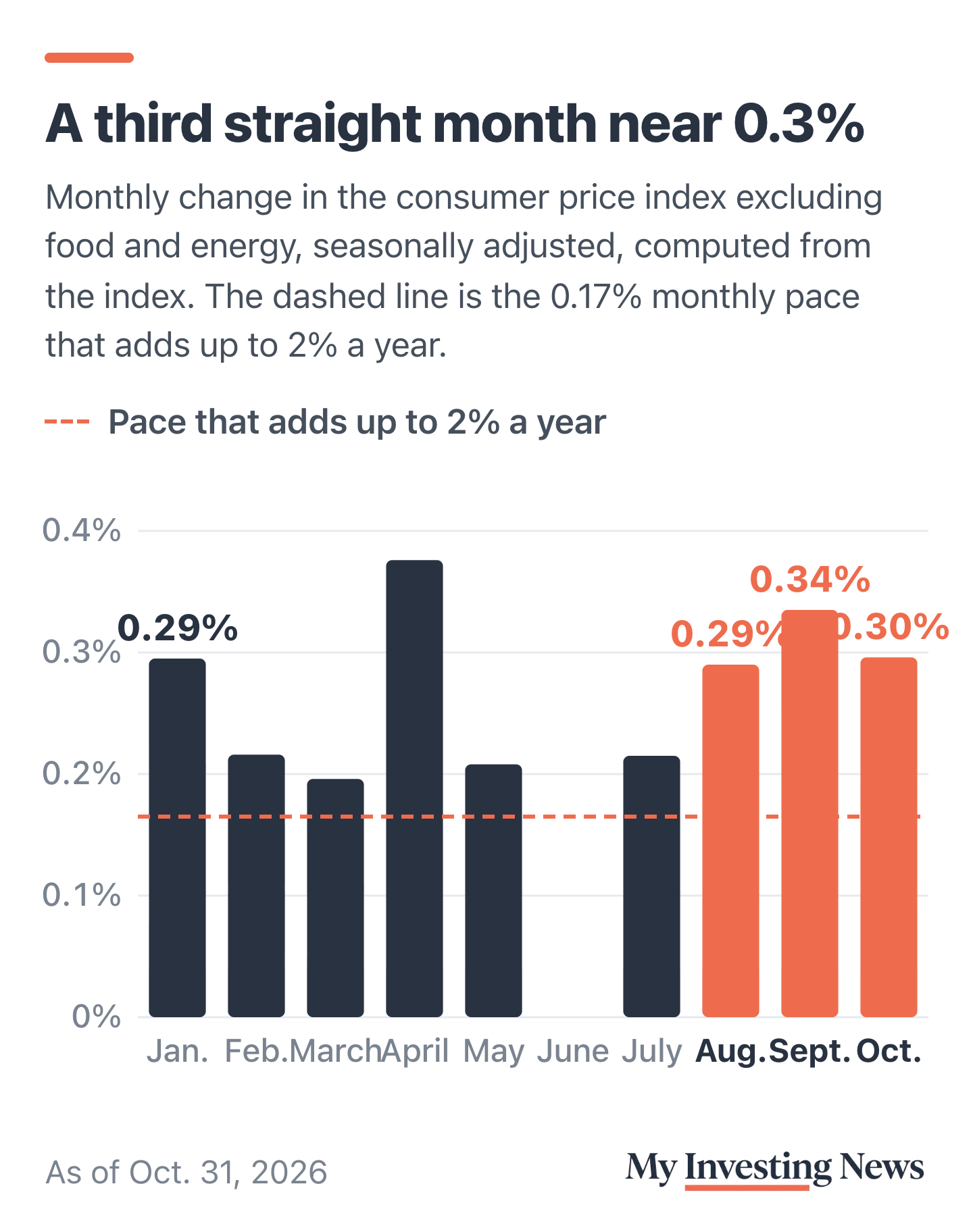
There is a case for patience in the same numbers. Core prices dipped 0.02% in June, so the six-month pace is a milder 2.69%. And because October 2025 prices were never collected during the government shutdown, the report has no 12-month change for October; the latest one, for September, put core CPI 2.6% above a year earlier. The overall index rose 0.4% in October after 0.6% in September, as the jump in energy prices slowed to 0.7%. Waller’s speech leaned on a different gauge: core inflation by the Fed’s preferred measure, the price index for personal consumption expenditures, was 3.1% in September, he said, with price increases spreading across goods and services. By Charlie Bilello’s count, inflation has run above the Fed’s 2% goal for 67 straight months.
Waller’s trigger, as of Nov. 10, 2026
What a 50 Point Hike Has Meant Since 1990
Since 1990, the Fed has raised rates by half a point or more 11 times, and every one came in three hiking cycles: 1994 and 1995, 2000, and 2022. Each started with quarter-point moves before the first big one.
- 1994: After three quarter-point increases, the Fed raised by half a point in May 1994, with core CPI rising at a 2.6% three-month pace. It kept going: another half point in August, three-quarters in November and a half point in February 1995, to 6%. It began cutting in July 1995, and the economy avoided a recession.
- 2000: After five quarter-point increases, a half-point move in May 2000 took the target to 6.5%, with core CPI at a 2.2% pace. It was the last hike. The Fed began cutting with a half point in January 2001, and a recession began that March, according to the National Bureau of Economic Research.
- 2022: After one quarter-point increase, the Fed went half a point in May 2022, with core CPI running at 5.5%. Four three-quarter-point moves followed, then a half point and four quarter points, ending at 5.25% to 5.5% in July 2023. The first cut came in September 2024, again with no recession.
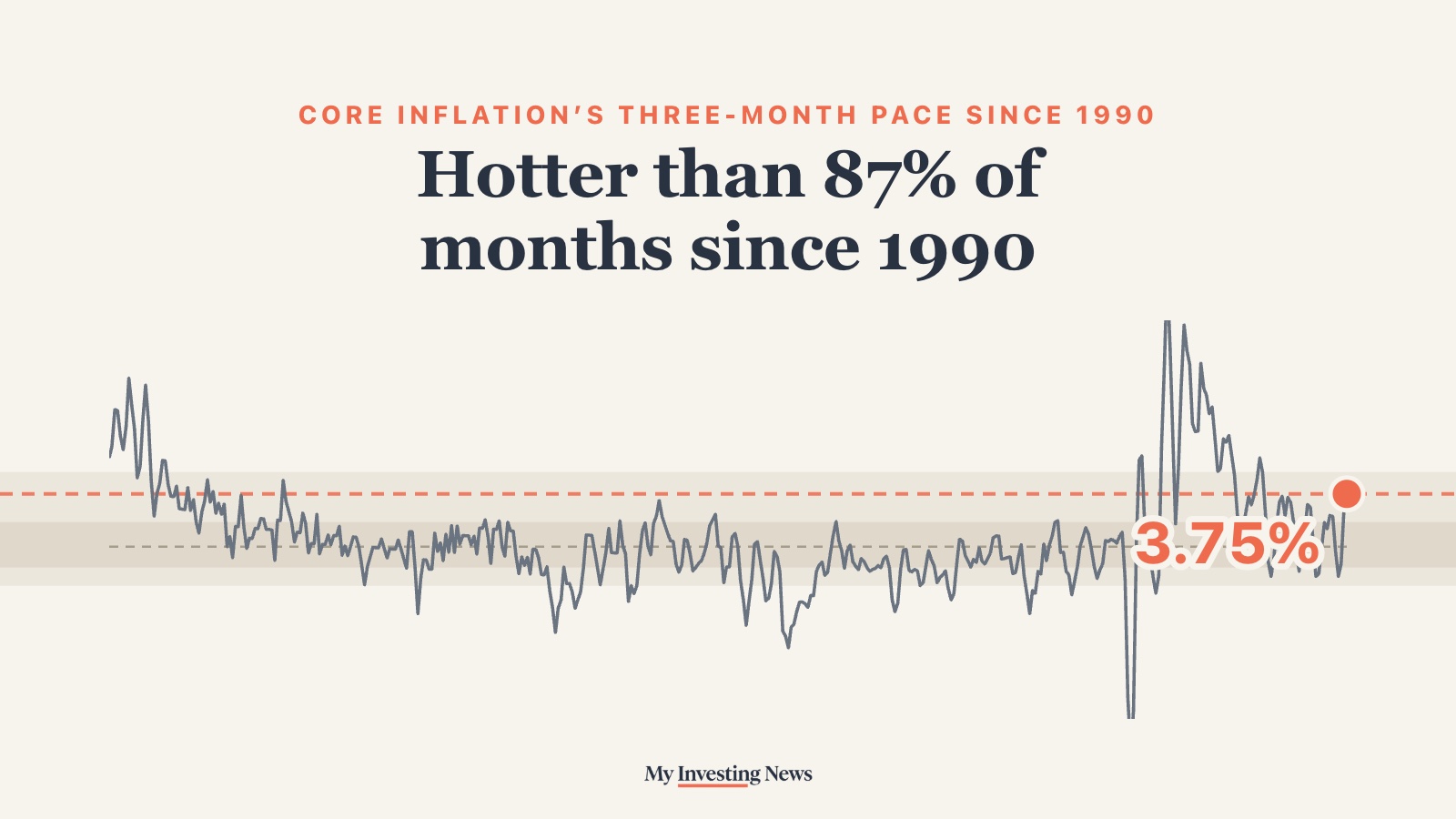
This cycle has one quarter-point increase so far, in September, which put the range at 3.75% to 4%. Core inflation’s 3.75% three-month pace is hotter than it was when the Fed made its first half-point move in 1994 or 2000, and cooler than in 2022. It is also unusual against the full record. The three-month pace has been higher in only about 13% of months since 1990, and October’s is the highest since April 2024.
Core inflation’s three-month pace is higher than in 87% of months since 1990
Core CPI (excluding food and energy), annualized change over the latest three months, every month since January 1990. The shaded bands hold the middle half and the middle 80% of all 440 readings.
What Bettors Say
Traders moved twice on Tuesday. On Polymarket, the odds of a December hike of half a point or more were 0.5% at 3 a.m. Eastern, before Waller spoke. They were 5.3% at 8 a.m. and 11.4% at 8:54 a.m., after the CPI. The odds of a quarter-point hike stood at 84.5%, and the odds of no change fell to 2.7% from 19.5% before the speech.
The market still treats a half-point move as the outside case. Waller is one of 12 voters, and other officials have argued that part of today’s inflation will fade; Stephen Miran has said more than a point of core inflation is temporary.
What to Watch
Producer prices for October come out Nov. 13. The minutes of the Oct. 27 and 28 meeting, where Waller voted to hold, are due Nov. 18, and the Fed’s preferred inflation gauge for October follows on Nov. 25. The Fed meets Dec. 8 and 9 and will publish new projections. The November CPI is scheduled for Dec. 10, the day after the decision, so October’s report is the last CPI officials will see before they vote. The Fed’s own forecasts missed inflation by nearly 4 points in 2021, so the new projections will get a close read.
Waller said a third straight core reading around 0.3% should put a half-point December hike on the table, and October delivered it, at an annualized 3.75% over three months. Half-point moves since 1990 have usually led to more hikes, though once, in 2000, the move was the last before cuts. The case for waiting rests on a milder 2.69% six-month pace and three more data releases before Dec. 9.