Where we heard itThe Pomp Podcast, Nov. 5, 2026. Host Anthony Pompliano interviewed Jan van Eck, chief executive of the fund company VanEck.
Jan van Eck thinks the next U.S. financial crisis will start in Washington. On The Pomp Podcast on Nov. 5, the VanEck chief executive said past crises came out of the banking system or other industries, while “this is going to be started in DC.” His evidence that the rest of the world sees it coming was two numbers about China.
The gold buyers, he added, are “private Chinese investors,” not the central banks that get most of the attention. “So the world kind of sees that we’re doing this and they’re like backing off,” he said. We checked both claims: the first against the Treasury Department’s monthly count of foreign holdings, which goes back to 2000, and the second against the World Gold Council’s demand figures for 2026.
The Treasury Claim Holds, With Room to Spare
China’s holdings peaked at $1,316.7 billion in November 2013, according to Treasury’s international capital data. In August 2026, the latest month published, residents of mainland China held $590.7 billion. That is a drop of 55.1%, a bit more than the half van Eck described, and the lowest level since August 2008.
China’s weight among foreign holders has shrunk even faster. It held 23.0% of all foreign-owned Treasuries at its peak and 6.3% in August 2026. Its holdings have been lower at every year-end since 2020, and they kept falling through the Treasury selloff that began in March.
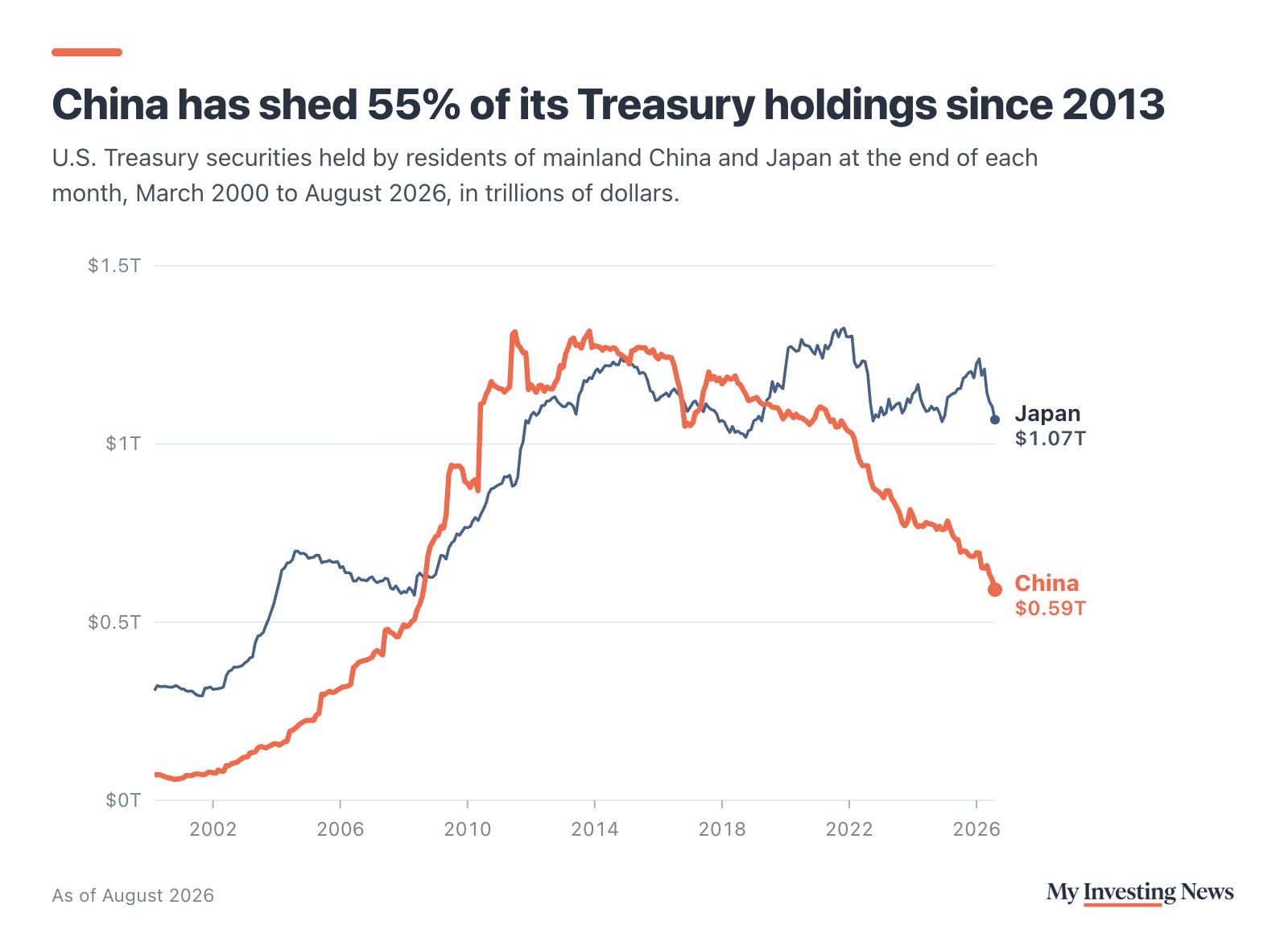
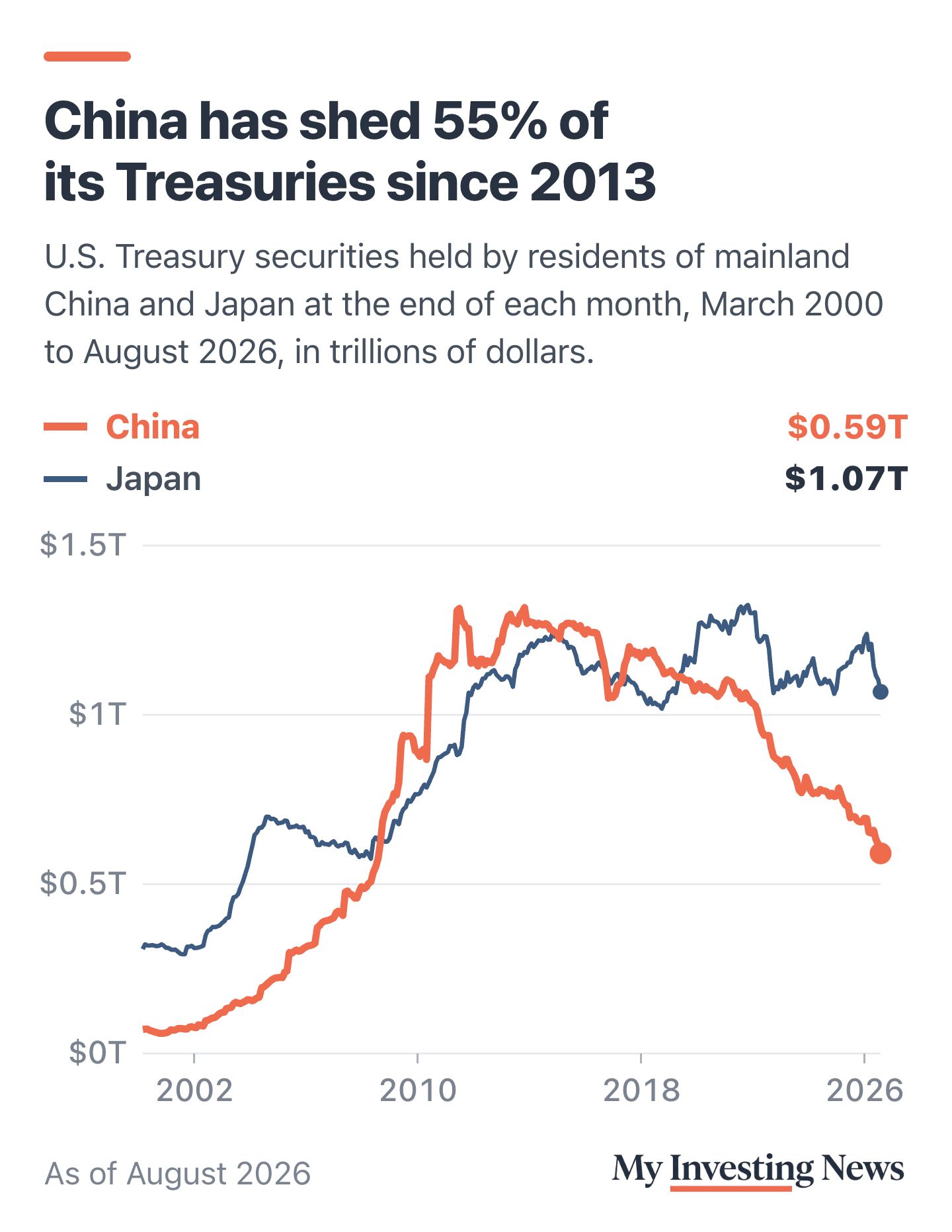
China isn’t the only big holder pulling back. Japan, still the largest foreign holder, cut its Treasuries from $1,239.3 billion in February 2026 to $1,068.3 billion in August 2026, a drop of 13.8% in six months. Japan’s record was $1,325.5 billion in November 2021.
Foreign holders of Treasuries, August 2026
Who Bought Instead
Foreigners as a group did not back away. Total foreign holdings rose from $5.72 trillion at China’s peak to $9.33 trillion in August 2026. The growth came from financial centers. Holdings attributed to the United Kingdom rose from $150.4 billion to $1,009.5 billion, passing China in March 2025. Belgium, the Cayman Islands, Luxembourg and Canada each hold roughly $450 billion to $490 billion now, up from $57 billion to $201 billion.
Treasury’s own notes warn that these figures follow custody: securities held in overseas accounts “may not be attributed to the actual owners.” A bank in London or Brussels can hold Treasuries for buyers anywhere, China included. What the data does show clearly is who is buying. Foreign central banks and governments held 71% of foreign-owned Treasuries in November 2013 and 40% in August 2026. Private investors filled the gap.
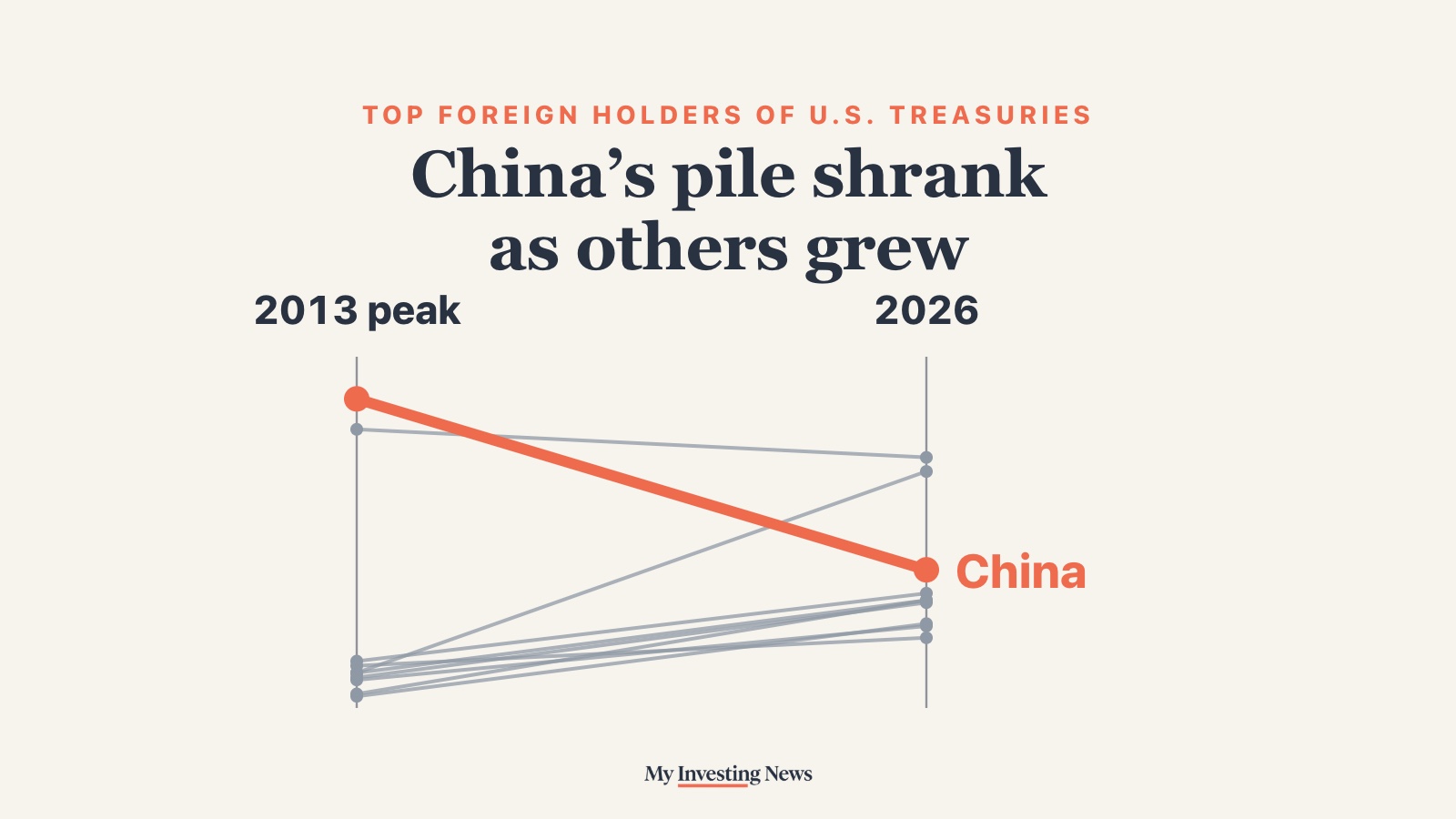
China fell from first to third as financial centers piled into Treasuries
Treasury securities held by today’s 10 largest foreign holders, at China’s peak in November 2013 and in August 2026, in trillions of dollars. Treasury counts holdings by where they are held, so a custodian in Belgium or Luxembourg can hold for buyers anywhere.
Van Eck’s broader point gets some support from a different measure. Foreign holdings have grown far slower than the debt. Marketable Treasury debt held by the public was $11.77 trillion in November 2013 and $31.81 trillion at the end of August 2026, according to the Monthly Statement of the Public Debt. Foreigners owned 48.6% of it then and 29.3% now, so Americans now absorb most new borrowing. Steve Eisman has argued that companies borrowing for AI now compete with the Treasury for that money.
The Gold Claim Comes Up Short
Chinese households are buying gold at a record pace. The World Gold Council counts 393 metric tons of gold bars and coins bought in mainland China in the first nine months of 2026, the most on record for that stretch and 11% above the previous high, set in 2013. Add 202.5 tons of jewelry and China’s private buyers took 595.5 tons.
Mines produced 2,921 tons over the same nine months, by the council’s quarterly counts. China’s private buying equals about 20% of that, roughly a fifth, and 14% in the third quarter alone. The council doesn’t break out Chinese gold funds, but all Asian funds together added 34 tons in the third quarter, which doesn’t close the gap. On the council’s count, van Eck’s “almost half” is more than twice the actual share. Gold has slipped from its January record, and Thierry Borgeat argues it is near a cycle bottom.
What to Watch
Treasury publishes the holdings figures monthly, about seven weeks after each month ends, and revises them once a year against a fuller survey. Watch Japan, which has cut faster than China this year, and whether the financial centers keep adding. Watch the share held by central banks too: if it keeps shrinking, the Treasury relies even more on private buyers to fund its deficits.
Van Eck is right about China and Treasuries: its holdings are 55% below the November 2013 peak, and foreigners now own a much smaller share of U.S. debt. His gold figure is too high: China’s private buyers took about 20% of mine output this year, with record bar and coin buying but nowhere near half.