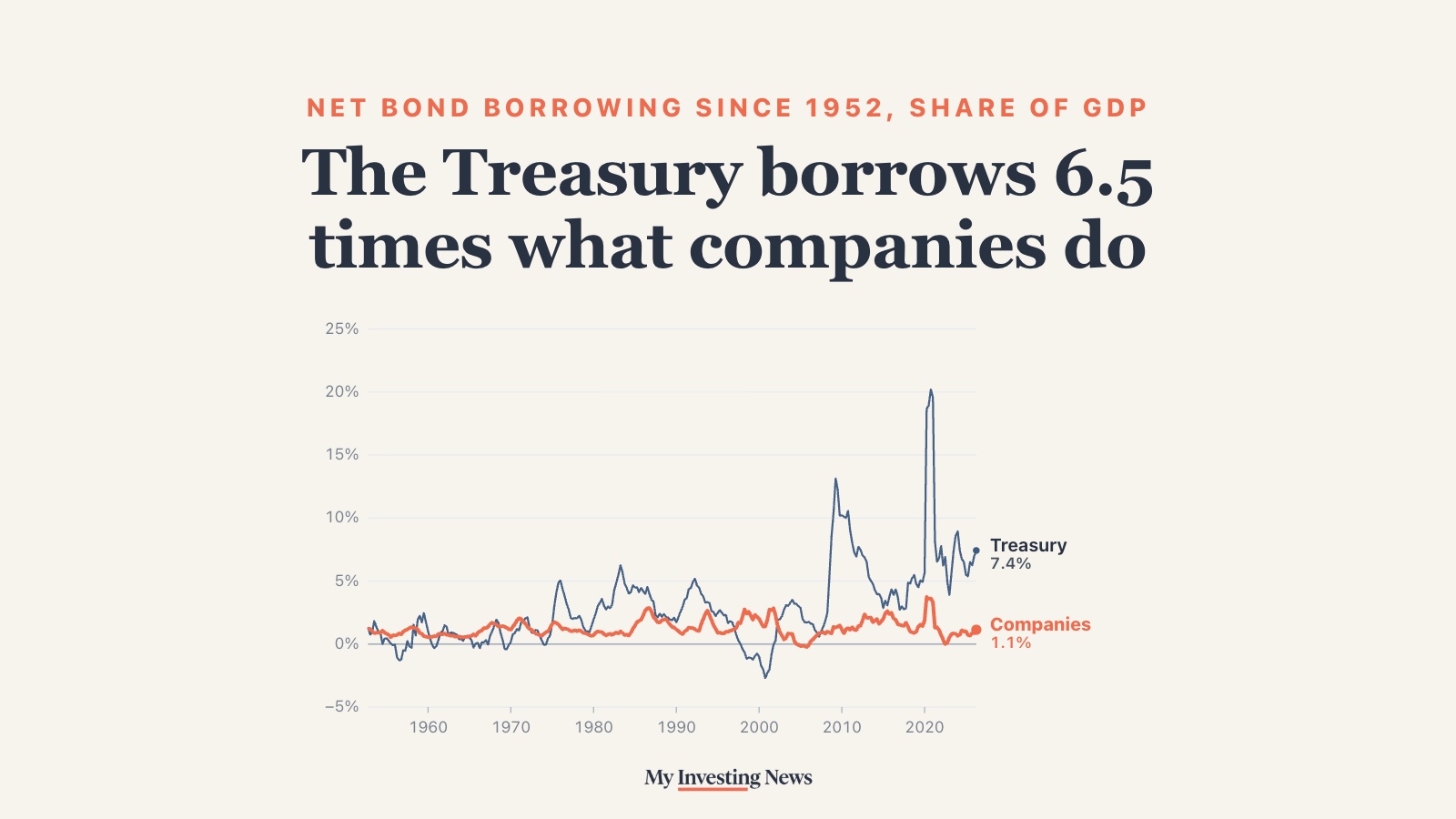
Where we heard itThe Real Eisman Playbook, episode 80, “Big Short Reunion w/ Danny Moses,” Oct. 19, 2026, with host Steve Eisman.
Steve Eisman, the investor whose bet against subprime mortgages was told in “The Big Short,” thinks the AI boom has reached the bond market in a way it never has before. On his podcast on Oct. 19, talking with fellow “Big Short” investor Danny Moses, Eisman said rates will stay higher for longer, and that roughly $500 billion of AI-related bond sales this year is “crowding out” the government.
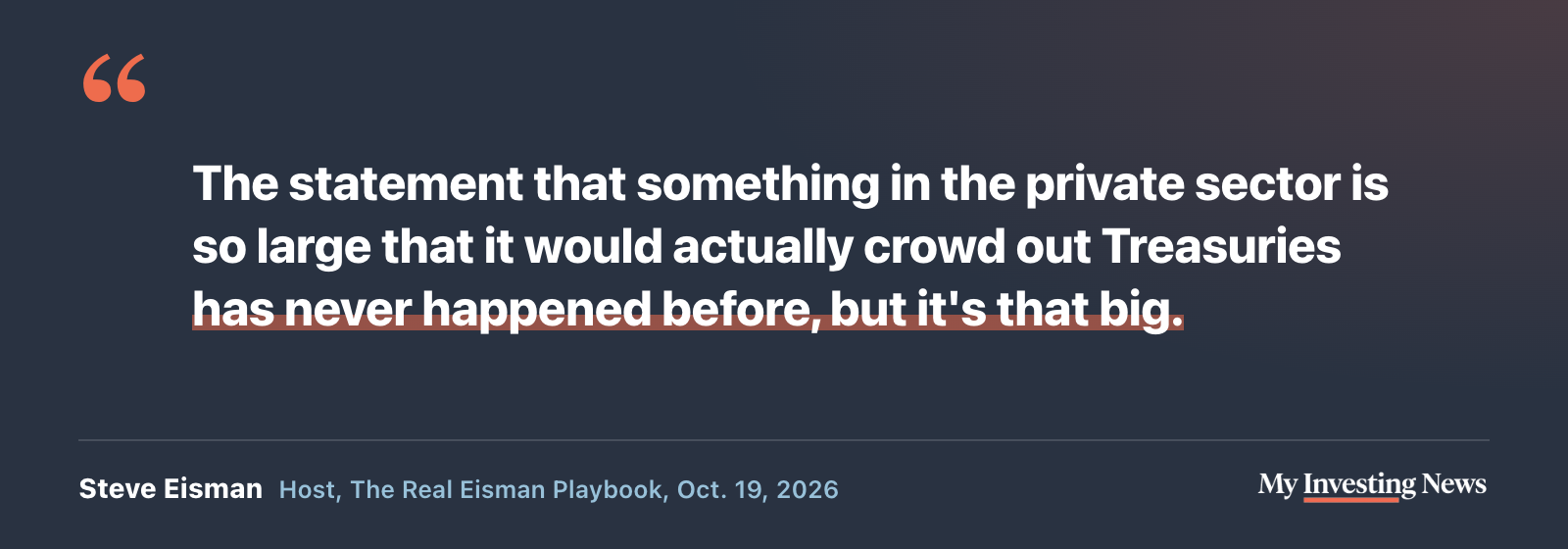
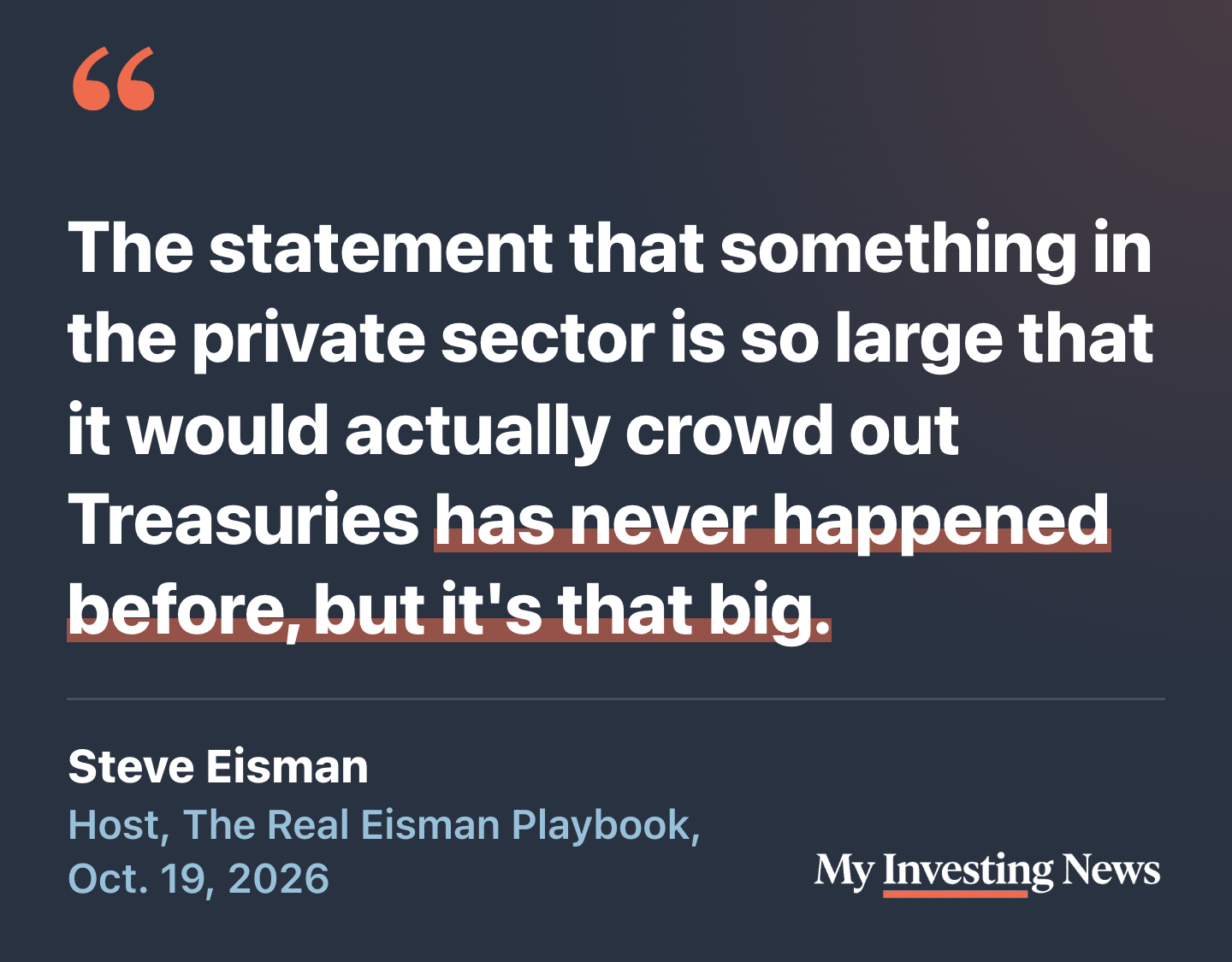
He went further than that. Private borrowing big enough to crowd out the U.S. Treasury, he said, is something new:
What Eighty Years of Borrowing Show
Crowding out is an old idea in economics. When one borrower takes a big share of the money available to lend, everyone else has to pay more to get theirs. Usually the worry runs the other way, with government deficits squeezing out companies. Eisman’s point is that AI spending has made companies big enough to squeeze the government.
We tested the first half of that claim with the Federal Reserve’s Financial Accounts of the United States, which track how much each part of the economy borrows. We used net borrowing, meaning new bonds sold minus old bonds paid off, since that is the amount investors have to find fresh money for. Figures like the $500 billion Eisman cited count new bonds sold before any repayments, which is why they can run higher than the net total for all companies combined.
By that measure, U.S. nonfinancial companies have borrowed more in the bond market than the Treasury before. It happened in 26 of the 80 years from 1946 through 2025. Twenty-one of those came before 1975, when federal borrowing was small. The last five ran from 1997 to 2001, when budget surpluses let the Treasury pay down debt in four straight years.
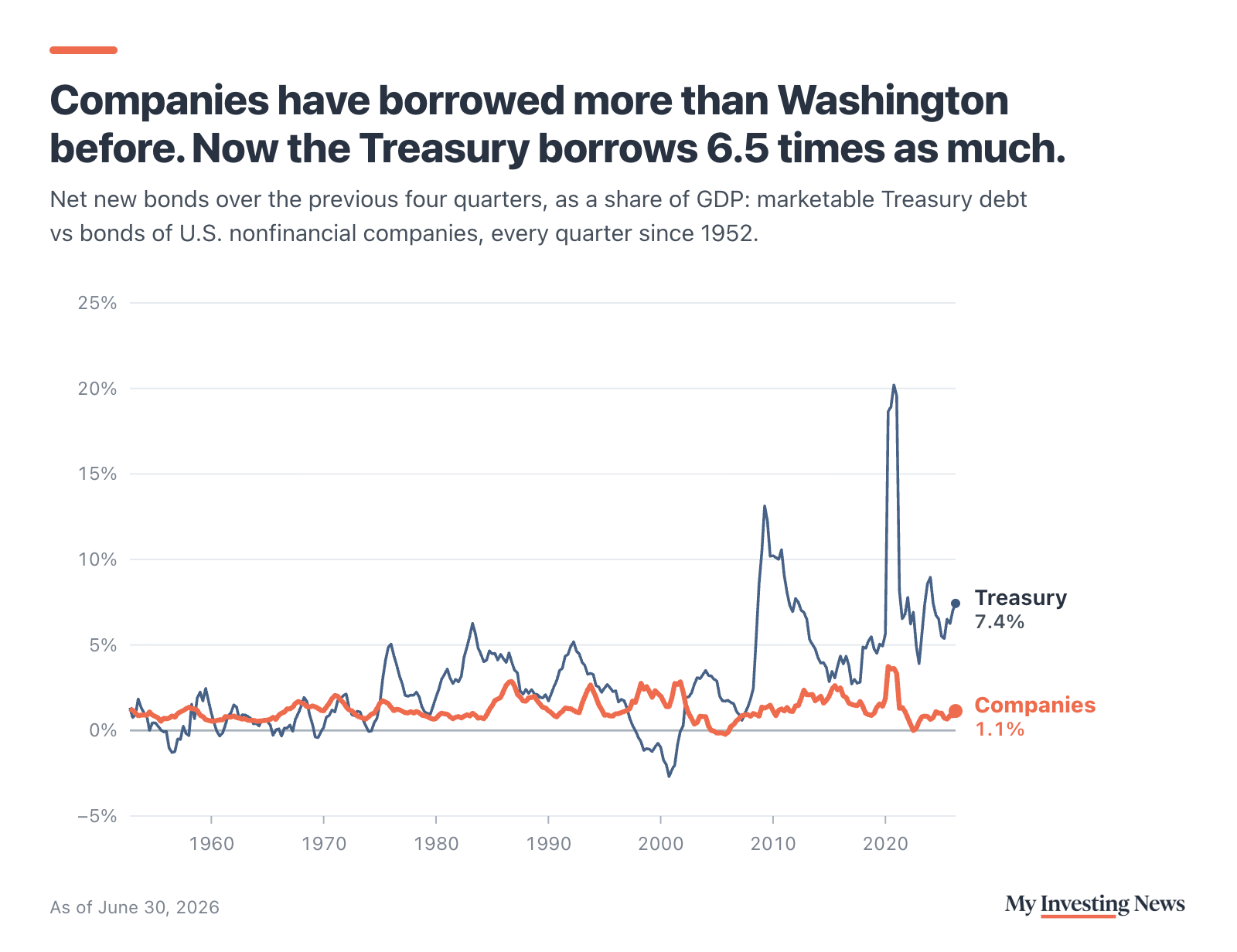
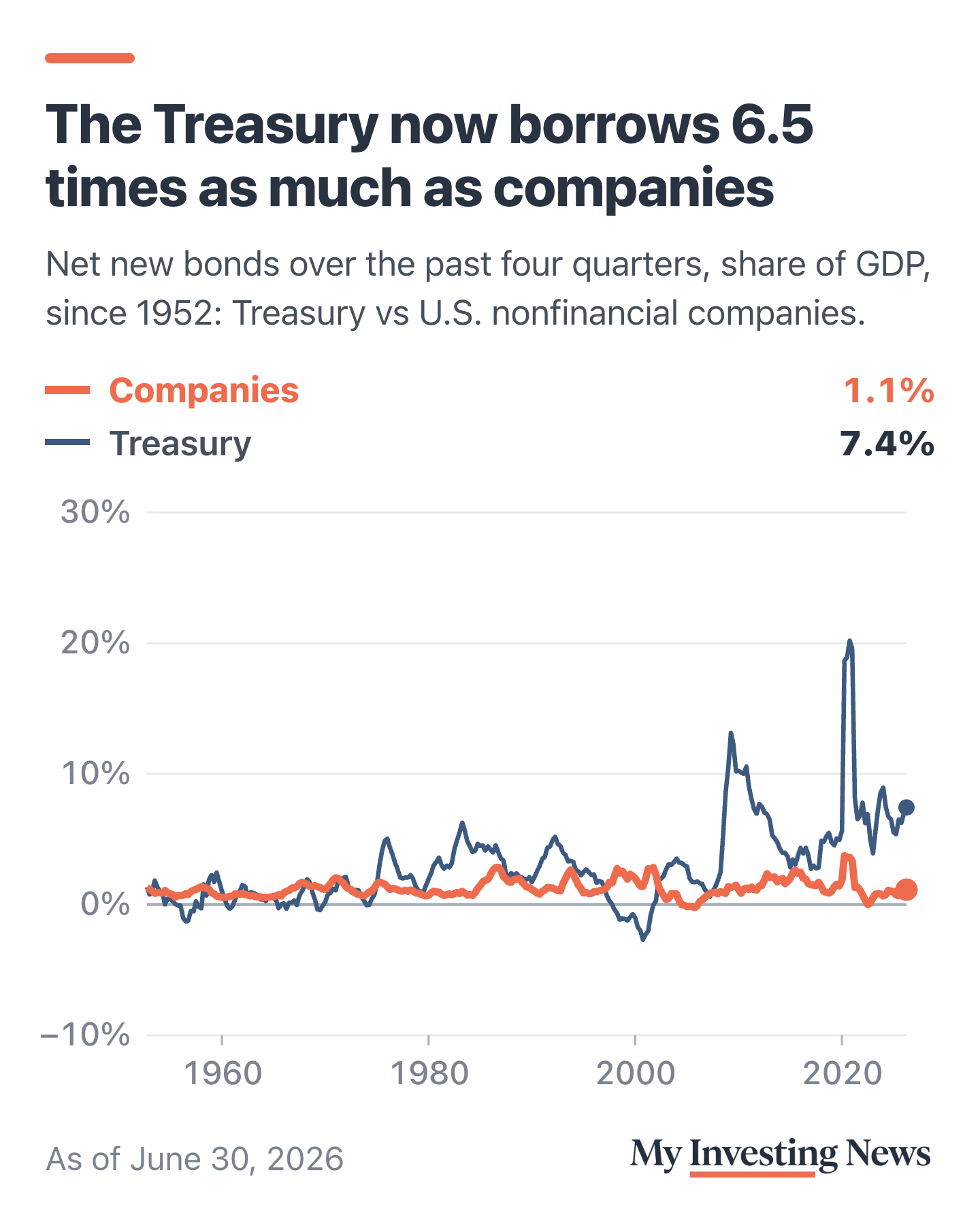
That is far from where things stand now. In the four quarters through June 30, 2026, the latest the Fed has published, nonfinancial companies added a net $362 billion in bonds. The Treasury added $2.36 trillion in marketable debt, 6.5 times as much. Even counting banks, other financial firms and foreign companies that sell bonds in the U.S., corporate borrowing came to $961 billion, about 41% of the Treasury’s.
Bond borrowing and its price, as of Oct. 26, 2026
Where Crowding Out Would Show Up
Crowding out is really a claim about prices. If AI borrowers were soaking up the money that would otherwise buy Treasuries, investors would demand more to hold both kinds of debt, and the first sign would be companies paying more to borrow next to the government.
That hasn’t happened. The extra yield on medium-grade (Baa) corporate bonds over the 10-year Treasury averaged 1.48 percentage points in September, lower than in 71% of months since 1953. On Oct. 26 it was 1.45 points, below its level on 97% of trading days since daily records began in 1986. The spread on investment-grade bonds as a whole was 0.90 point.
Companies pay a smaller premium over Treasuries than in 71% of months since 1953
The extra yield on medium-grade (Baa) corporate bonds over the 10-year Treasury, in percentage points, every month since April 1953. The bands hold the middle half and middle 80% of all 882 readings.
The stress has shown up in weaker AI borrowers instead. CoreWeave’s bonds were yielding about 15% in mid-October, a price tied to one company’s risk.
The Treasury side gives Eisman more support. The term premium, the extra yield investors want for locking up money in a 10-year Treasury instead of rolling over short bills, was 0.63 percentage point on Oct. 26 by the New York Fed’s estimate. It was −0.82 point at the end of 2020, and it reached 0.98 point on Oct. 7, the highest since June 2014. A rising term premium is what crowding out would look like for the government. Huge federal deficits and doubts about inflation push the same way, though, and the premium can’t say which borrower is responsible. Ed Yardeni has called the climb in yields a sign of economic strength.
What to Watch
Treasury’s quarterly refunding statement, due the morning of Nov. 4, will say how it plans to split the coming quarter’s borrowing between short bills and longer notes and bonds. More long debt would add to the supply the term premium has to absorb. The Fed’s Financial Accounts for the third quarter, due in December, will show whether companies’ net borrowing picked up with the AI bond sales.
Foreign demand matters too. China held $590.7 billion of Treasuries in August, down from $699.7 billion a year earlier, according to Treasury data. If the rise in Treasury yields keeps coming while corporate spreads stay this tight, that points to the government’s own borrowing as the bigger source of pressure.
Eisman says AI bond sales are big enough to crowd out Treasuries for the first time. The record says companies borrowed more than the Treasury in 26 years since 1946, last in 2001, and today the Treasury borrows 6.5 times as much as nonfinancial companies, while the premium companies pay over Treasuries is lower than in 71% of months since 1953. The risk to watch is the term premium: if it keeps climbing as AI issuance grows, Eisman’s case gets stronger.