Where we heard itX, Oct. 26, 2026, and the arvy Macro Cycles post it links to. Thierry Borgeat, chief investment officer of arvy. Checked against gold futures settles through Oct. 27 and World Bank monthly prices since 1975.
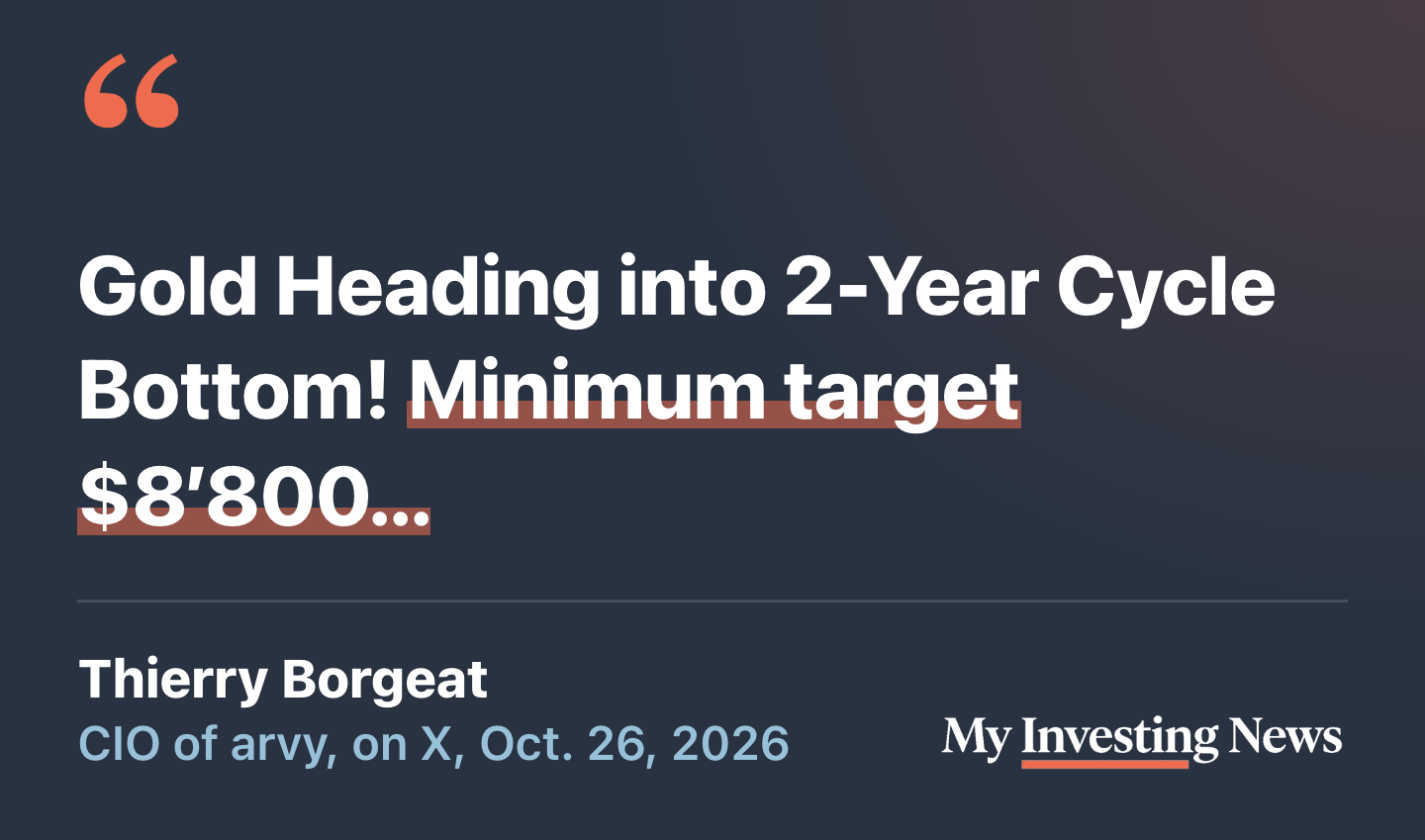
Thierry Borgeat thinks gold’s slide is nearly over. On Oct. 26, the chief investment officer of arvy posted that gold was heading into a two-year cycle bottom, with a “minimum target” of $8,800, and shared the call again the next day. In the arvy Macro Cycles post behind it, his team writes that its “minimum target for 2028 remains” $8,800, the top it projects for gold’s eight-year cycle.

Gold futures settled at $4,074.60 an ounce on Oct. 27, so $8,800 is a gain of 116%. Gold set its record settle of $5,318.40 on Jan. 29, fell as low as $3,992.10 on July 16, 24.9% below the record, and finished Oct. 27 down 23.4% from the top and 6.1% for 2026.
Borgeat’s team called this year’s drop in advance. In the same post, it says it was bullish on gold in 2024 and 2025 but thought 2026 would “very likely not” be a gold year and expected “a bigger correction.” Gold futures rose 27.5% in 2024 and 64.4% in 2025 before turning lower. The question now is whether the bottom is in, and whether a climb to $8,800 by 2028 fits gold’s history.
How Deep Gold’s Bear Markets Went
To test the bottom call, we found every decline of 20% or more in gold’s monthly average price since 1975, using World Bank data. There were eight. They fell 21% to 53% from peak to low, with a median of 38%, and the median one took 22 months to hit bottom.
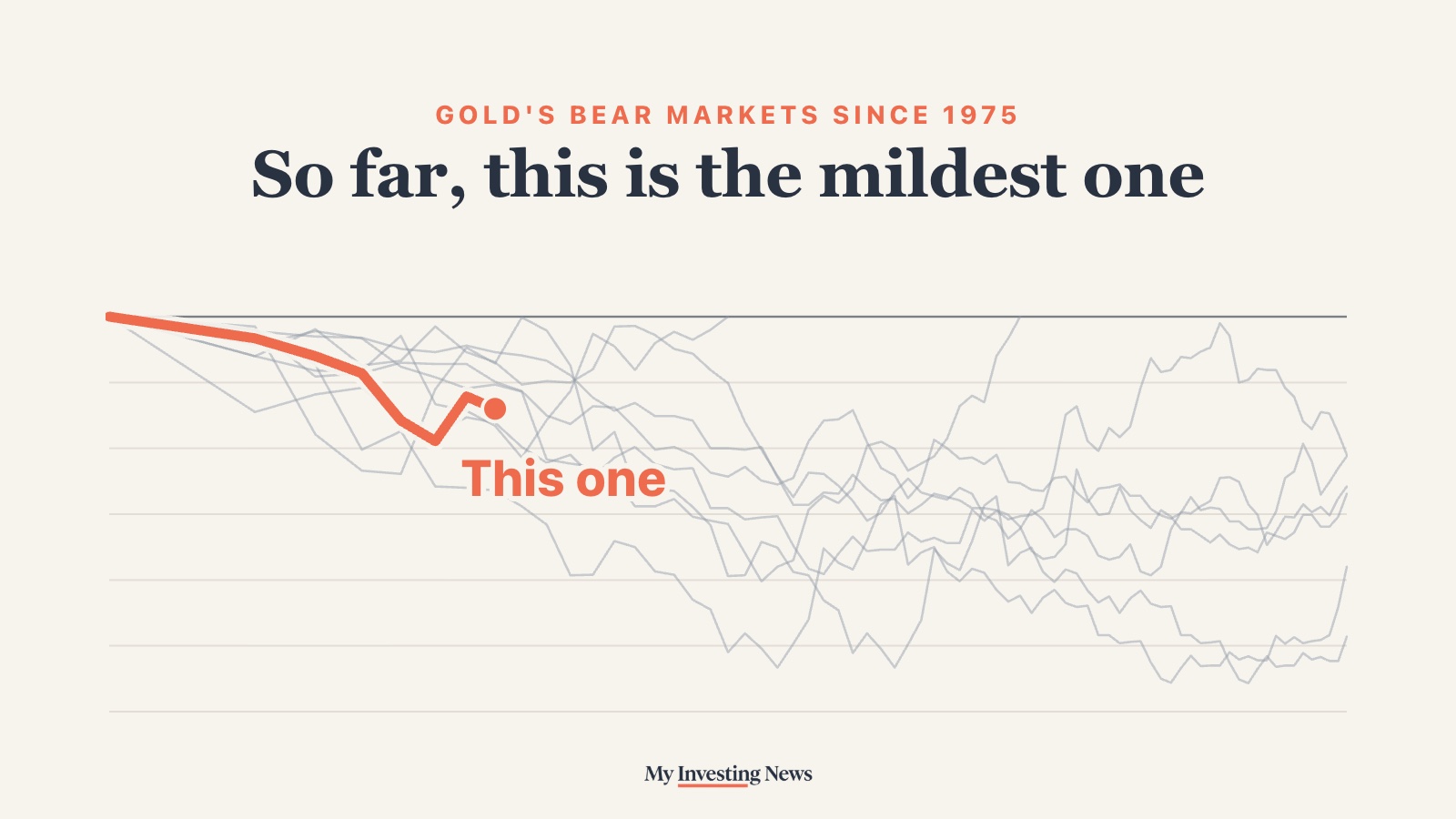
Measured the same way, this decline is the mildest yet. Gold’s monthly average peaked at $5,020 in February 2026 and bottomed so far at $4,073 in July, 19% lower. Monthly averages smooth out daily swings, which is why that figure is smaller than the 25% drop in daily settles.
Gold’s eight bear markets since 1975 fell 21% to 53%. This one’s low so far is 19%.
Gold’s monthly average price, as a percentage below its peak, by months since each peak. Gray: every decline of 20% or more since 1975, until gold regained the peak or six years passed. Coral: since the February 2026 peak, through Sept. 2026.
Two past declines look like this one: early 1980, when gold fell 24% in four months, and 2008, when it fell 21% in eight. Both ended within a year of the peak, which is the path Borgeat expects. The other six ran deeper and longer. A median-sized decline from February’s monthly average would put gold near $3,112 an ounce.
Gold and the $8,800 target
What $8,800 Would Take
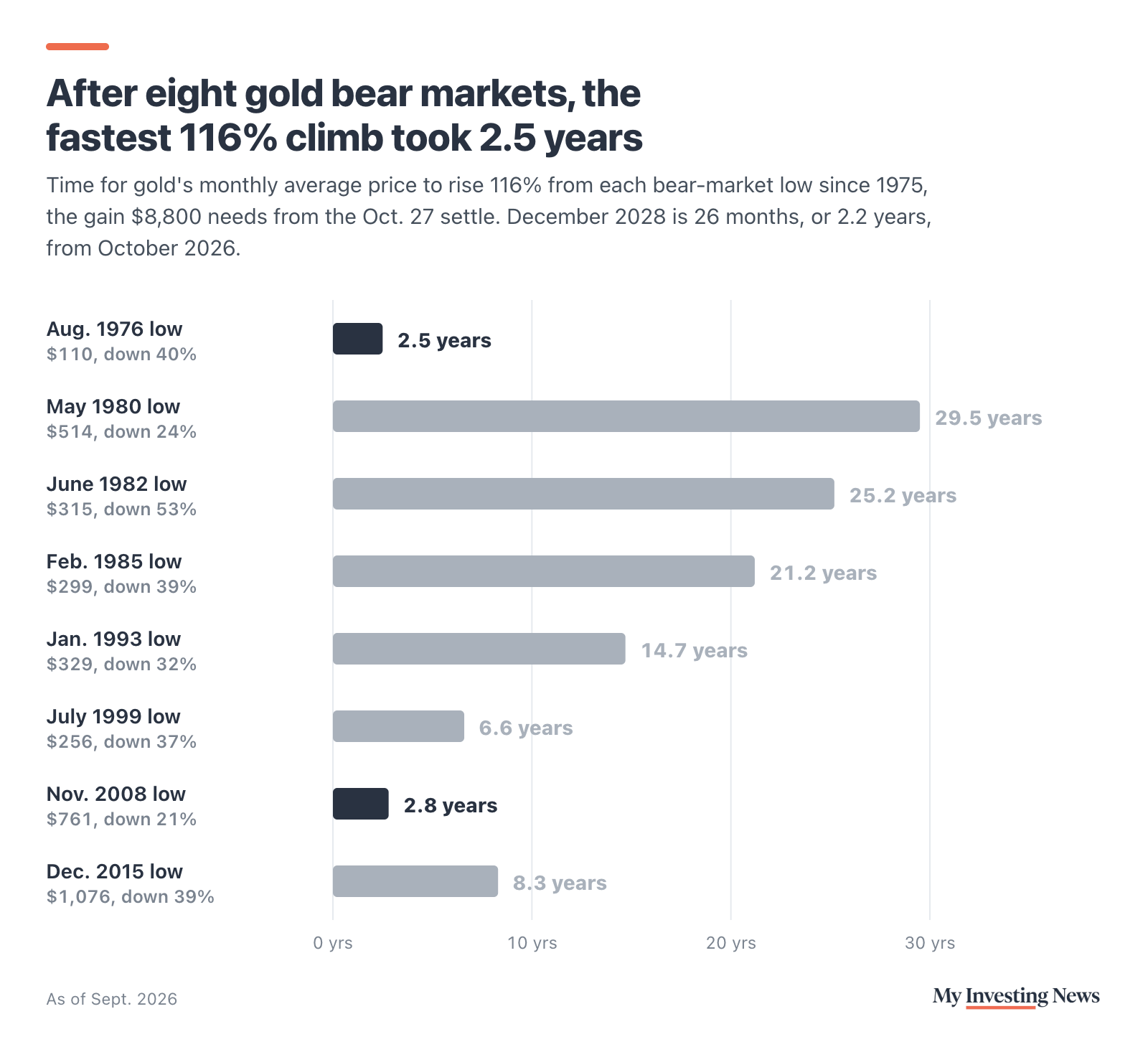
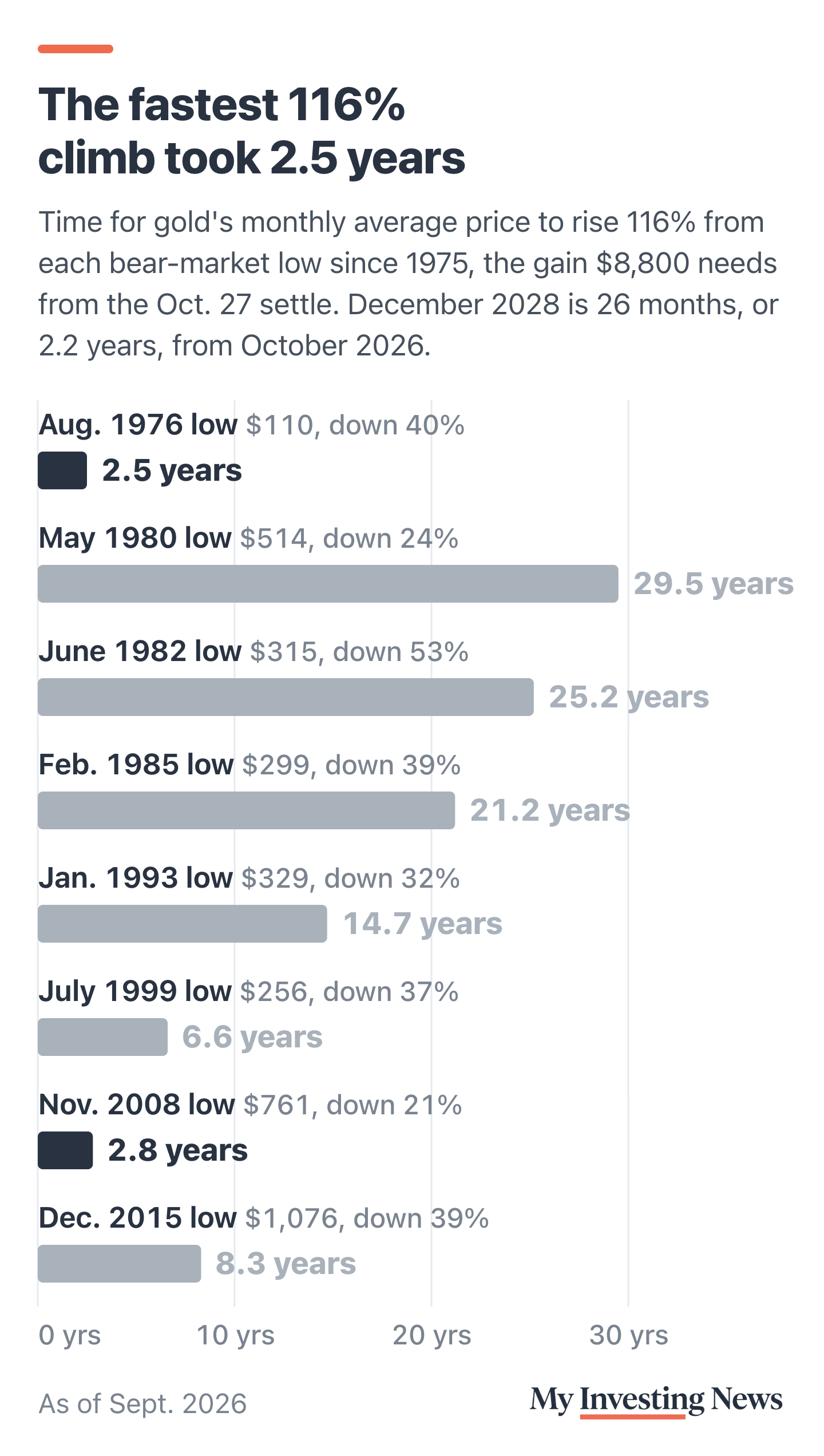
The bigger claim is the target. After each of the eight bear-market lows since 1975, we measured how long gold’s monthly average took to rise 116%. It happened within three years only twice: 30 months after the August 1976 low and 33 months after the November 2008 low. The other six took 6.6 to 29.5 years.
Borgeat’s window is shorter than either. From October 2026 to the end of 2028 is 26 months. In the first two years after each past low, gold’s best gain ranged from 19% to 87%. Gold has made fast runs before, though: it rose 64.4% in 2025 alone.
What to Watch
Borgeat’s macro-cycles account named the levels it is watching on Oct. 27, in a post he reshared: support at 4,000 to 3,880, where “a brief undershoot can’t be ruled out,” and a break back above 4,100 to signal a turn toward 4,350 to 4,500. Gold settled at $4,074.60 that day, between the two.
These prices are as of Oct. 27, before the Fed’s Oct. 28 decision, the Nov. 3 midterms and the Nov. 6 jobs report, any of which can move gold. Gold has fallen on hot data before: traders sold it on September’s inflation report. Borgeat has made calendar calls on stocks as well, including the midterm-year stretch for the S&P 500, and Tom Lee made a cycle-bottom call on bitcoin in early October.
Borgeat’s bottom call is plausible by gold’s history: the drop so far is the mildest of the bear markets since 1975, and two past ones ended this quickly. His $8,800 minimum target is the harder part. It needs a 116% gain, and after none of the bear-market lows since 1975 did gold climb that much within 26 months; the fastest took 30 months.