Where we heard itMorningstar’s Investing Insights podcast, “Want to Invest in Anthropic? Here’s What to Know Before the IPO,” Nov. 6, 2026. Harrison Rolfes, senior research analyst at Morningstar’s PitchBook (profile), interviewed by Ivanna Hampton.
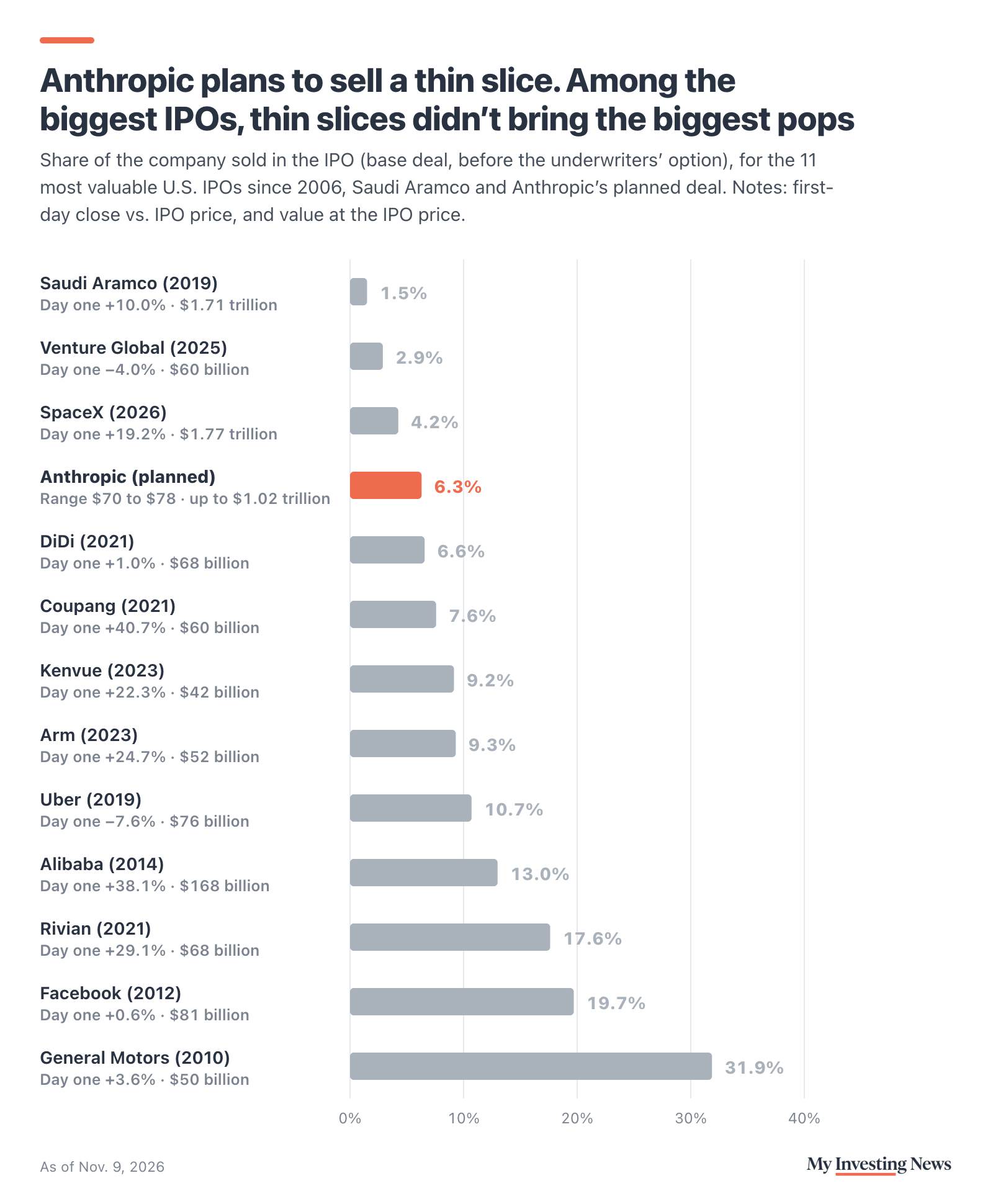
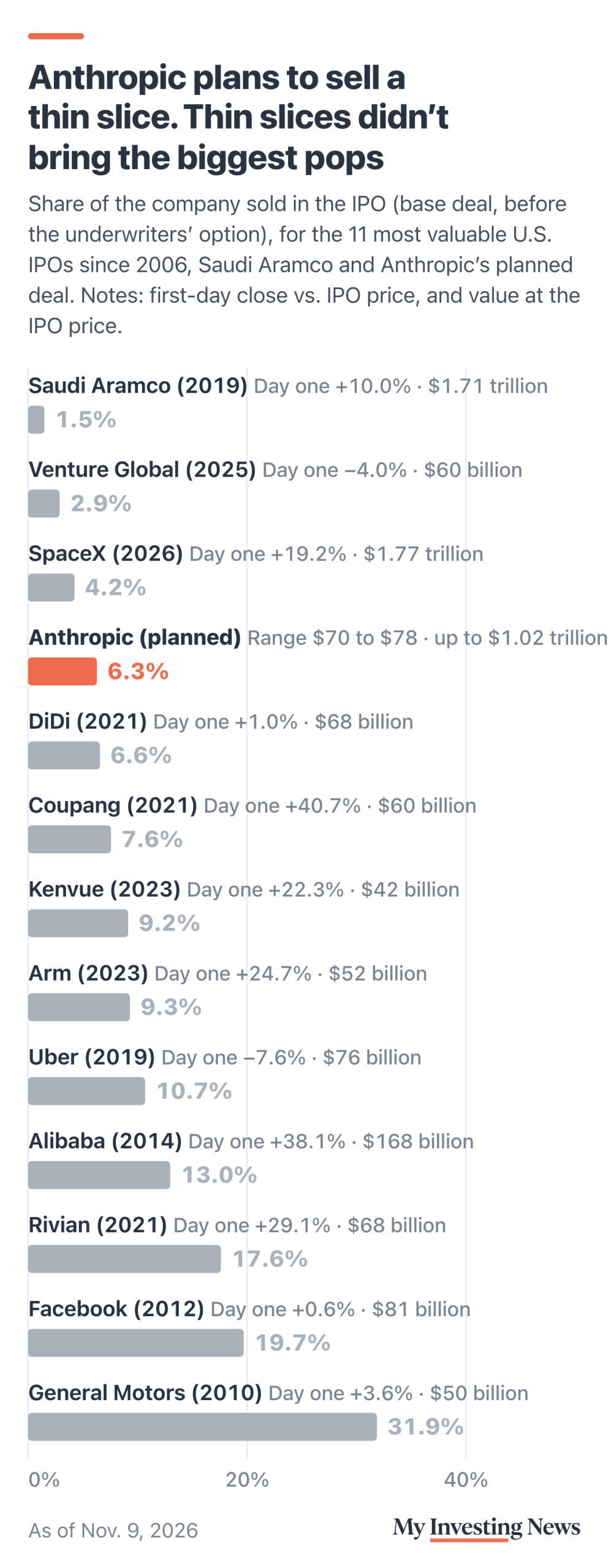
Anthropic plans to sell only a thin slice of itself. In an amended filing dated Nov. 10, the AI company set a price range of $70 to $78 a share for 825 million shares, according to its registration statement. That is 6.3% of the 13.09 billion shares it expects to have outstanding afterward, which would value the company at $916 billion to $1.02 trillion at the IPO price. It plans to list on Nasdaq as ANT.
Harrison Rolfes, a senior research analyst at Morningstar’s PitchBook, said on Morningstar’s Investing Insights on Nov. 6 that a small float cuts both ways. Asked what SpaceX’s June debut says about a deal of Anthropic’s size, he answered:
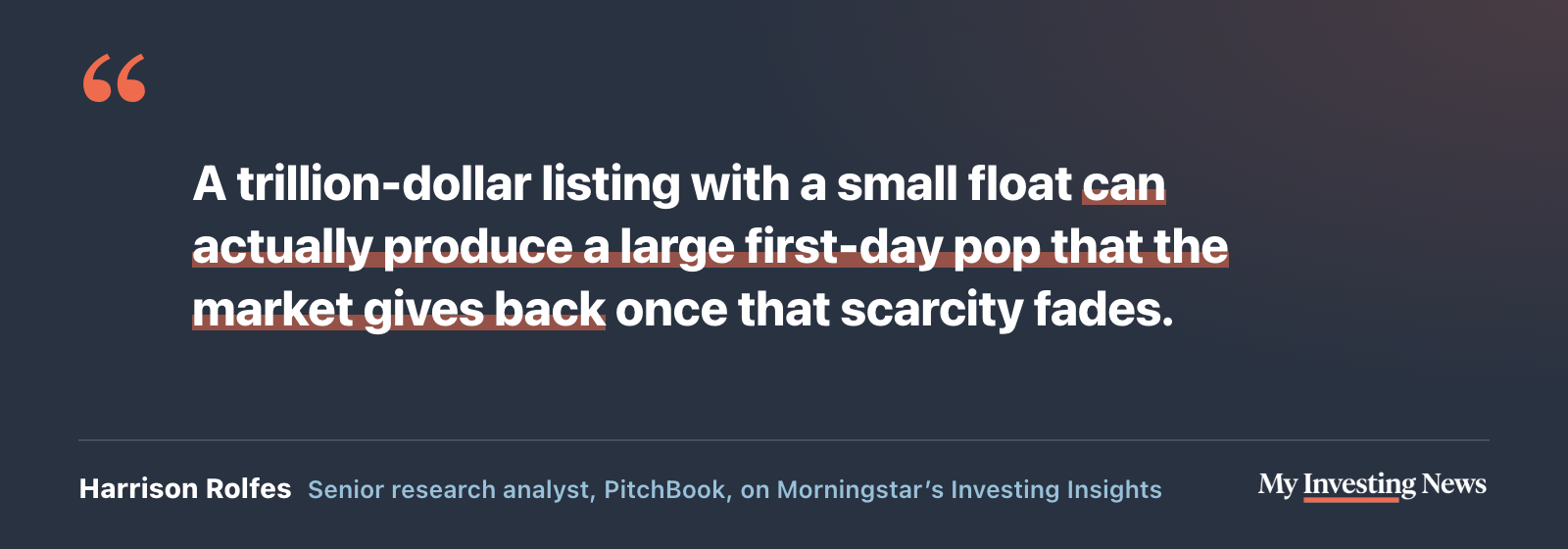
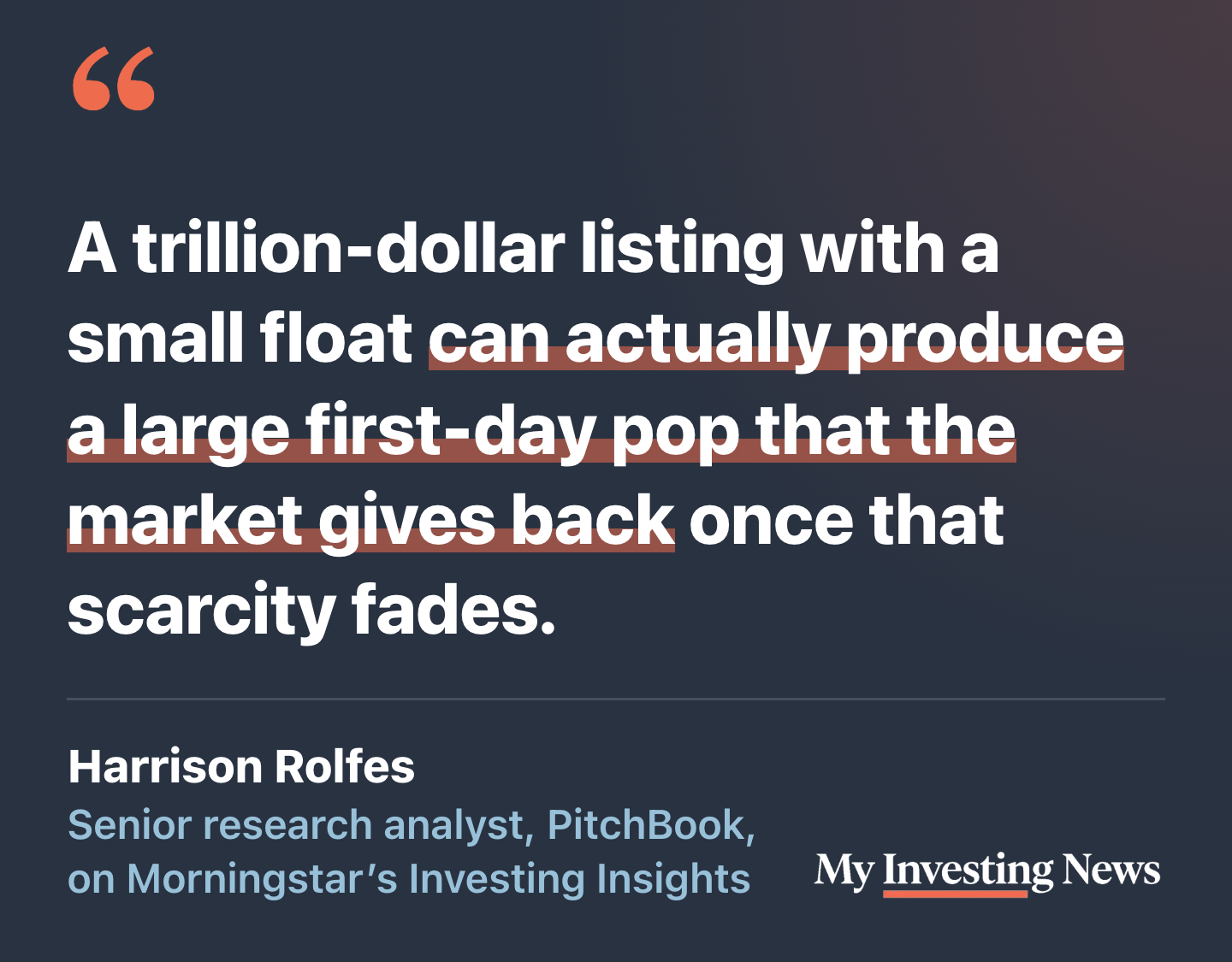
His advice was to “judge the deal against the price range, not against the first day of trading.” We checked both halves of the warning against the biggest IPOs on record.
What We Tested
We took the 28 U.S. IPOs since 2006 worth $15 billion or more at their IPO price, the list from our look at how the biggest IPOs did in year one, and found each one’s float: the shares sold in the base deal, before the underwriters’ extra allotment, as a share of all shares outstanding afterward, from each final prospectus. Then we measured the first-day close against the IPO price and the stock about three, six and 12 months later (63, 126 and 250 trading days) against that first close, using Yahoo Finance prices. Klarna is left out because Yahoo’s history skips its first day. Saudi Aramco, which sold 1.5% of itself in Riyadh in 2019, is shown for scale.
The floats ran from 2.9% for Venture Global to 50% for Visa, with a median of 9.2%. SpaceX sold 4.2%, the second-smallest slice on the list. Anthropic’s 6.3% would rank fifth-smallest.
The Pop Didn’t Follow the Float
The first half of the warning doesn’t show up in the record. The 16 IPOs that sold less than 10% of the company had a median first-day gain of 17%. The 12 that sold 10% or more had a median of 29%. Seven in each group closed day one up 20% or more. Figma, with a 7.6% float, more than tripled on its first day, but Venture Global, with the smallest float at 2.9%, closed below its IPO price.
SpaceX fits his description. It closed its first day 19.2% above its $135 IPO price on June 12, peaked at 57% above it on June 16, and by Aug. 5 was 20% below it. As of the Nov. 9 close it was 5.2% above the IPO price and 11.7% below its first close. Aramco rose 10% on day one, the most the Saudi exchange allowed in a session, and was back below its IPO price within three months.
Float and the first year, biggest U.S. IPOs since 2006
The Giveback Was the Rule
The second half holds up, for big and small floats alike. Of the 25 IPOs with a full year of trading, 20 were below their first-day close a year later. That includes 11 of 15 small floats and 9 of 10 larger ones. The small floats fell further: a median 50% from the first close, against 31% for the larger deals. With 15 and 10 stocks in the two groups, that gap is suggestive at most.
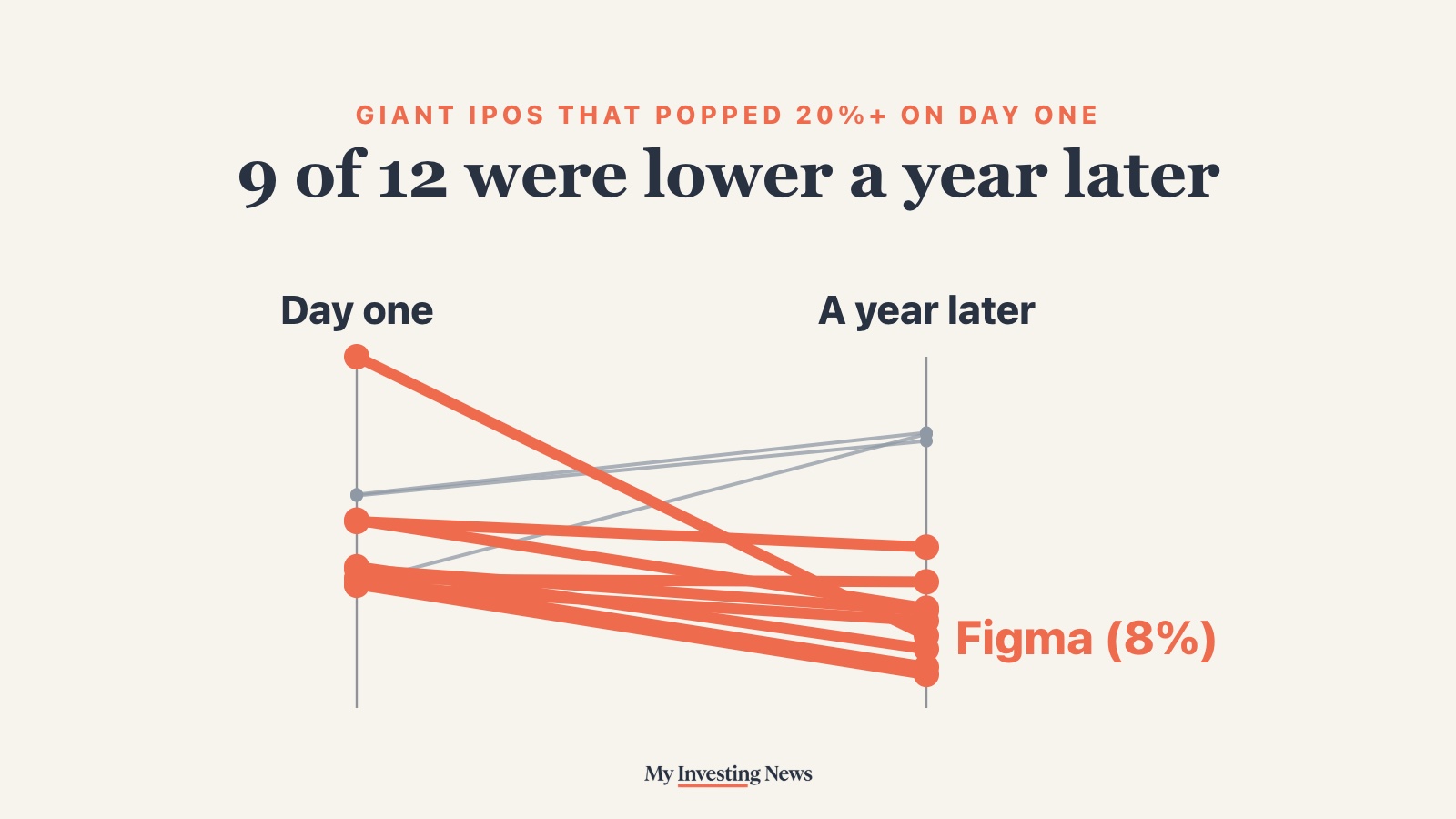
The big first-day winners show it most clearly. Of the 12 that closed day one up 20% or more and have a year of trading, 9 ended that year below their first close, and 7 were below the IPO price itself. Only Arm, Airbnb and Snowflake kept climbing. Arm, which sold 9.3% of itself in 2023, was 119% above its first close a year later.
9 of 12 giant IPOs that popped 20% or more on day one were lower a year later, big float or small
U.S. IPOs worth $15 billion or more at the IPO price since 2006 that closed day one up 20% or more and have traded a full year. Left: first-day close vs. IPO price. Right: 250 trading days later. Coral: below the first-day close a year later. Share of the company sold in the IPO in parentheses.
That is why Rolfes pointed to the price range. An investor who bought at the first-day close paid for the pop; one who got shares at the IPO price had a cushion. Who gets those shares matters too. Robinhood’s CFO said companies now ask to give a fifth of a deal to individual investors, and Anthropic’s filing says part of its offering will go to retail investors through brokers including Schwab, Fidelity and Robinhood.
What to Watch
The price range can still change before Anthropic prices, and so can the share count. A higher range or a bigger deal would change the float. The filing also lets non-founder directors, officers, employees and consultants sell up to 10% of their locked-up shares starting on the first trading day, and seven companies, among them Google, Nvidia and Microsoft, have agreed to buy $26 billion of nonvoting shares at the IPO price in a private placement.
Rolfes also expects the market to test the stock after the debut: “we might see a similar dip the way that SpaceX did.” Questions about Anthropic’s competitive lead are in its own filing, and the first months of trading will show how much of the opening price holds.
Rolfes is half right on the record. Small floats did not bring bigger first-day pops: the median was 17% for floats under 10% and 29% for larger ones. But giving it back was the norm: 20 of 25 giant U.S. IPOs with a year of trading ended it below their first close. Anthropic plans to sell 6.3%, and its range of $70 to $78 is the price to measure it against.