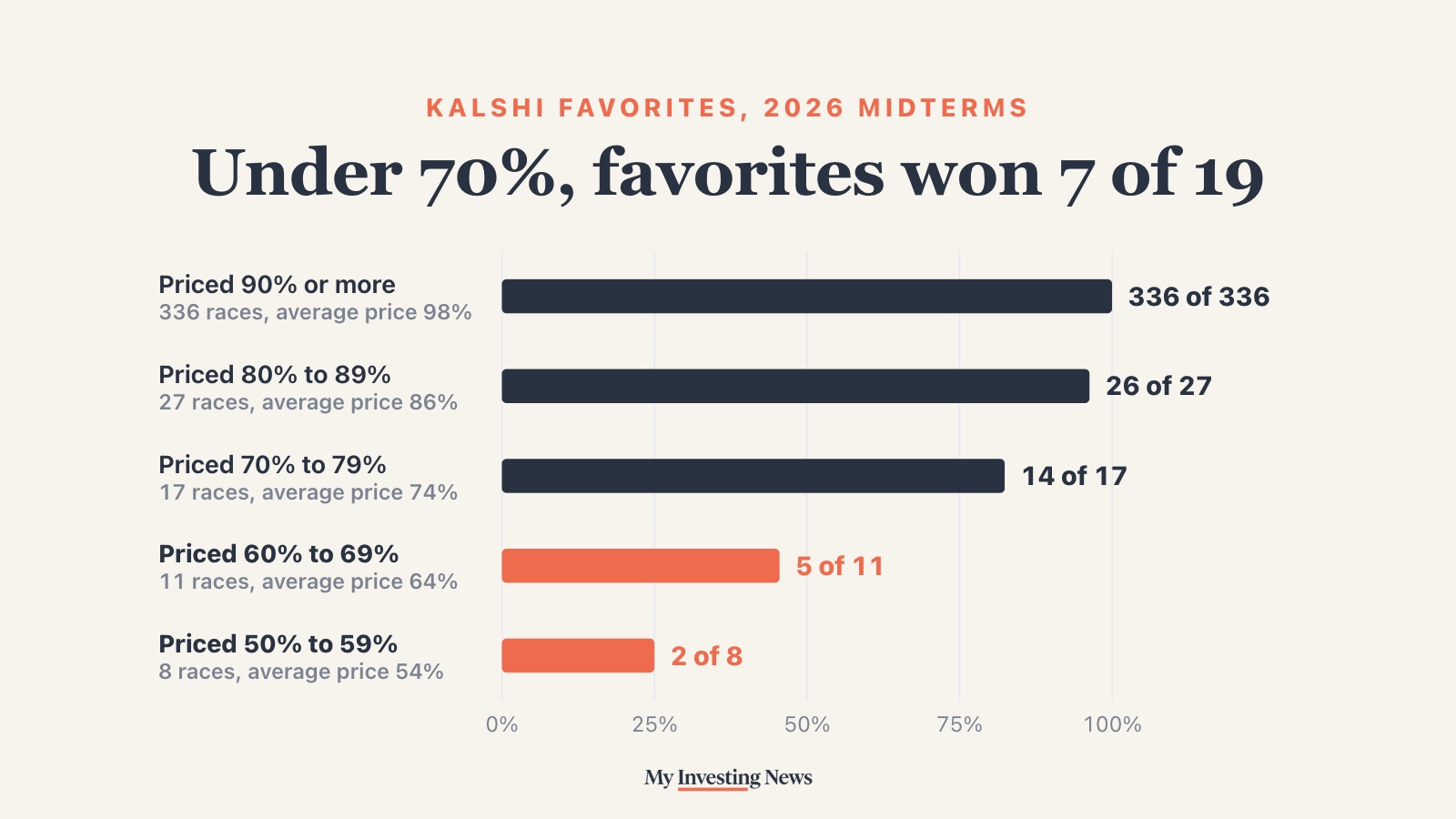
Where we heard it“Bloomberg Businessweek Weekend,” Nov. 6, 2026, with Nicole Kagan, head of research at Kalshi.
Kalshi wants its midterm record to be the headline. Asked on Bloomberg Businessweek Weekend how accurate the prediction markets were in the Nov. 3 elections, Nicole Kagan, the exchange’s head of research, said “extremely accurate” and gave the count.
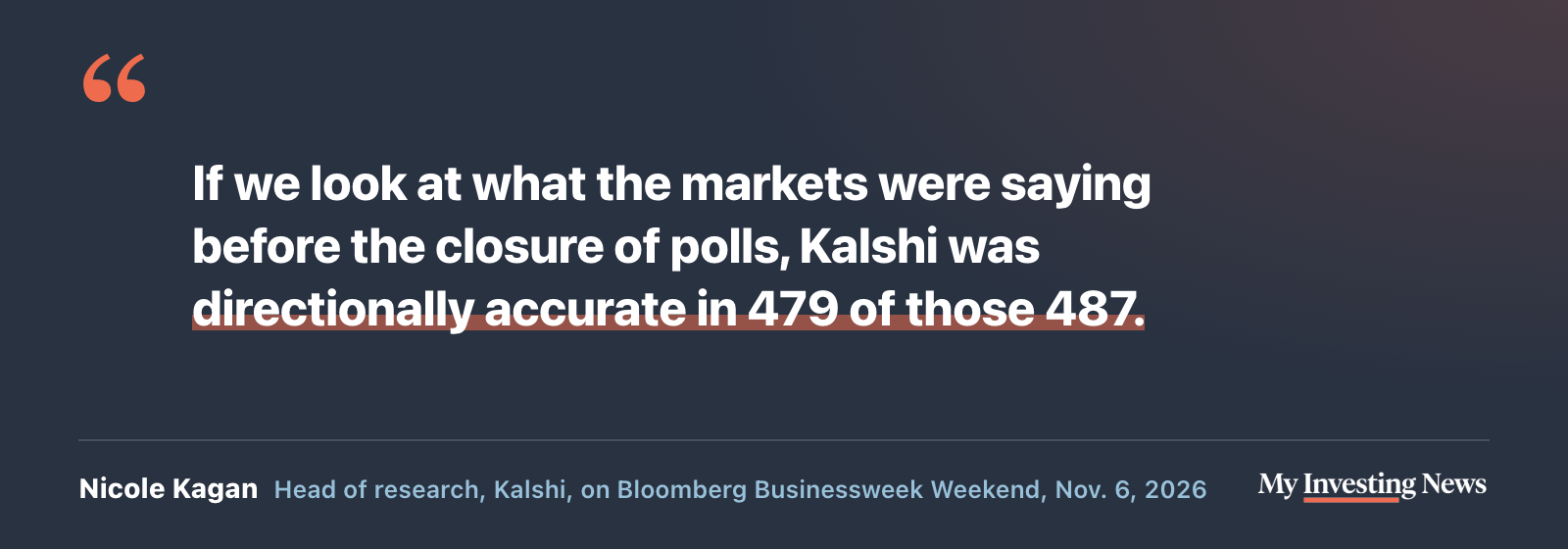
That works out to “about 98 plus percent,” she said. The count is real, but most of it comes from races nobody needed a market to call. The test that matters is the close ones, and there the favorites won a little more than half the time. Every favorite that lost was a Republican.
What Kalshi Counted
Kalshi’s recap, posted the morning after the election and reproduced by RotoWire, covered the 487 races resolved by 6 a.m. ET on Nov. 4. It mixed six kinds of contests: 360 House races, 33 Senate, 34 governor, 27 attorney general, 10 lieutenant governor and 23 secretary of state. Kalshi’s post said the result was “forecasted before a single vote was counted.” Kagan put it more carefully: the prices were taken “before the closure of polls,” state by state, which means hours after the first returns from Kentucky and Indiana had started to move other markets. She described that herself.
We ran our own check on Kalshi’s data. We took the price of every House, Senate and governor market at 6 p.m. ET on Nov. 3, before the first polls closed anywhere, using the midpoint between the best bid and offer. Then we scored the favorite in every race Kalshi had settled by the end of Nov. 7. That gave us 399 races. The favorite won 383 of them, or 96%: 321 of 334 House races, 30 of 32 Senate races and 32 of 33 governor races.
The Close Races
Most of those races were never in doubt. In 336 of them, the favorite was priced at 90% or more, and all 336 won. The real test is the 36 races where the favorite was under 80%. There, the favorite won 21. The prices implied about 24 wins, so the market overrated its close favorites by about three races.
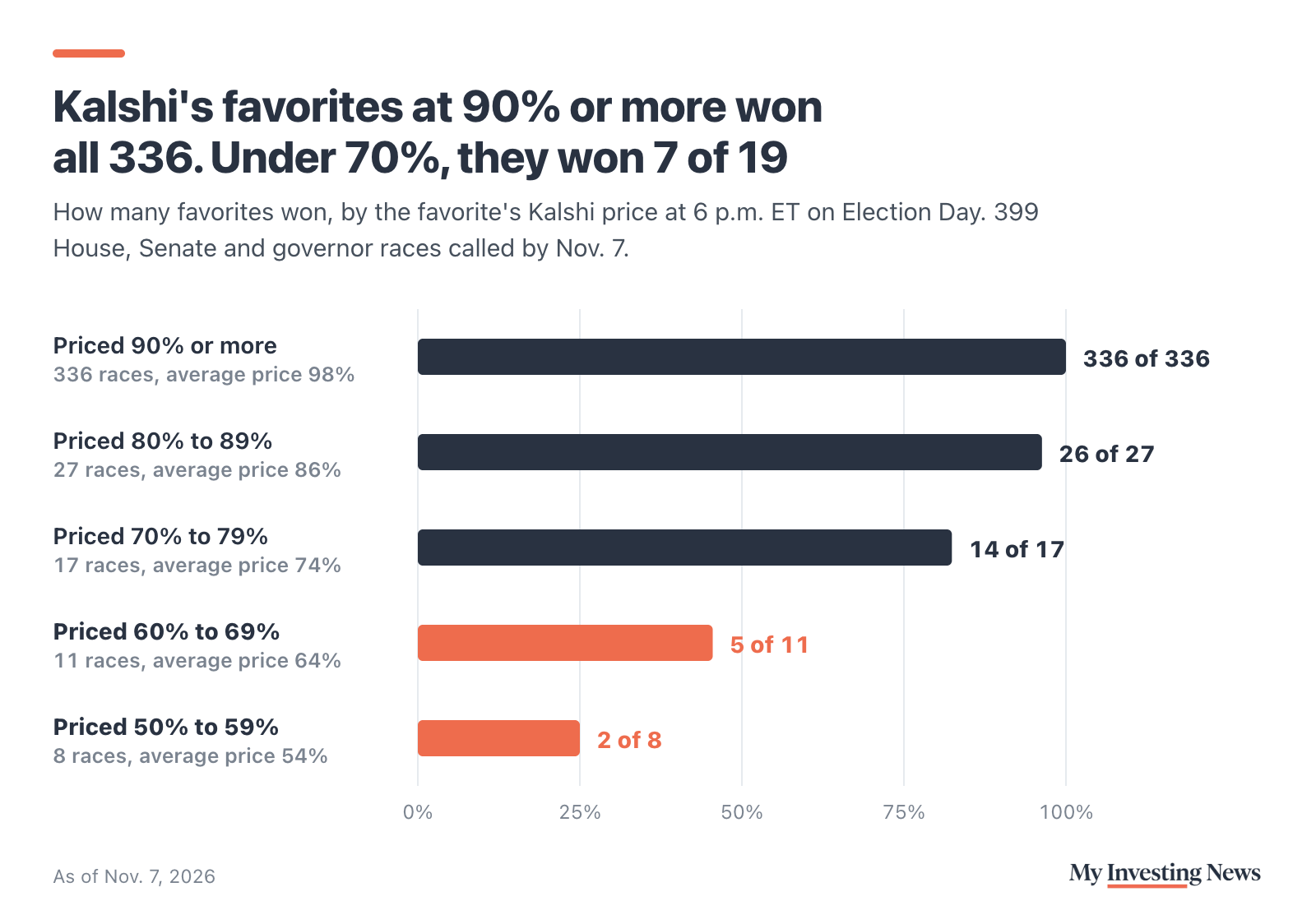
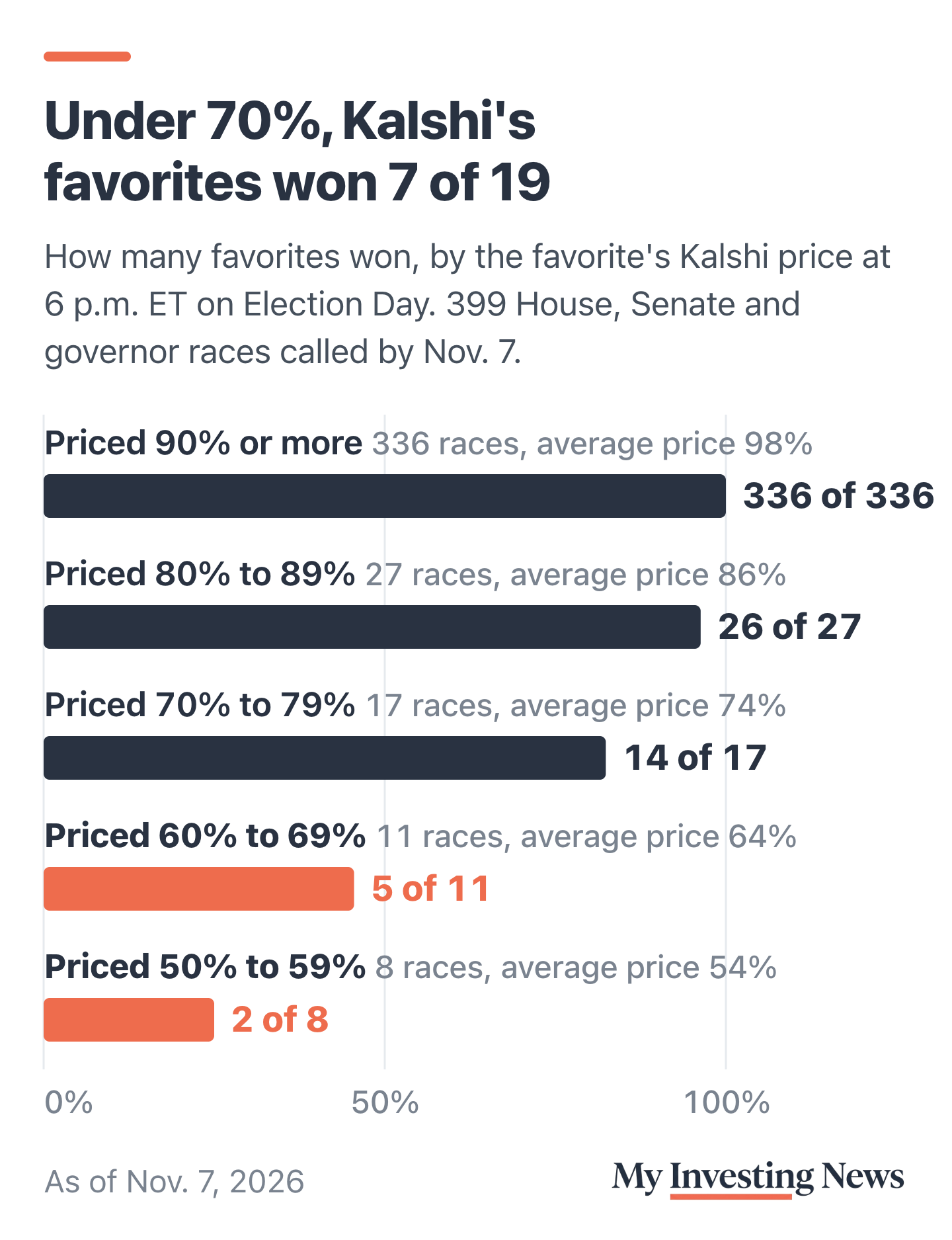
The gap is wider lower down. Favorites priced from 70% to 79% won 14 of 17, close to what the odds said. Below 70%, they won 7 of 19, against about 11 the prices implied. In the 50s, where a favorite is barely one, they won 2 of 8. Those are small samples, and a few races either way would change the picture. They are also close to what bettors did in past Senate races: on PredictIt and Polymarket in the four cycles from 2018 to 2024, Senate favorites priced under 70 cents won 8 of 18.
Kalshi’s midterm favorites, scored
Every Miss Went One Way
All 16 favorites that lost were Republicans, and all lost to Democrats. In the close races, Democratic favorites won all 12. Republican favorites won 9 of 24. Bettors saw the wave coming. At 6 p.m., Kalshi priced Democrats at 93% to win the House and about 75% to win the Senate, and they won both; a month earlier, markets gave Republicans a 36% shot at the Senate. What the prices missed was how far down the ballot the wave would reach. Sen. Darline Graham in South Carolina, Gov. Greg Abbott in Texas and Ashley Hinson, the Republican Senate nominee in Iowa, were all favored at 6 p.m., and all lost.
Timing explains much of the gap with Kalshi’s figure. The races called by 6 a.m. on Nov. 4 were mostly easy ones: in our data, favorites won 363 of 370 of them, and our count of four House misses among those early calls matches Kalshi’s. The 29 races called later, through Nov. 7, were all House seats, and the favorite won only 20. In the 12 of those that were close, it won 4. Before the vote, our model found that a 2018-size swing would flip 25 Republican House seats on this year’s maps. Three of the late House upsets came in seats where the Republican was priced above 70%.
The count isn’t finished. Twenty of the races we tracked had not been settled by the end of Nov. 7. In 8 of them, trading had turned against the 6 p.m. favorite, a Republican every time. Rep. Scott DesJarlais in Tennessee’s 4th District was priced at 98% before polls closed; by the end of Nov. 7, Democrat Victoria Broderick traded at 95 cents. In Mississippi, Sen. Cindy Hyde-Smith went from 86% to a market that priced Democrat Scott Colom at 99 cents. A separate review by DeFi Rate, using prices from before Election Day, counted 18 Kalshi misses, half of them in Texas.
South Carolina, Minute by Minute
Kagan’s best example was South Carolina, where Democrat Annie Andrews beat Graham. “The flip in South Carolina for Andrews happened within five minutes of polls closing in the state,” she said, and traders called the race “well before networks were calling it.” Andrews was priced at 30.5 cents at 6 p.m. Polls in the state closed at 7, when her last trade was 39 cents.
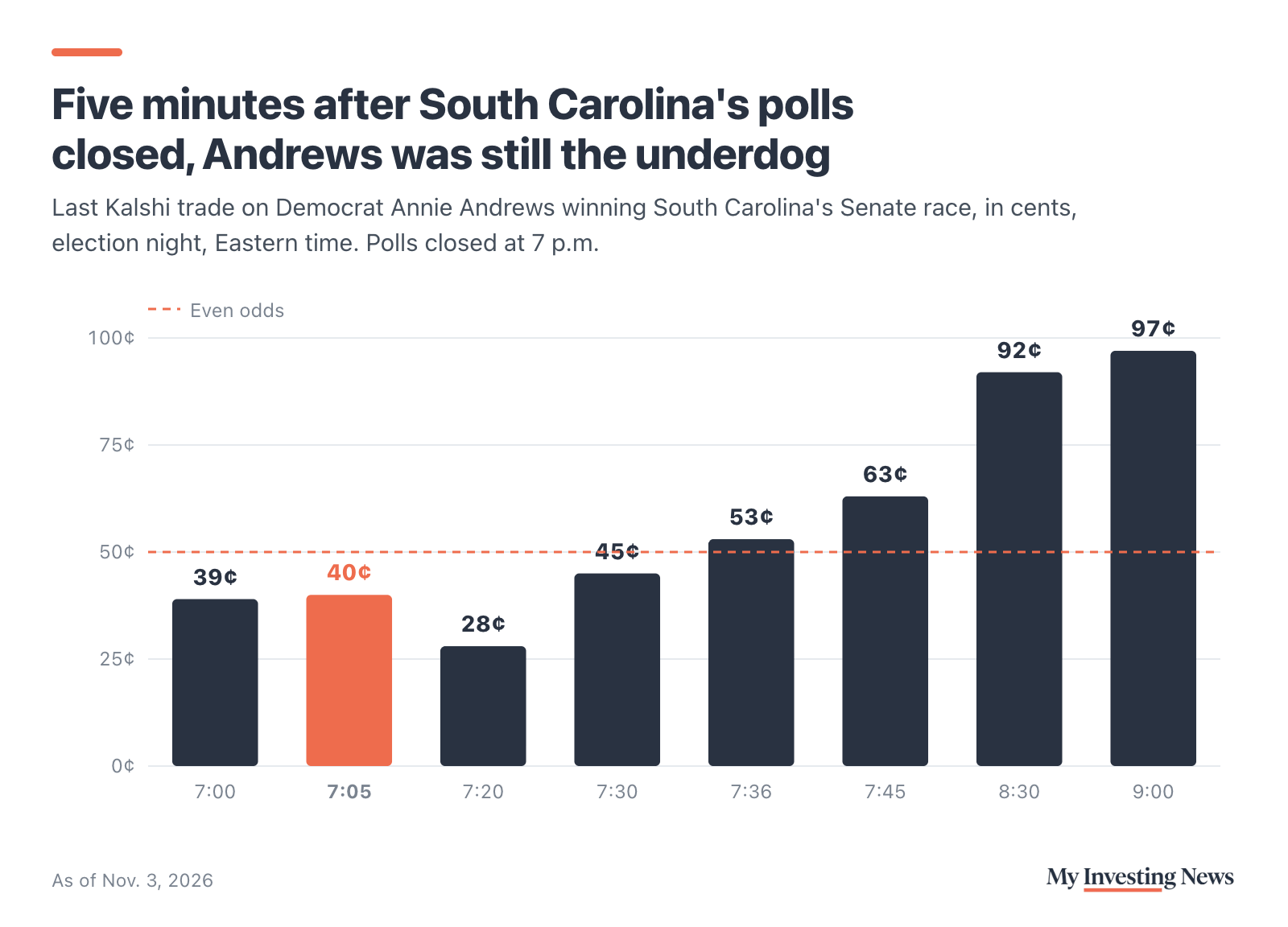
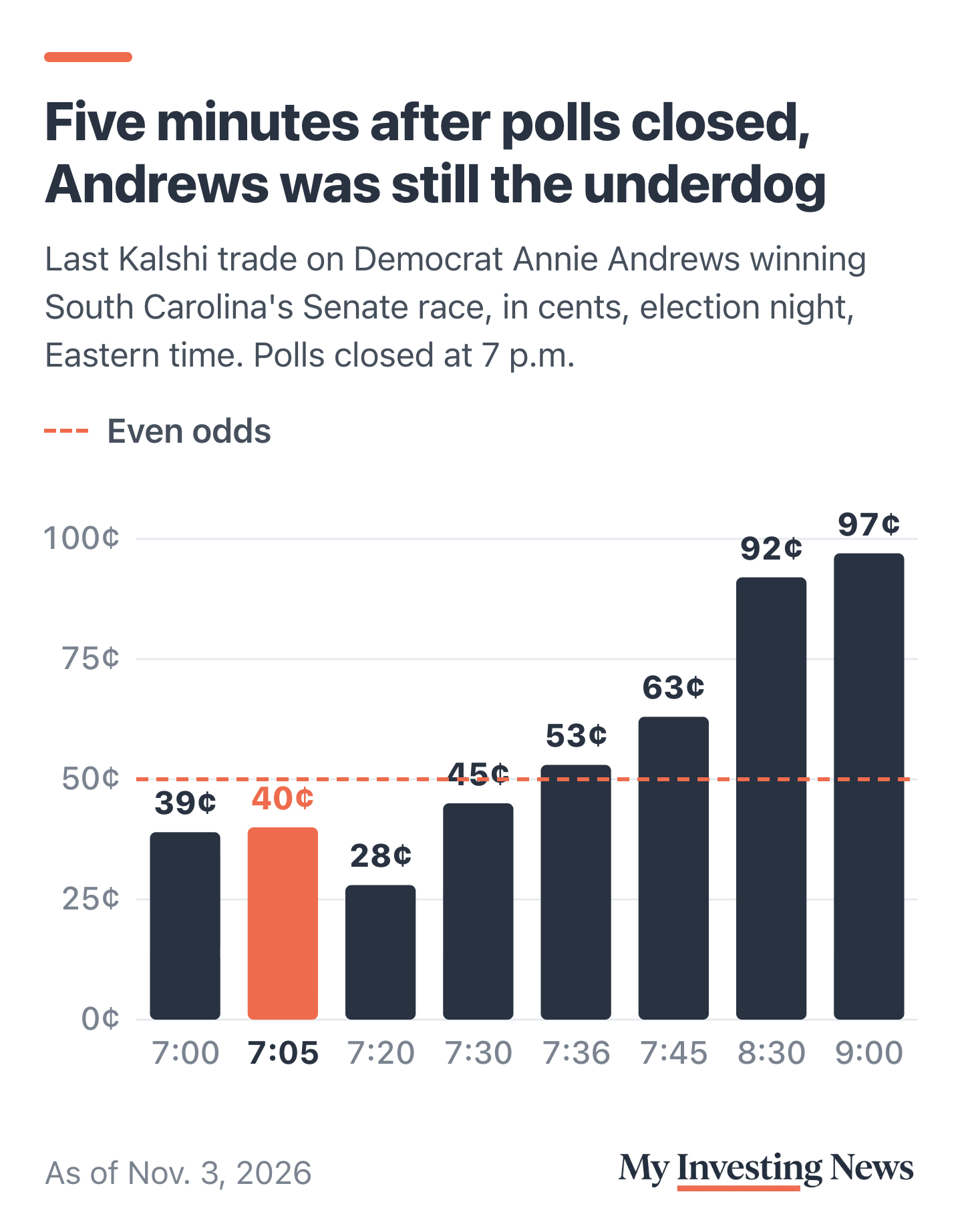
Kalshi’s minute-by-minute trades don’t show a flip within five minutes. In those first five minutes, Andrews traded no higher than 44 cents, and by about 7:20 she had slipped to 26 cents. She first traded above 50 cents at about 7:36, more than half an hour after polls closed, and reached 92 cents by 8:30. Kalshi settled the market at 10:41 p.m. Her larger point holds: traders had Andrews above 90 cents about two hours before Kalshi closed the market. The flip just took longer than five minutes.
What to Watch
The races still open are where the record can move most: Mississippi’s Senate count, Alaska, the Kansas governor’s race and the slow House seats in North Carolina, Florida and Tennessee. If the late-count leaders hold, more Republican favorites join the miss column, and the close-race record gets worse. Any accuracy figure Kalshi publishes from here is worth reading the same way: which races it counts, and what time it takes the price.
Kagan’s 479 of 487 is mostly a count of safe seats. At 6 p.m. on Election Day, Kalshi’s favorites won 96% of the 399 House, Senate and governor races called by Nov. 7, but only 21 of 36 close ones, and every miss was a Republican favorite. The markets read the direction of the wave and underpriced its size.