Where we heard itThree shows, Nov. 5 and 6, 2026: Jim Paulsen on CNBC’s Fast Money (Nov. 5); Skanda Amarnath, executive director of Employ America, on Bloomberg’s Odd Lots, “The Macro Implications of the Blue Tsunami” (Nov. 6); Steve Eisman on The Real Eisman Playbook weekly wrap (Nov. 6).
As stocks sold off after the midterm elections last week, three people who follow the economy closely each put a number on how much of it now rides on artificial intelligence. The numbers were 14%, about 8% and at least 50%. They are less far apart than they sound, because each speaker was measuring something different.
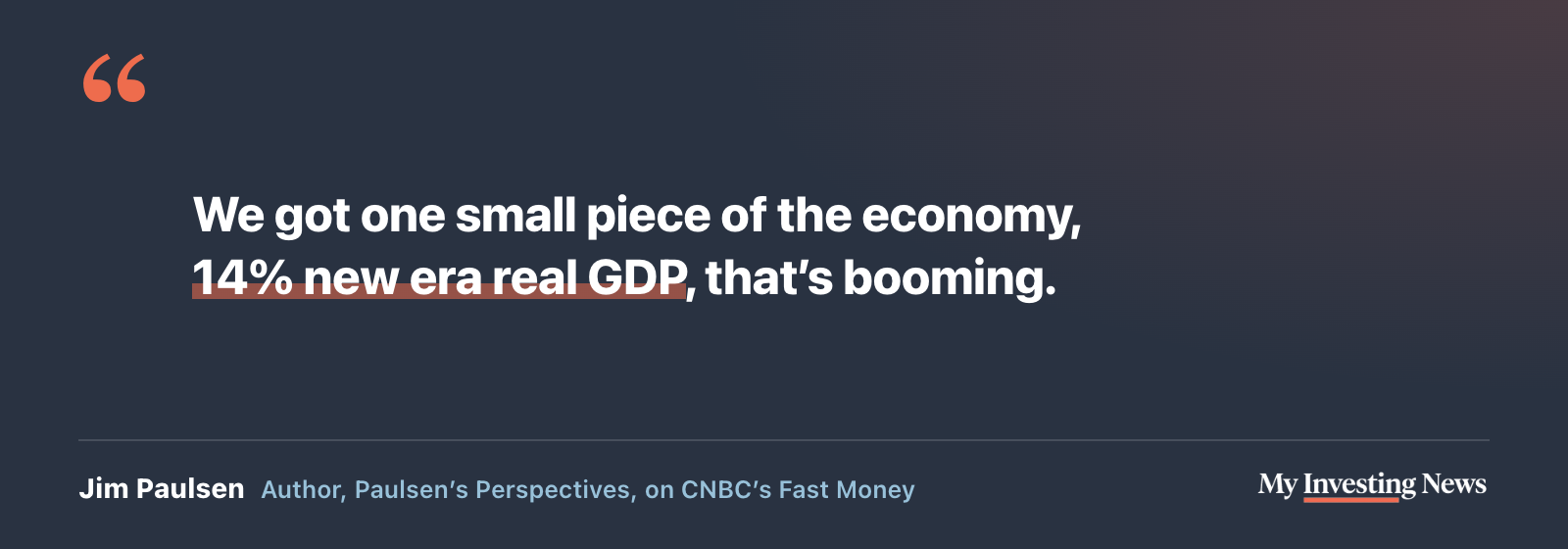
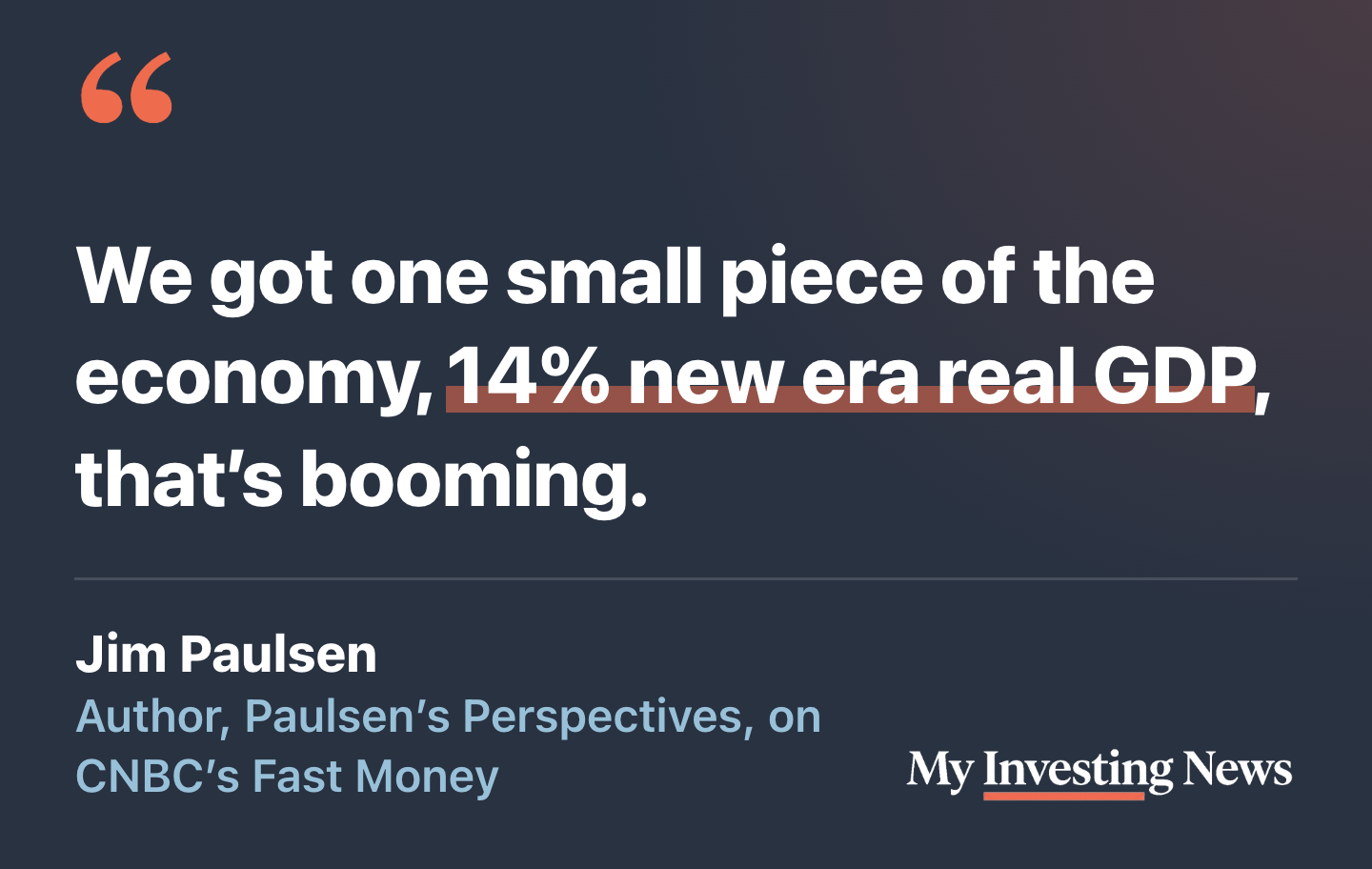
Jim Paulsen, the former Wells Fargo strategist who writes the Paulsen’s Perspectives newsletter, made the starkest case on CNBC’s Fast Money on Nov. 5. “We got one small piece of the economy, 14% new era real GDP, that’s booming. And we got 86% of the economy that’s barely been growing 1% in real terms annualized over the last two years,” he said. His worry is a slowdown in AI spending landing on an economy that is already growing slowly.
A day later, Skanda Amarnath of Employ America told Bloomberg’s Odd Lots that the AI-sensitive parts of spending are “something getting close to 8% of GDP,” counting tech hardware, tech software and industrial equipment. On his own podcast the same day, Steve Eisman said: “AI capex accounts for at least 50% of GDP growth this year. A slowdown in AI capex means a slowdown in the economy.”
Matching Each Number to BEA’s Books
The Bureau of Economic Analysis doesn’t publish an “AI” line, so we built the closest match from its national accounts, using the advance estimate for the third quarter of 2026, released Oct. 29. That report put real GDP growth at 3.4% at an annual rate and said investment in information processing equipment, mainly computers, led the gain in equipment.
Our narrow measure of AI-linked investment adds three lines: information processing equipment ($934 billion at an annual rate in the third quarter), software ($832 billion) and data-center construction ($83 billion). Together that is about $1.85 trillion, or 5.6% of GDP. Each speaker’s figure fits a different, wider slice.
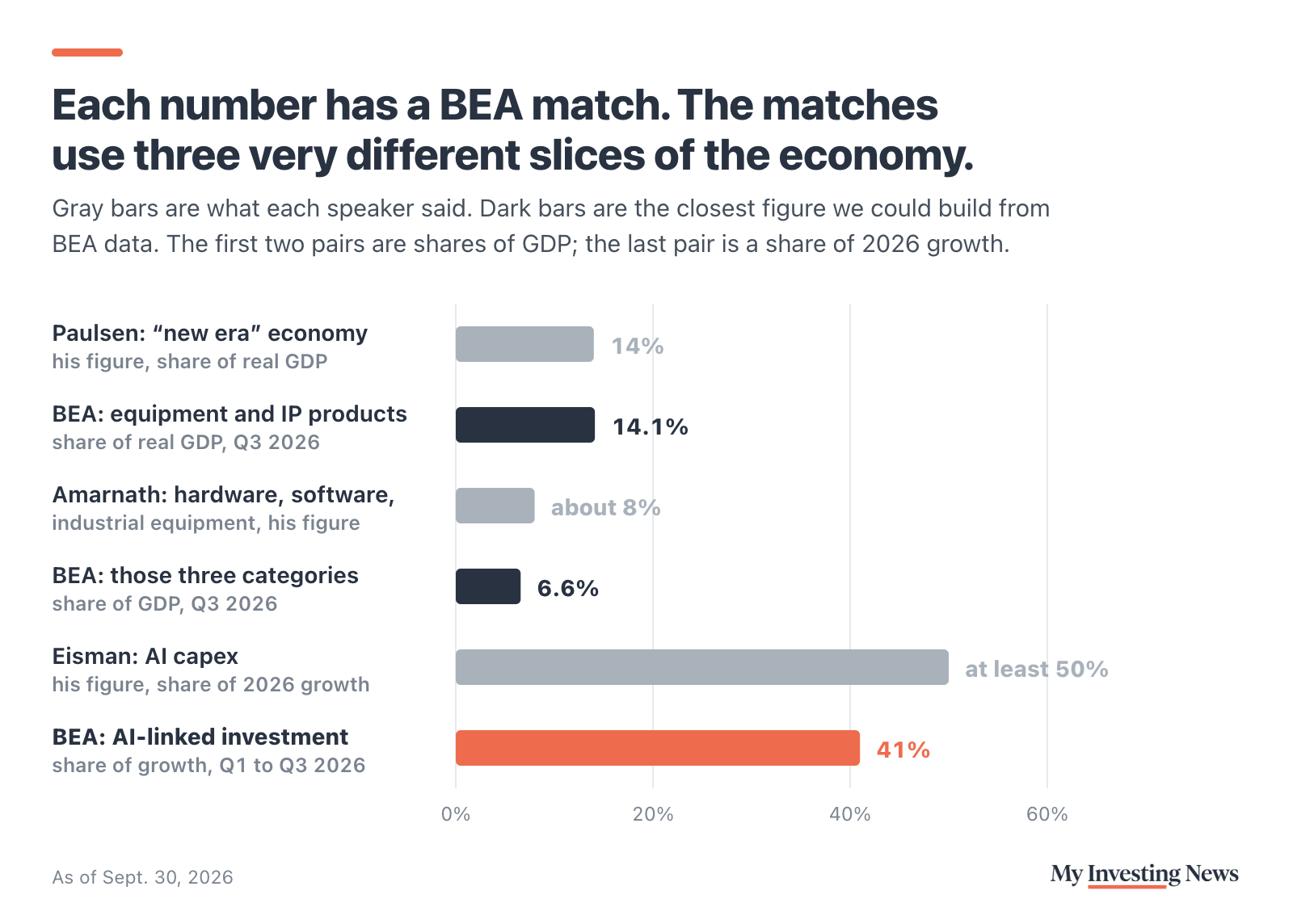
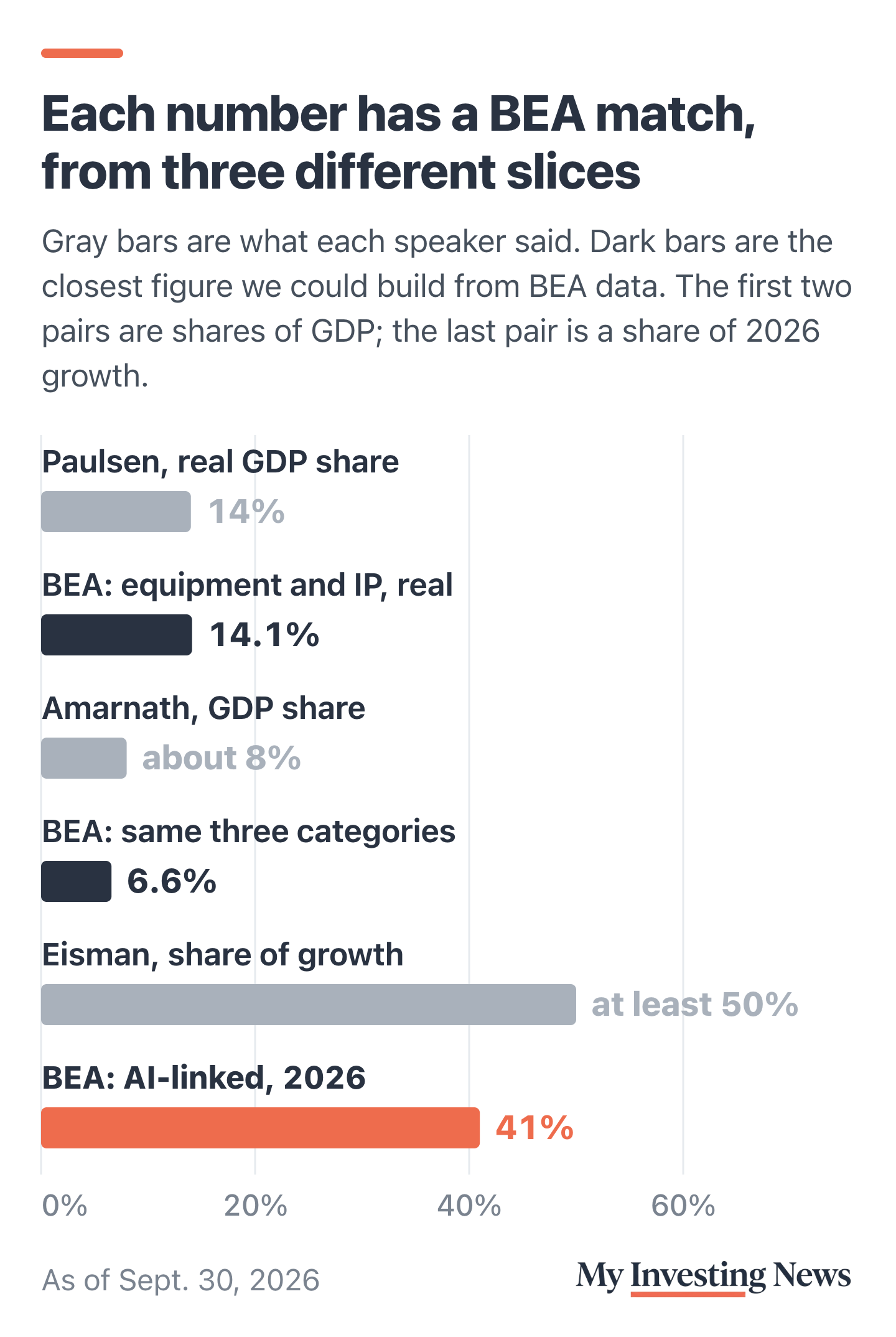
Amarnath’s 8% is close on his own terms. Information processing equipment, software and industrial equipment came to 6.6% of GDP in the third quarter in current dollars. Measured in inflation-adjusted dollars, the same three lines come to 8.7%, because computer prices have fallen since BEA’s 2017 base year, so the same spending counts as more output. He also flagged the main caveat himself: “obviously a lot of it is imported, but it still matters.”
Paulsen’s 14% lines up with a much broader group. He didn’t define “new era” GDP on air. The closest BEA match we found is all business equipment plus intellectual property products, which includes software and research and development. That group was 14.1% of real GDP in the third quarter and 12.1% in current dollars. Shares built from inflation-adjusted figures are approximate, since BEA’s chained dollars don’t add up exactly.
AI-linked investment in BEA’s data, 2026
Eisman’s 50%: Close, Depending on What Counts
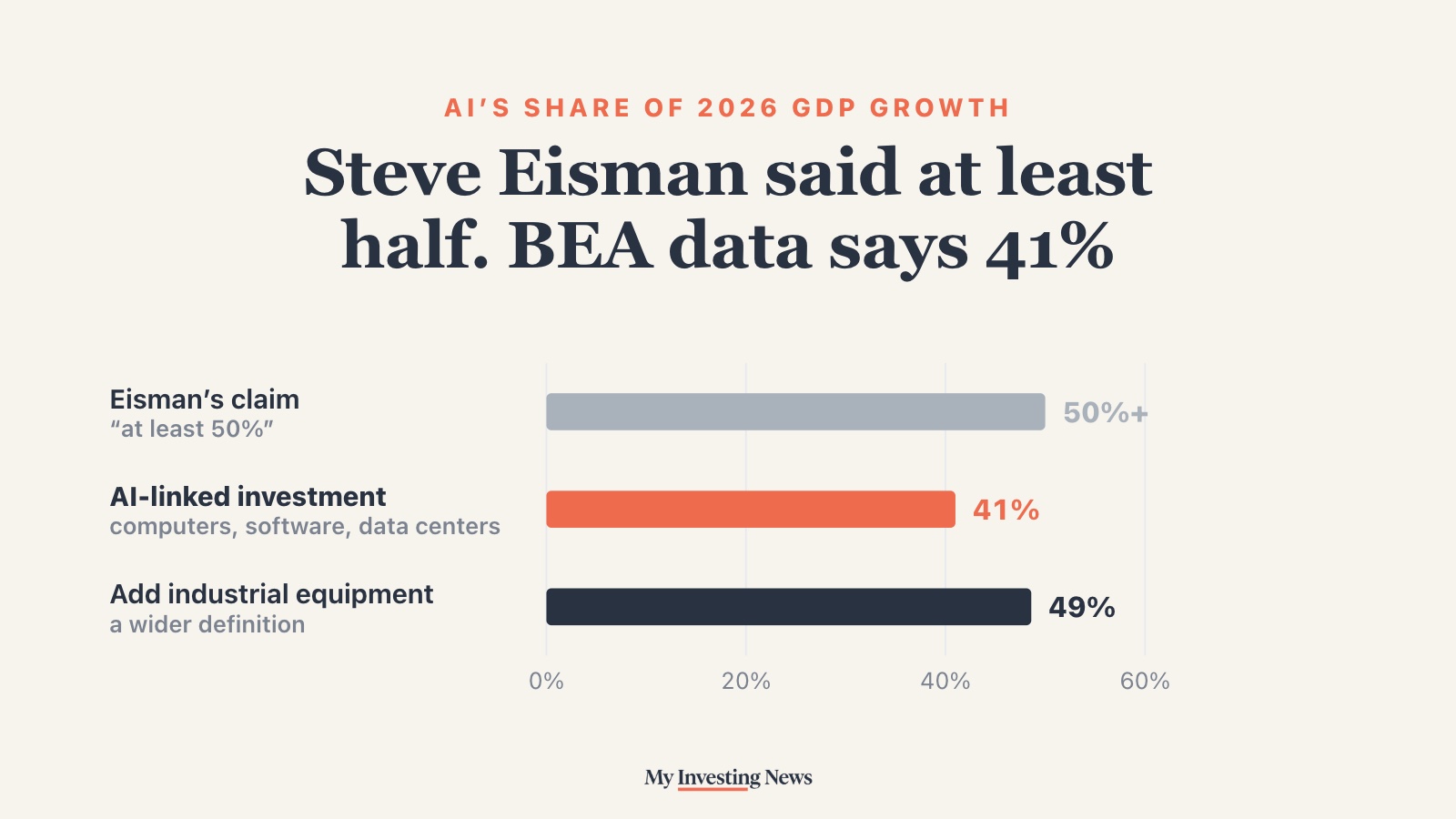
Eisman’s claim is about growth, which is where AI’s weight shows most. In the first three quarters of 2026, real GDP grew at an average annual rate of 2.7%. Information processing equipment, software and data centers added an average of 1.1 percentage points of that, or 41%. Computers and software alone, the two lines BEA publishes directly, account for 37%.
Widen the definition and he gets to about half. Adding industrial equipment, part of Amarnath’s list, lifts the share to 49%. Adding research and development instead gives a similar 48.5%. So “at least 50%” needs a generous definition, but it is in the neighborhood. Last year’s figure on our narrow measure was 43%.
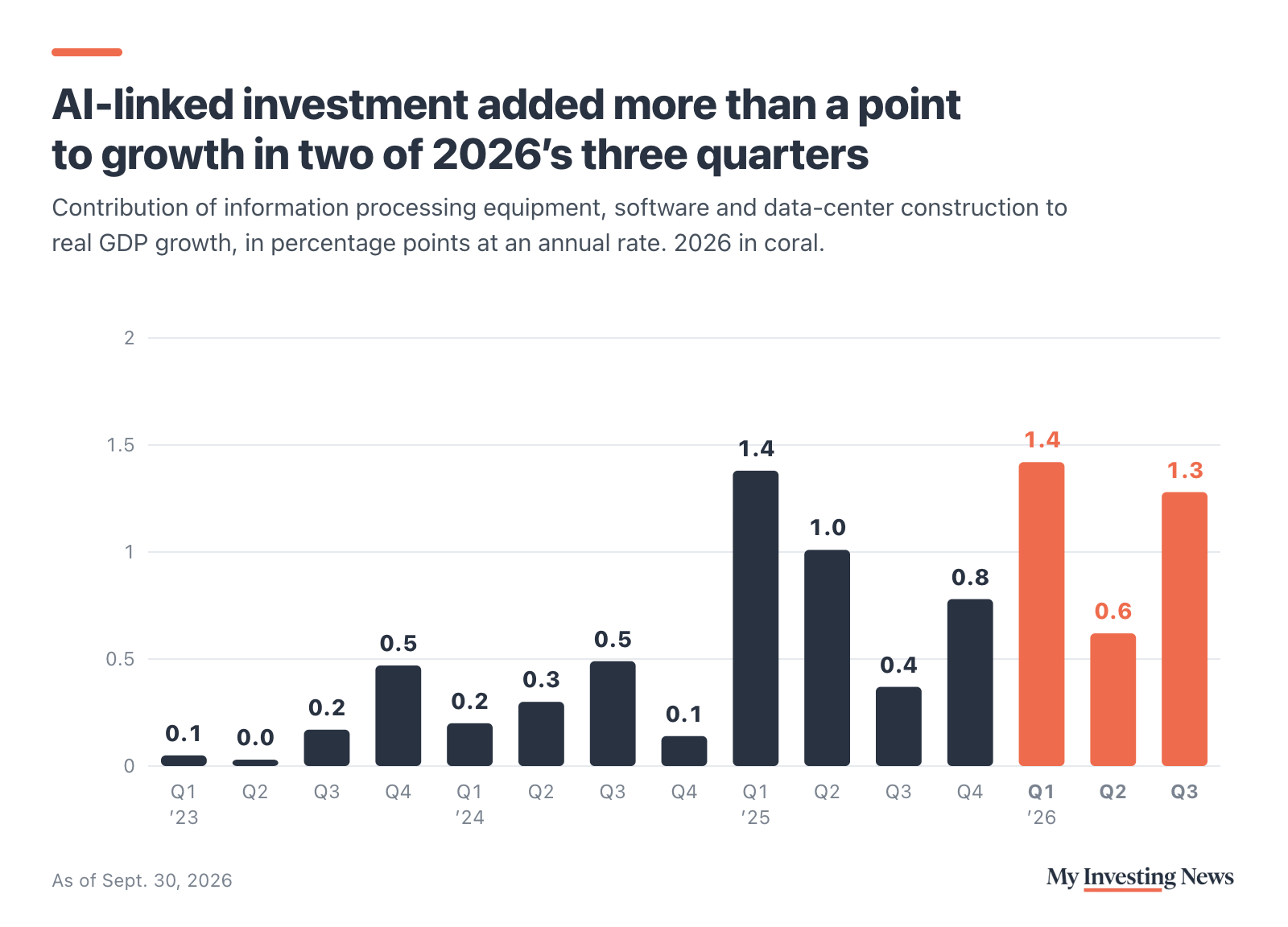
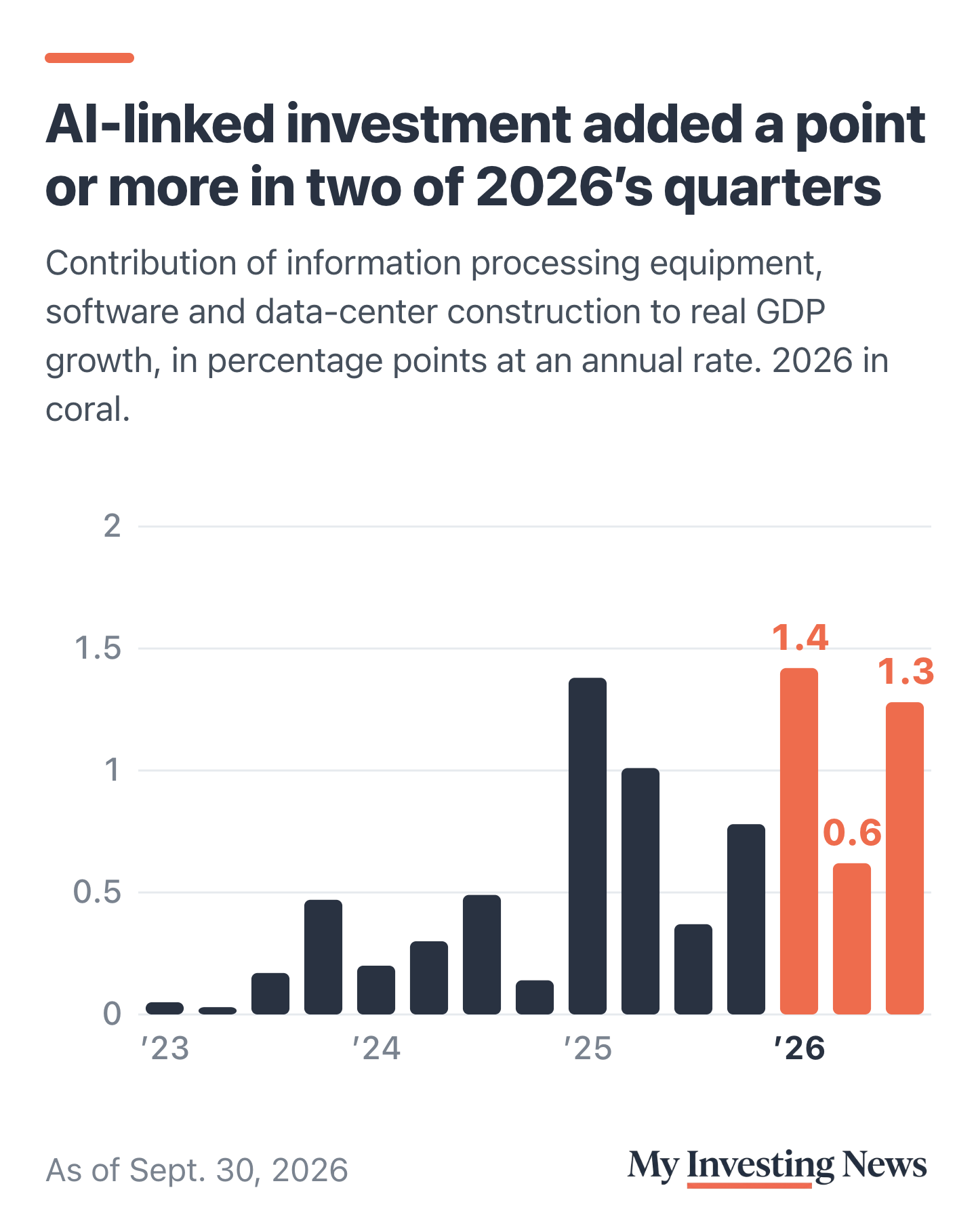
The quarterly path shows how lumpy it is. AI-linked investment added 1.4 points in the first quarter, when GDP grew 2.5%, 0.6 point in the second (2.2% growth) and 1.3 points in the third (3.4%). That swing is the binary risk Amarnath described: “It’s on or off.”
These are gross figures. Much of the hardware is imported, and imports subtract from GDP. By our estimate from BEA’s trade tables, imports of computers, peripherals and parts took away about 0.6 point a quarter on average in 2026. Not all of those machines end up in data centers, but if they all did, AI-linked investment’s net share of growth would fall to about 18%.
Paulsen’s 86%: Slow, but Faster Than 1%
Paulsen’s second number holds up less well. Over the last two years of data, from the fourth quarter of 2024 through the third quarter of 2026, real GDP grew at an average annual rate of 2.3%. Take out business equipment and intellectual property, his likely “new era” slice, and the rest of the economy grew about 1.4% a year. Take out only our narrow AI-linked lines and the rest grew about 1.5%.
That is slow, well under the pace of the whole economy, which is his point. It is also faster than the 1% he described. The gap between the two parts of the economy is real; its size depends on where you draw the line, as with the other two numbers. On the profit side, Peter Boockvar has said 70%-plus of third-quarter earnings growth is tied to AI.
What to Watch
Data-center construction is the line moving fastest. Census put private data-center spending at a $96.5 billion annual rate in September, up from $50.7 billion a year earlier, in its Nov. 2 construction report. BEA’s own data-center figure for the third quarter was $83 billion, still a small slice of GDP next to computers and software.
BEA’s second estimate of third-quarter GDP is due Nov. 25, and the third on Dec. 23, so all of these shares can shift. The bigger test is who keeps spending: Chamath Palihapitiya has argued that 1% of companies drive 90% of AI spending, and Eisman has pointed to how much of Nvidia’s business rests on a handful of customers.
All three numbers have a match in BEA’s data once you know what each speaker counted. On the narrowest measure, AI-linked investment is 5.6% of GDP and drove 41% of growth in the first three quarters of 2026, short of Eisman’s 50% unless industrial equipment or R&D is included. The risk all three describe is the same: the rest of the economy is growing slowly, so a pullback in AI spending would show up quickly.