Where we heard itAndrew Sheets, global head of fixed income research at Morgan Stanley, on the firm’s Thoughts on the Market podcast, Nov. 6, 2026. Also: Marketplace’s Morning Report, Nov. 9, and Jordi Visser on The Pomp Podcast, Nov. 7.
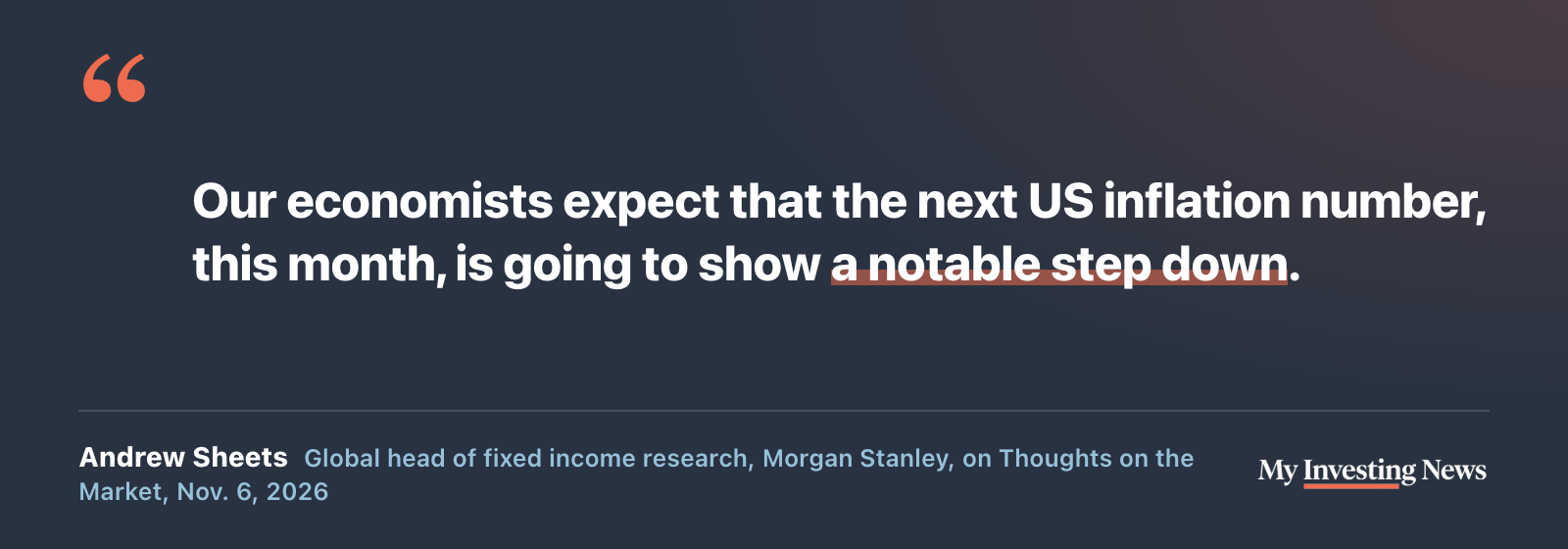
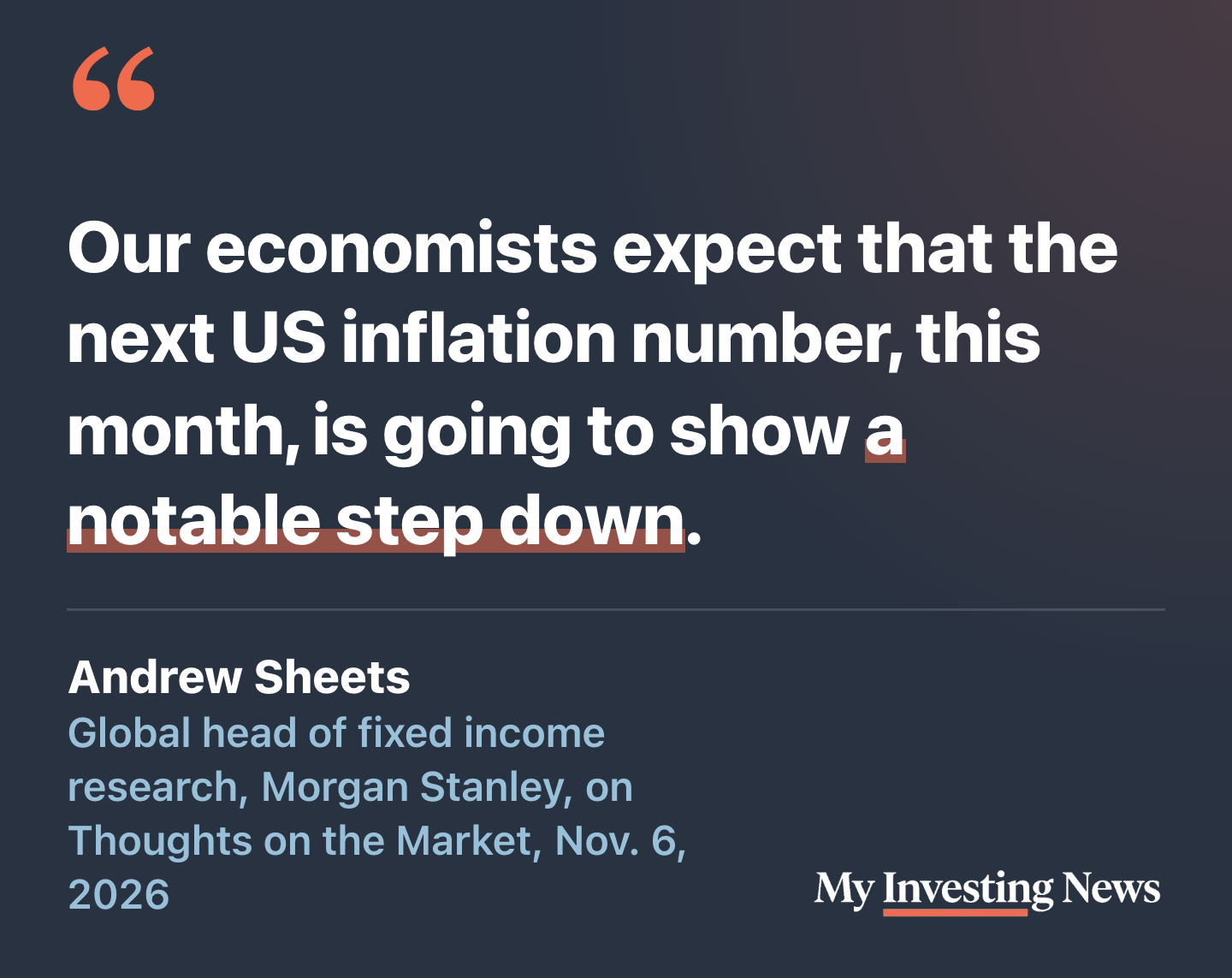
Four days before the October inflation report, Andrew Sheets, Morgan Stanley’s global head of fixed income research, told listeners of the firm’s podcast that relief was coming. He said the call came from the bank’s economists:
The report landed at 8:30 a.m. ET on Nov. 10. The consumer price index rose 0.4% in October on a seasonally adjusted basis, after 0.6% in September, the Bureau of Labor Statistics said. Prices excluding food and energy rose 0.3% for the third month in a row. We lined up every forecast we could find on the record before the release, plus the odds on a prediction market, and checked a bolder call about gas prices.
A Step Down, Just Not the One Forecast
Sheets got the direction right. Before rounding, the monthly rise slowed from 0.65% in September to 0.35% in October. The size was the problem. In a Nov. 9 preview quoted by eFXdata, Morgan Stanley’s economists said they expected core prices to “slow sharply to 0.19% m/m from 0.33% in September,” with headline prices also up 0.19% and the unadjusted index at 337.020. The index came in at 337.511. Core prices rose 0.30%, barely slower than September.
The firm had called September’s jump in housing costs “largely noise.” Shelter did cool, to a 0.3% gain from 0.4%, but not by enough to pull core inflation down with it.
The consensus missed too, by less. On Marketplace’s Nov. 9 Morning Report, Nancy Marshall-Genzer said, “Economists surveyed by Bloomberg estimate that inflation rose three-tenths percent last month.” A preview by investingLive put the consensus for core prices at 0.2%. Both readings came in a tenth of a point higher.
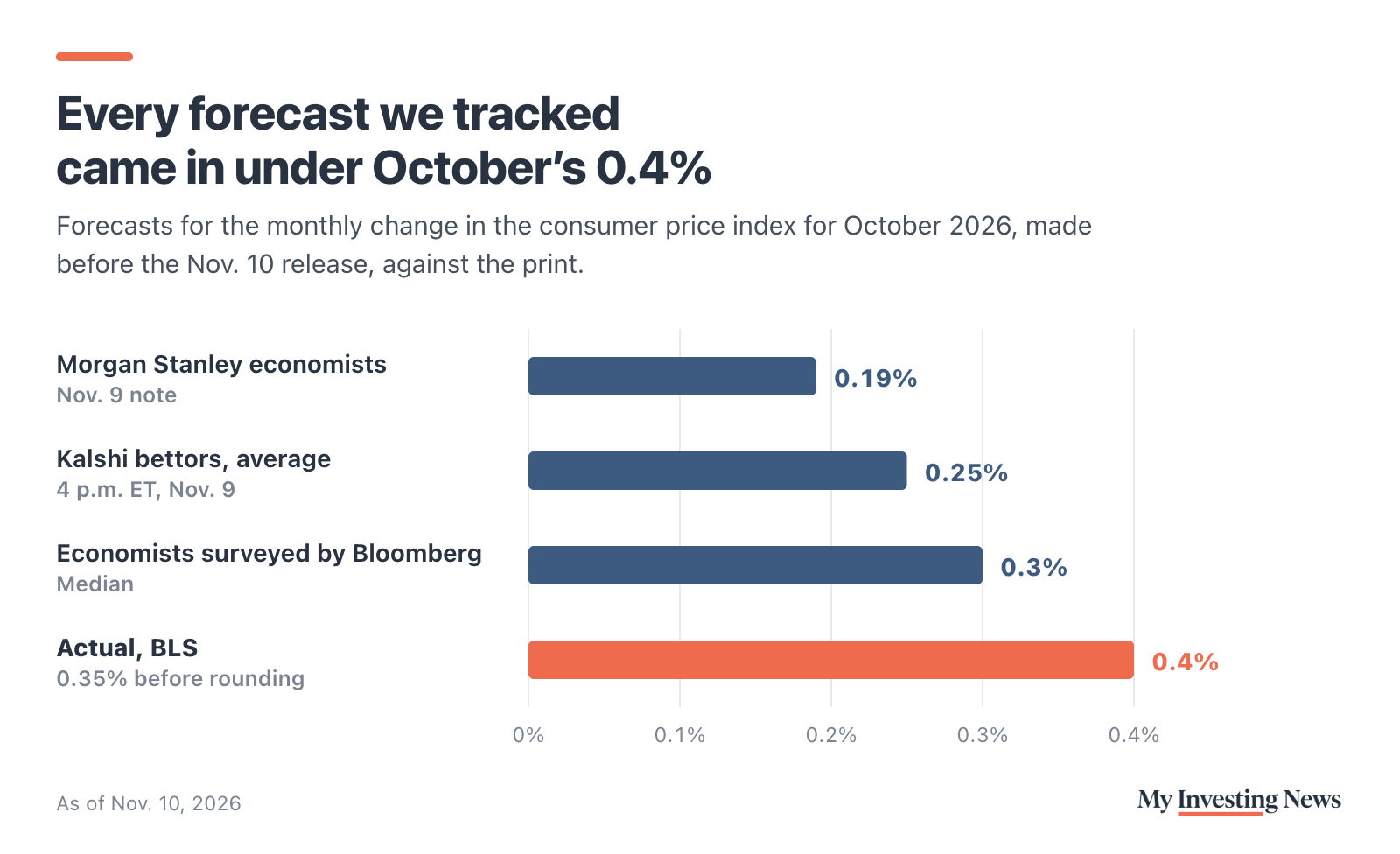
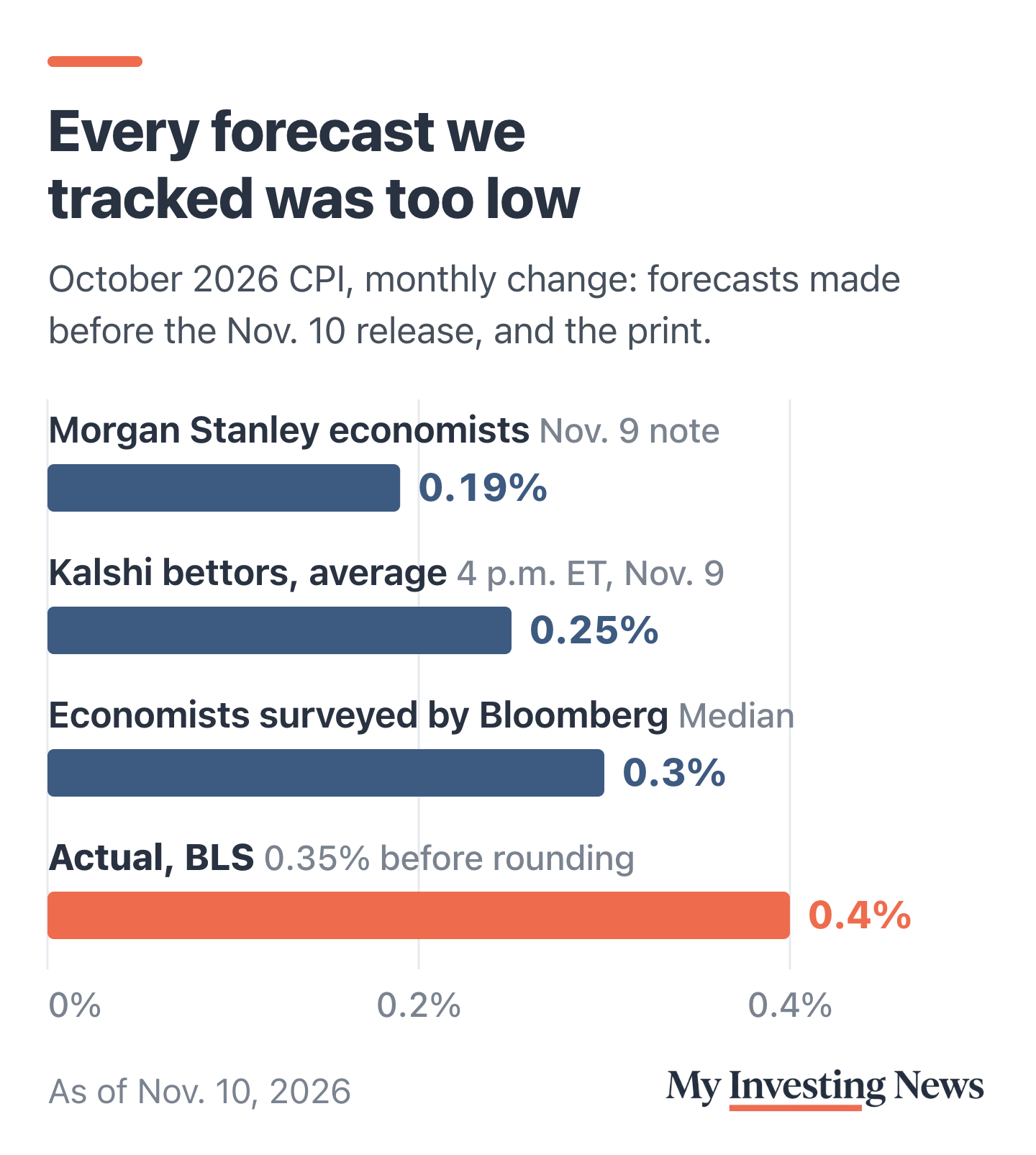
Bettors leaned low as well. On Kalshi, which lists contracts on each month’s reading, prices at 4 p.m. ET on Nov. 9 implied a 48% chance of 0.2%, 36.5% for 0.3% and 8.5% for 0.4% or more, an average of about 0.25%. The odds of 0.4% had been higher, at 17.5% on Nov. 6, the day Sheets spoke, and they climbed back to 22% by 8 a.m. on Nov. 10, half an hour before the release. Benn Steil has argued that private forecasters have long beaten the Fed. In October, the private forecasts all ran low.
The Number That Wasn’t There
Marshall-Genzer flagged the other oddity of this report the day before: “There will be no comparisons to last year.” The government shutdown stopped price collection in October 2025, so the bureau has no year-earlier index for most items and published no annual inflation rate.
The bureau does publish a method for filling a gap: take the geometric mean of the months on either side, and treat the result as unofficial. Applied to September and November 2025, it puts prices about 4.0% above a year earlier in October, up from 3.7% in September. Core prices come out 2.8% higher, from 2.6%. On that rough math, the run of inflation above 2% that Charlie Bilello counted at 67 straight months through September kept going.
A few indexes do have a year-ago value. Gasoline is one, and it shows pump prices in October 37.4% above October 2025.
October 2026 CPI at a glance
Three Months at 0.4% or More, Twice This Year
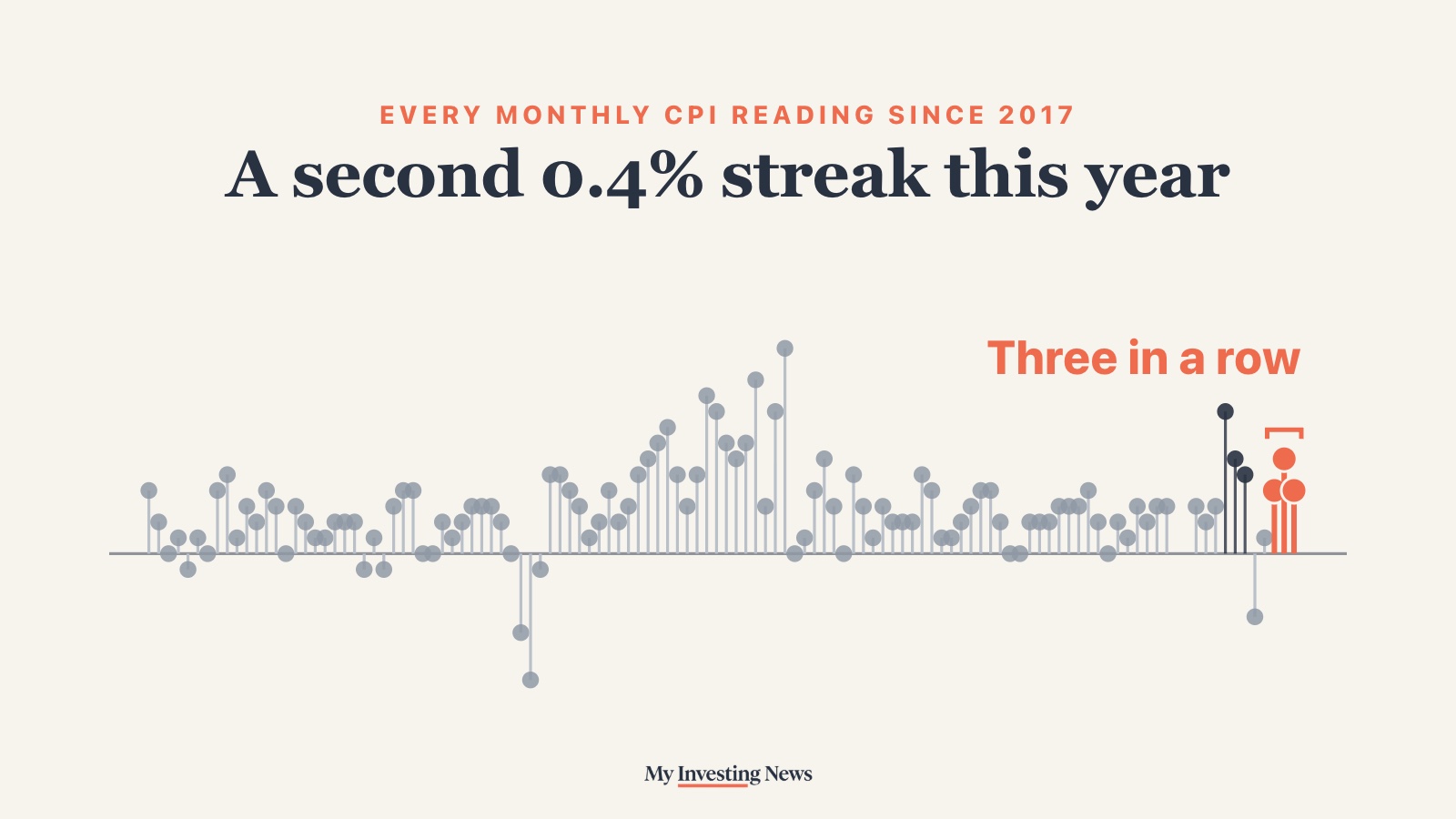
October was the third straight month at 0.4% or higher, after 0.4% in August and 0.6% in September. It was the second run like that this year: March, April and May rose 0.9%, 0.6% and 0.5%. Since 1997, the only other year with two separate runs of three months or more at that pace was 2021. Six of the first 10 months of 2026 rose 0.4% or more, the most in any year since 2022, which had 7.
Prices rose 0.4% or more for a third straight month, the second such run this year
Monthly change in the consumer price index, seasonally adjusted, for each of the 116 months published since January 2017 (October 2025 was never collected). Coral: August to October 2026. Dark: March to May 2026.
Energy drove much of the late-summer heat. Gasoline jumped 9.1% in September after adjusting for the season and rose another 1.0% in October, even though raw pump prices slipped 0.7% that month. Seasonal adjustment expects gas to get cheaper in the fall, so a small drop counts as a rise.
Jordi Visser’s Call for a Negative Print
Macro investor Jordi Visser made the boldest call. On The Pomp Podcast on Nov. 7 he said the consumer price index “will be negative for the December reading for November, most likely,” because “gas at the pump has already fallen” from $4.40 to $4.10, with gasoline futures pointing to $3.75. He called the move from $4.40 to $3.75 “pretty close to a 20% fall.”
That math runs high: $4.40 to $3.75 is a drop of 14.8%. The Energy Information Administration’s weekly survey, the latest published before the October report, had regular gas at $4.15 on Nov. 2, down 7.3% from $4.48 on Sept. 21. Gas at $3.75 would sit 13% below October’s average of $4.31. Jim Bianco pointed out in October that gas had never cost this much in the fall.
A drop that size can pull the whole index negative. It did in June, when pump prices averaged $4.05, down from $4.48 in May, the adjusted gasoline index fell 9.7% and overall prices fell 0.4%. November is harder. In every November from 2017 to 2025, seasonal adjustment made the gasoline change look higher than the raw one. In November 2023, raw gas prices in the index fell 7.3%, the adjusted figure fell 4.2%, and overall prices still rose 0.1%. In November 2018, the same 7.3% raw drop became 6% after adjustment, and overall prices fell 0.1%.
What to Watch
October’s report was the last before the Fed’s Dec. 8 to 9 meeting, and Marshall-Genzer said the central bank “is expected to raise interest rates next month.” The November report, due at 8:30 a.m. ET on Dec. 10, lands the day after that decision. It will test Visser’s call, and whether core prices, stuck at 0.3% for three months, finally show the step down Morgan Stanley expected.
October’s 0.4% rise was slower than September’s, so Sheets’ step down showed up in the headline. It came in above every forecast we tracked, from Morgan Stanley’s 0.19% to the consensus 0.3%, and core prices didn’t slow. With an unofficial annual rate near 4.0%, the next relief depends on gas falling far enough to outrun November’s seasonal adjustment.