Where we heard itAndrea De Michelis, Musa Orak, Avani Pradhan and Albert Queralto, Federal Reserve Board economists, “The Effect of Oil Prices on Core Inflation: Recent Evidence from the Advanced Economies”, FEDS Notes, Nov. 9, 2026. Cited by Fed Governor Christopher Waller in a speech in London on Nov. 10.
Central banks have long treated an oil spike as something to wait out. Gasoline and heating bills jump, headline inflation jumps with them, and core inflation, which leaves out food and energy, barely notices. A note published Nov. 9 by four Federal Reserve Board economists says that rule stopped holding after the pandemic.
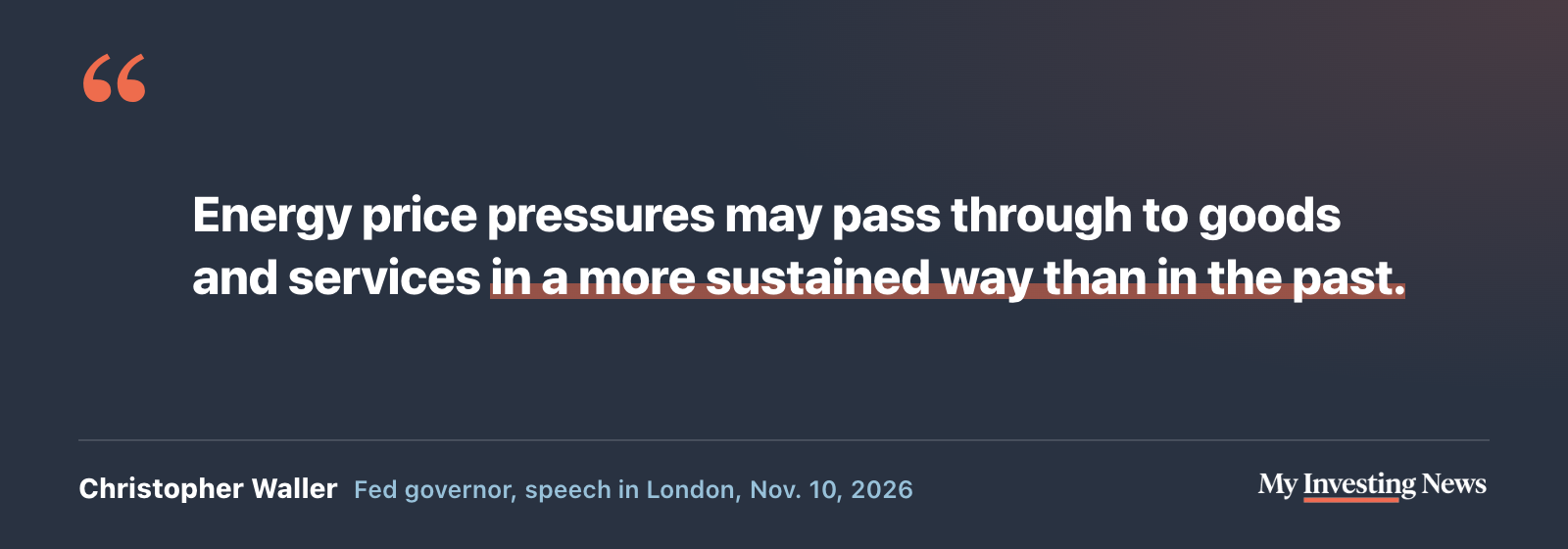
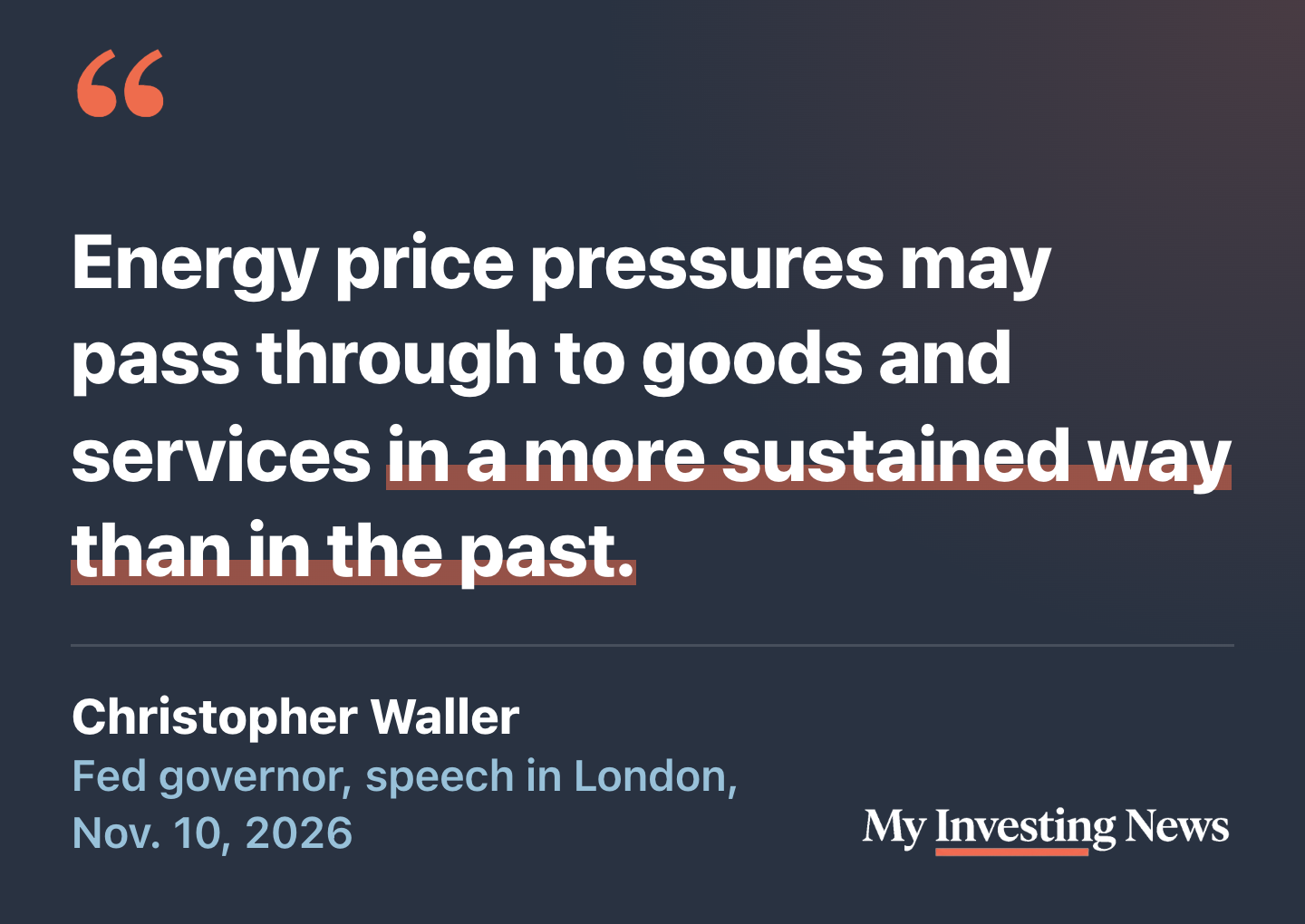
Fed Governor Christopher Waller picked it up the next morning. Speaking at a Bank of England watchers conference in London, he said the researchers find “a potential shift in the inflation process after the pandemic that suggests core inflation may be more responsive to energy shocks,” and that “this new work cautions against taking too much comfort” in the habit of looking through them. His summary of the finding:
What the Fed Researchers Found
The authors pooled data from five economies (the U.S., Canada, the euro area, Japan and the U.K.) from 2000 through mid-2026 and asked two questions: has core inflation become stickier, and does oil now leak into it? The answer to both was yes. Before the pandemic, a 10-point rise in oil-price inflation raised core inflation by about 0.01 percentage point, a number indistinguishable from zero. Since 2021, the same move adds about 0.14 point. “A channel that was effectively switched off before the pandemic became active afterwards,” they wrote. Core inflation’s persistence, how much of last quarter’s rate carries into this one, roughly doubled, to about 0.65 from 0.35.
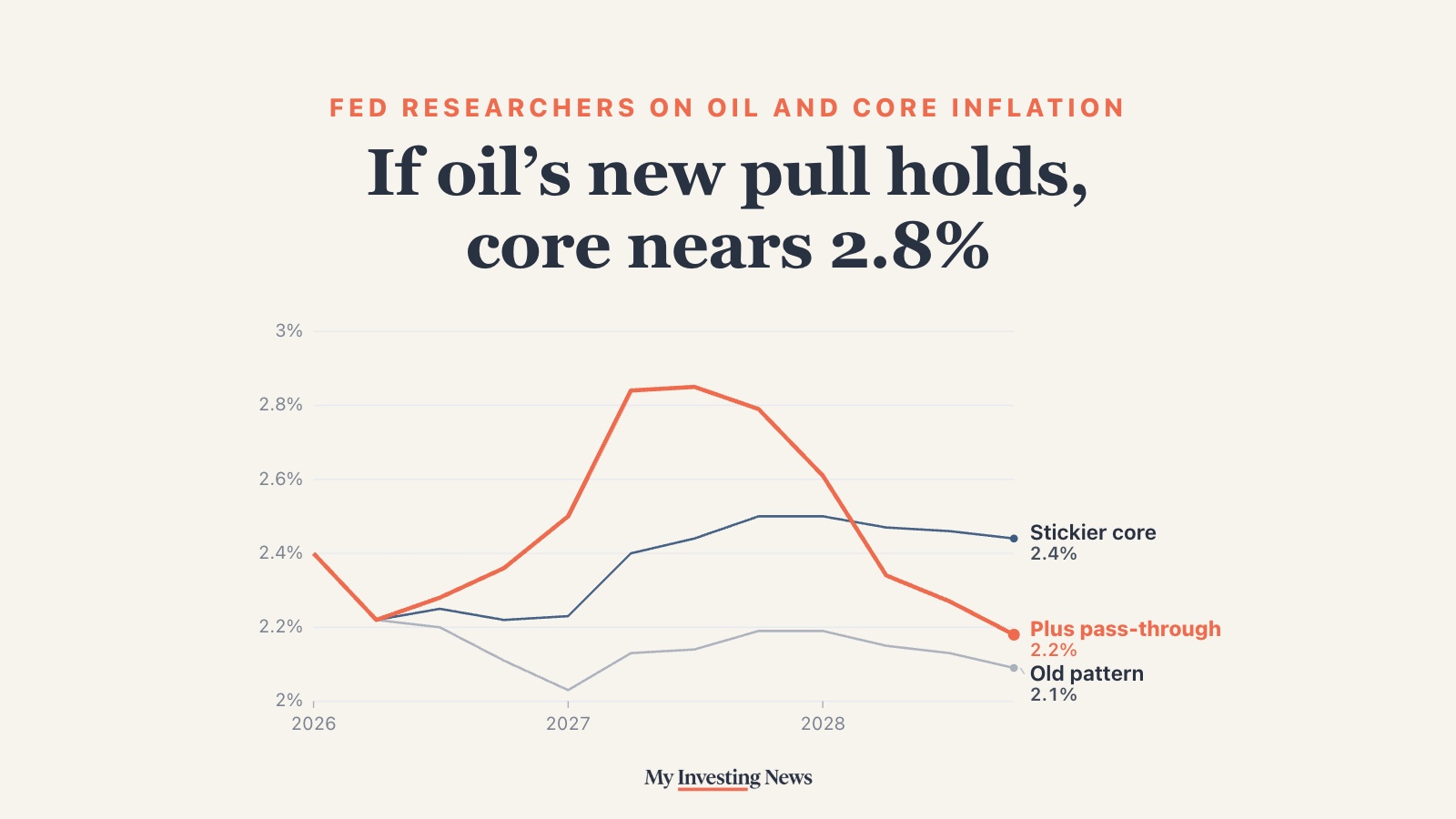
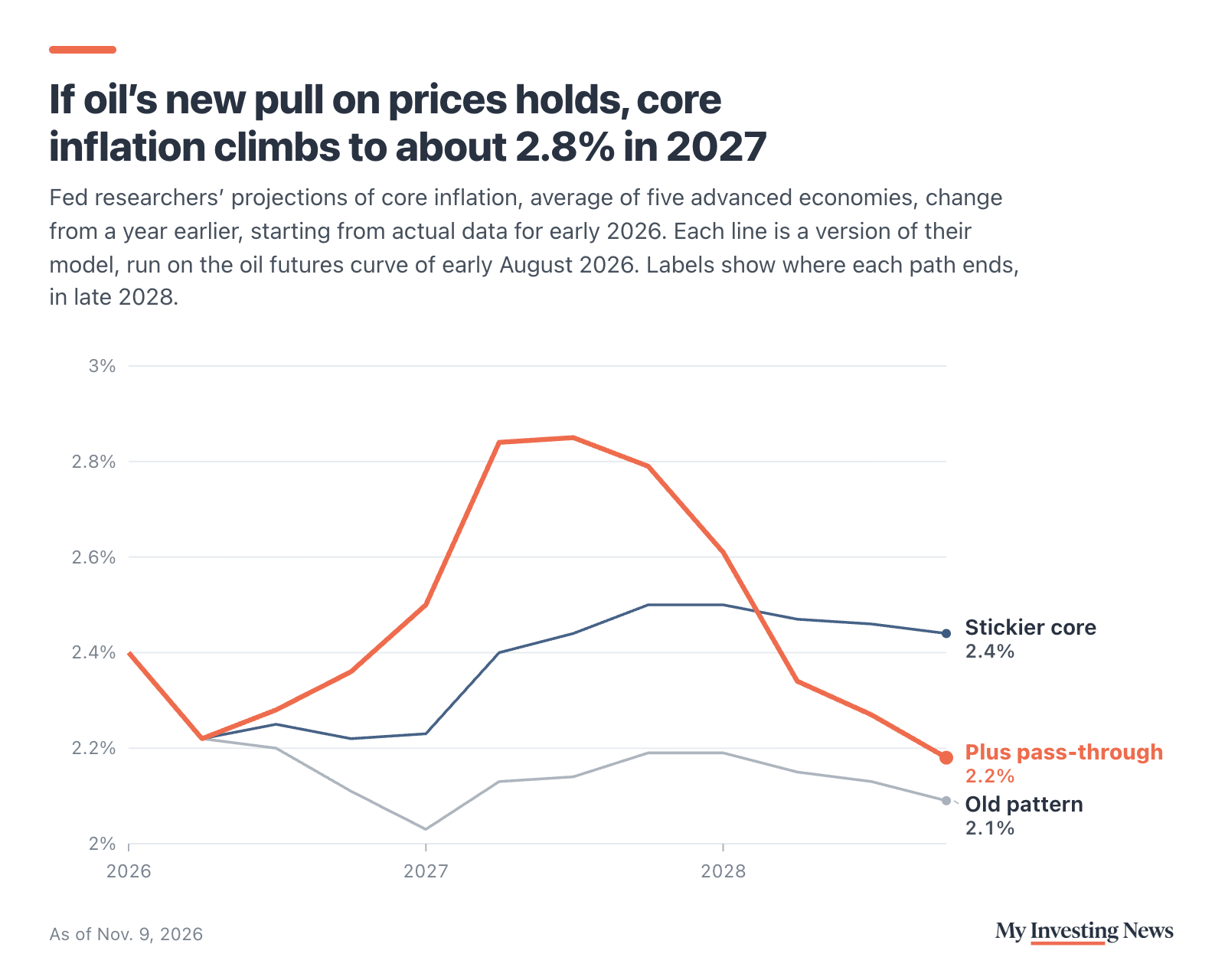
The stronger oil link holds for the U.S. In country-by-country estimates, the increase in pass-through was significant in Canada, Japan and the U.S., and weaker in the euro area and the U.K. The authors then ran their model forward on the oil futures curve. With the old pattern, core inflation peaks near 2.2%. With stickier core alone, it plateaus near 2.5%. With both changes, it climbs to about 2.8% in mid-2027 before easing.
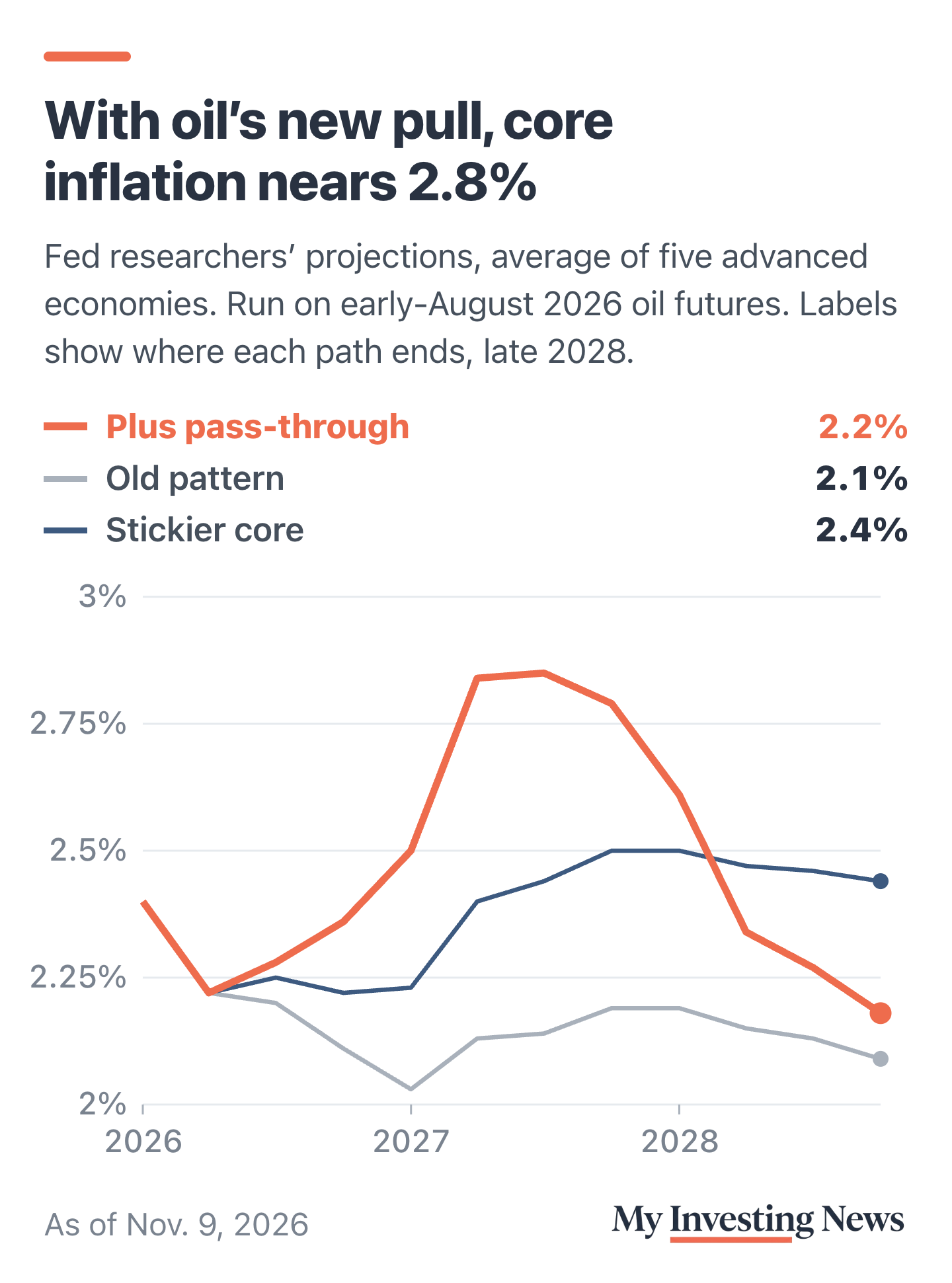
The Scenario Was Built on August Oil Prices
Those paths start from the Brent futures curve of early August, when the front-month contract settled between $79.36 and $83.77 a barrel. Oil then climbed: Brent settled at $117.64 on Oct. 30. It has since fallen 21.3%, to $92.57 at the Nov. 9 settlement, and U.S. crude (WTI) is down 16.6% to $86.85. Even so, Brent is still 52% above where it ended 2025, at $60.85, and above the level the Fed paths were built on.
Waller made the same point. Energy prices are down from their highs, he said, “they are still quite elevated relative to the start of the year, and the ultimate effect on inflation will depend on what levels are sustained.” He also argued that diesel prices won’t fall as readily as crude, because refining capacity is limited.
Oil and core inflation, by the numbers
What the Drop Is Worth, by the Note’s Own Math
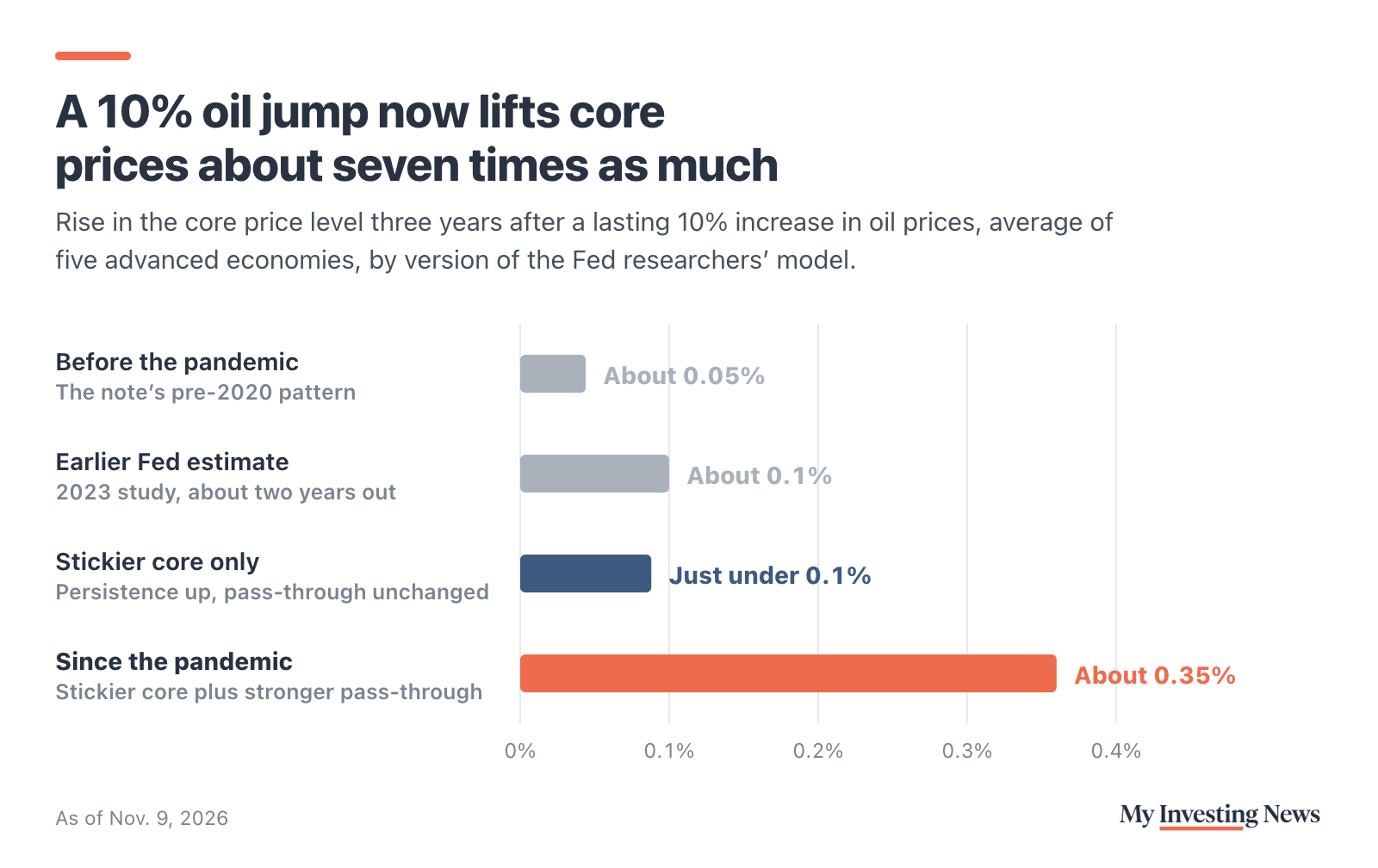
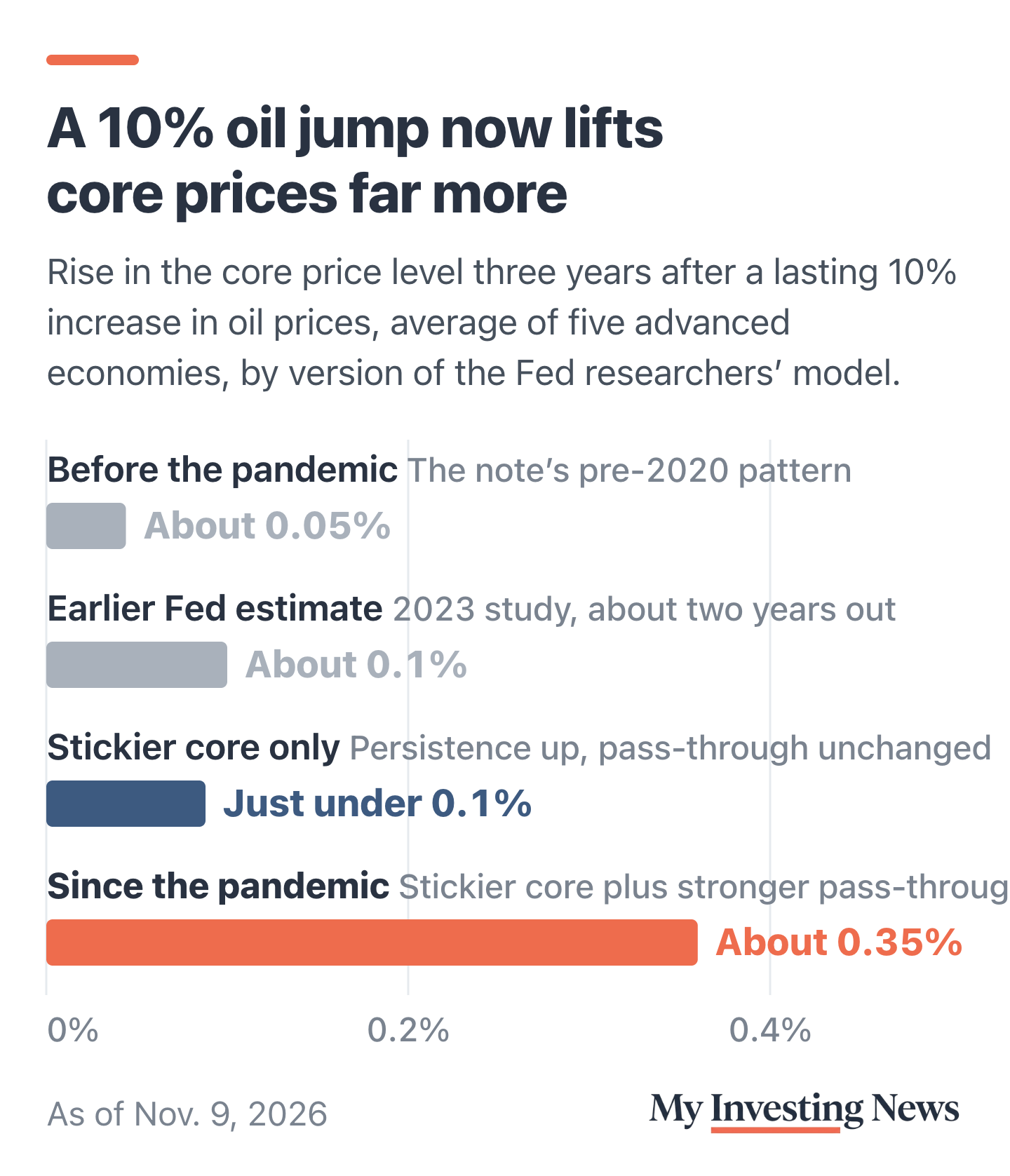
The note puts a size on it. Under the pre-pandemic pattern, a lasting 10% rise in oil lifts the core price level by about 0.05% after three years. With stickier core inflation and stronger pass-through, the figure is about 0.35%, roughly seven times as much. An earlier Fed study, using data through 2022, found about 0.1% over roughly two years.
Because the model is built on percentage changes in oil, the estimate can be scaled. By our rough arithmetic, if Brent stayed 21.3% below its Oct. 30 level, the post-pandemic pattern implies core prices about 0.9% lower after three years than otherwise, against about 0.1% under the old one. Run the same math on the year as a whole and Brent’s 52% rise since December still adds about 1.6% to core prices over three years, against about 0.2% before the pandemic. Those figures are averages for five economies, and the authors call their projections an upper bound.
The Caveats, and What to Watch
The authors are careful about what they can claim. The post-pandemic years were unusual, with reopening demand, stimulus, tight labor markets and supply-chain snarls, so the stronger link may partly reflect oil rising alongside strong demand. Their method can’t tell a lasting change in how prices are set from a run of more frequent supply shocks, and they write that second-round effects “have not yet materialized.” Stephen Miran has argued that more than a point of core inflation is temporary; this note is the case for caution.
In the U.S., core consumer prices rose 0.3% in October for the third straight month of roughly that size, a 3.75% annualized pace. Waller had said a third reading like that should put a half-point hike on the table at the Fed’s Dec. 8 to 9 meeting. After past oil spikes, headline inflation fell quickly while core came down far more slowly. Watch where Brent settles through December, diesel prices, and core goods prices in the November CPI report.
Fed researchers find that oil, once a headline-only problem, now feeds into core inflation, and Waller is treating that as a reason not to look through it. Brent’s 21.3% drop since Oct. 30 helps, but oil is still well above where the year began. The finding rests on a short, unusual stretch of data, and the authors call their paths an upper bound.