Where we heard itThoughts on the Market, Morgan Stanley’s podcast, “A Stock Market Bottom in Sight,” Nov. 9, 2026. Speaker: Mike Wilson, chief investment officer and chief U.S. equity strategist at Morgan Stanley. Podcast page
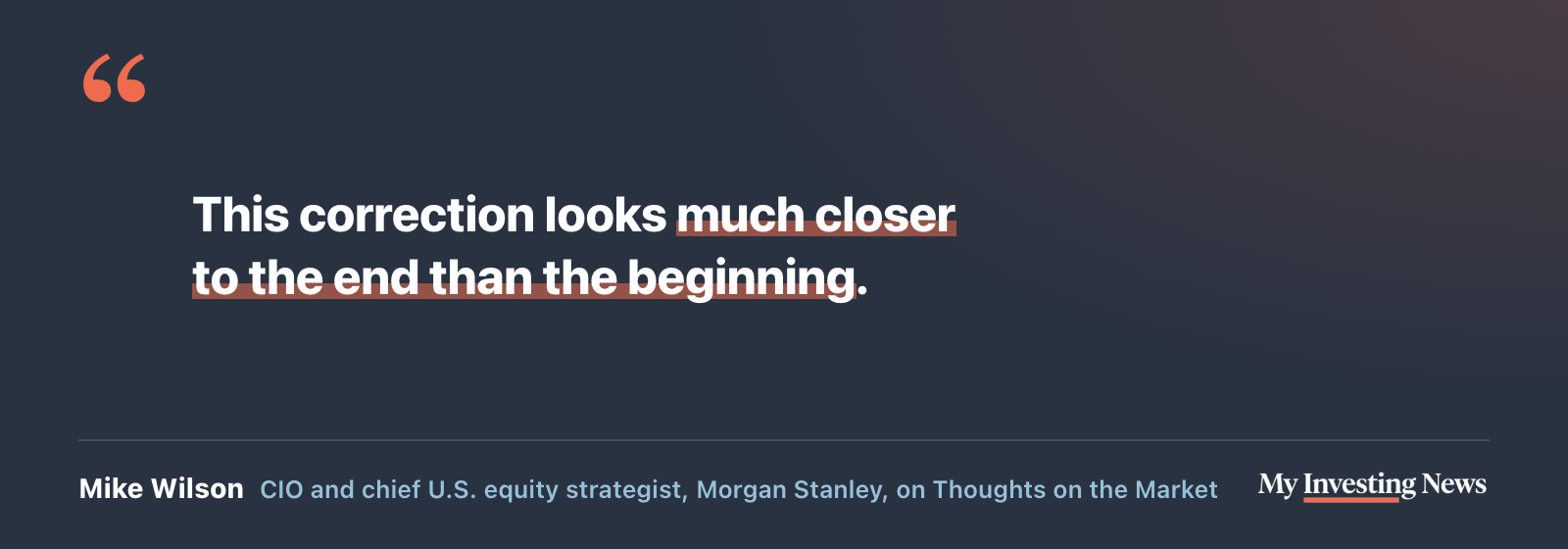
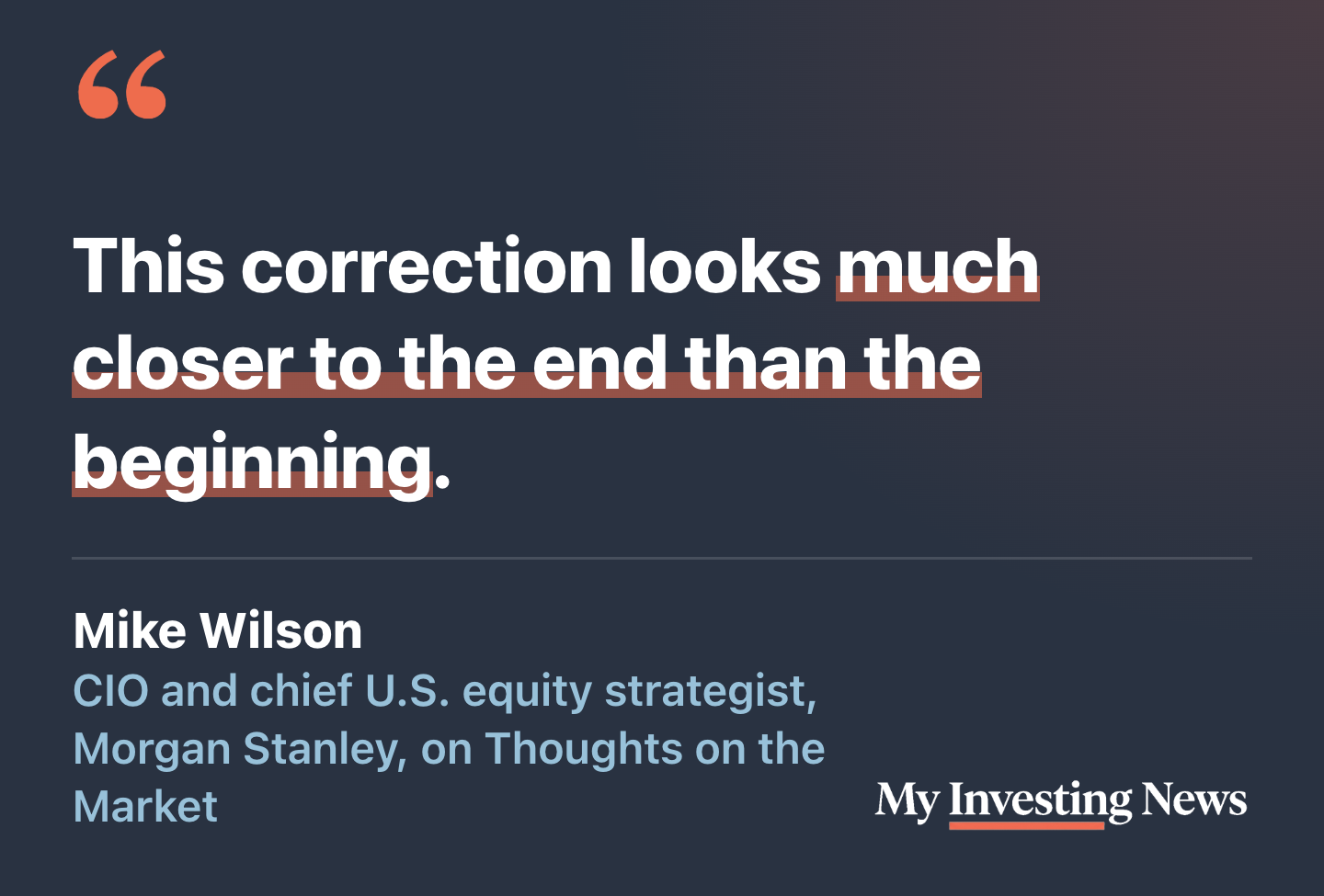
Morgan Stanley’s Mike Wilson says the stock market’s pullback is nearly done. “The good news is that this correction looks much closer to the end than the beginning,” he said on the firm’s Thoughts on the Market podcast, recorded the morning of Nov. 9.
Two weeks earlier, before the midterm vote, he told investors to be ready to buy a sharp drop around Election Day. The drop came two days after the vote. The S&P 500 fell 4.4% on Nov. 5 to 7,353.73, 5.9% below its Oct. 6 record close of 7,818.93. It rose 2.3% on Nov. 9 to 7,549.94. Wilson has made dated market calls for years, so we went back and scored them.
What Wilson Said on Nov. 9
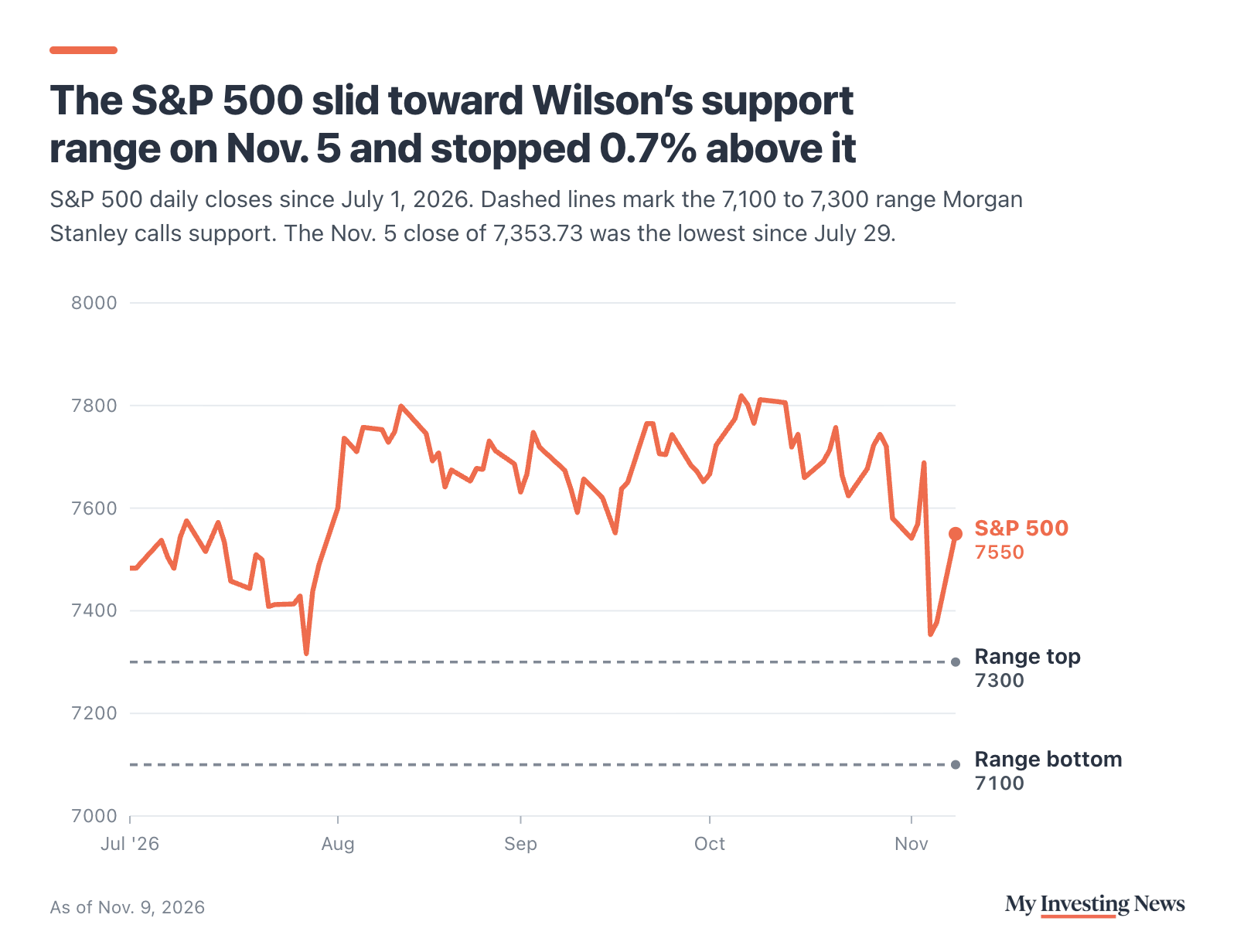
His case rests on where prices have already gone. “The S&P 500 has moved toward our 7100-to-7300 support range we identified back in August,” he said, “while semiconductors are down roughly 40% from their June highs.” He called the midterms “the rumor” and said the market “spent several months selling it.”
The Nov. 5 close sat 0.7% above the top of that range, and the day’s intraday low was 7,350.35. It was the index’s lowest close since July 29. The chip numbers hold up. The PHLX Semiconductor Index closed 38.4% below its June 22 record on Nov. 5. After a two-day bounce, it was 31.4% below that high at the Nov. 9 close. We couldn’t find the August note that set the range. On the podcast, he called 7,000 important support in late July and said in September that the index could trade near 7,100 in a worst case.
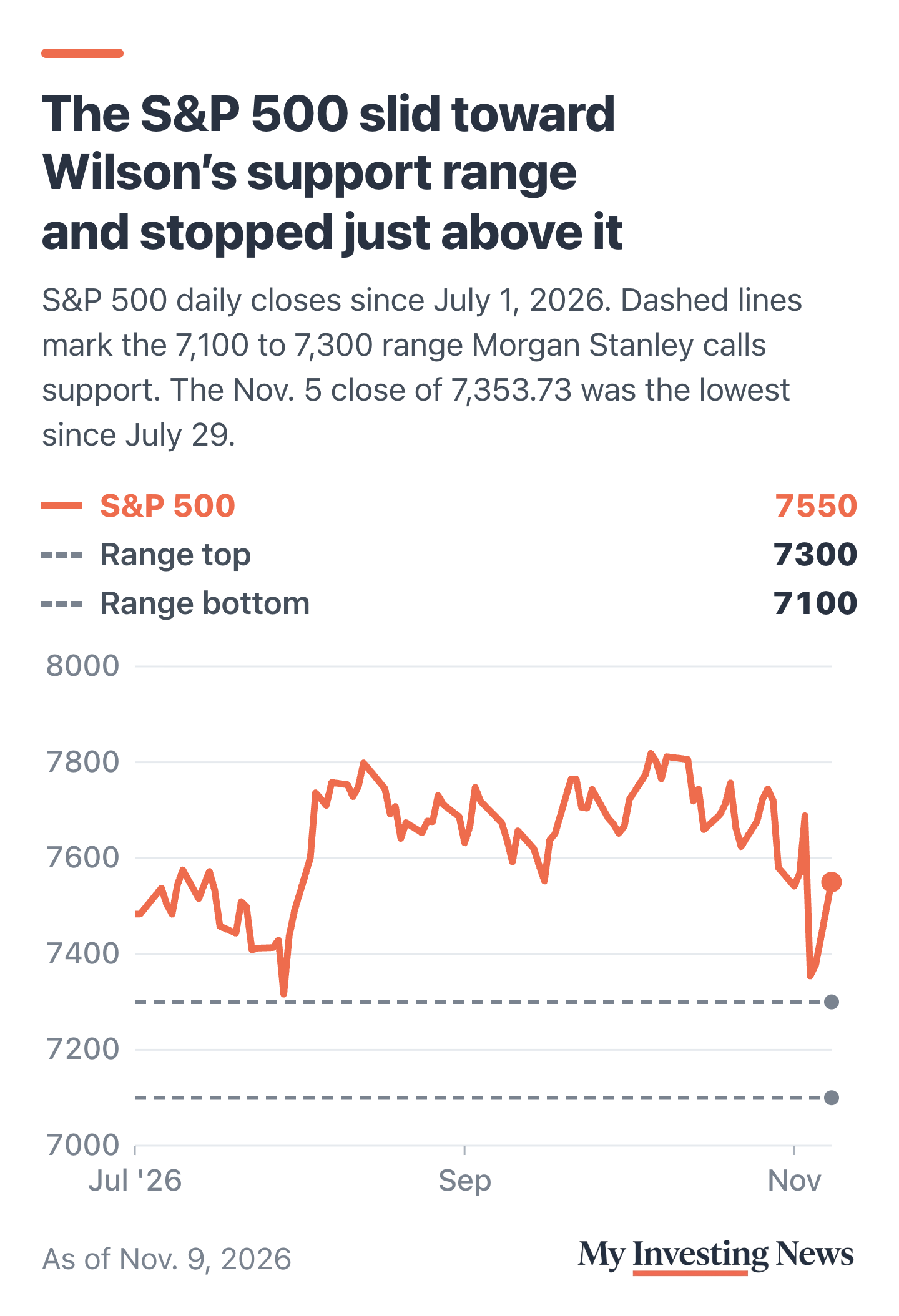
He isn’t calling the exact low. “I would not be surprised to see one more test of last week’s lows, perhaps even a break on lower momentum,” he said. “However, I would not wait for a perfect low since markets rarely send engraved invitations.” He wants to add to quality cyclical stocks, industrials in particular.
Part of his case for industrials is that “freight volumes have turned positive for the first time in nearly four years.” The Cass Freight Index backs the turn, if not the exact span. Shipments rose 2.1% from a year earlier in August and 1.9% in September, after 42 straight monthly declines. The last increase before that was in January 2023, about three and a half years earlier. Volumes are still low: September shipments were 14.4% below September 2022.
Scoring 16 Dated Calls
To test his record, we read the transcripts Morgan Stanley publishes for every episode of the podcast going back to 2022, plus a CNBC interview, and pulled every market call Wilson tied to both a level and a time frame. We added his targets for the end of each year. A level call aged well if the index closed within 2% of his number inside his window. A year-end target aged well if the year’s last close landed within 10% of it. We left out calls with no deadline and his “worst case” scenarios.
By that test, 7 of the 16 calls aged well, and the split by era is stark. Of the 9 he made from late 2021 through late 2023, when he was one of Wall Street’s best-known bears, 2 worked. Of the 7 since his November 2024 outlook, 5 have.
Wilson’s market calls, scored through the Nov. 9 close
The Bear Years
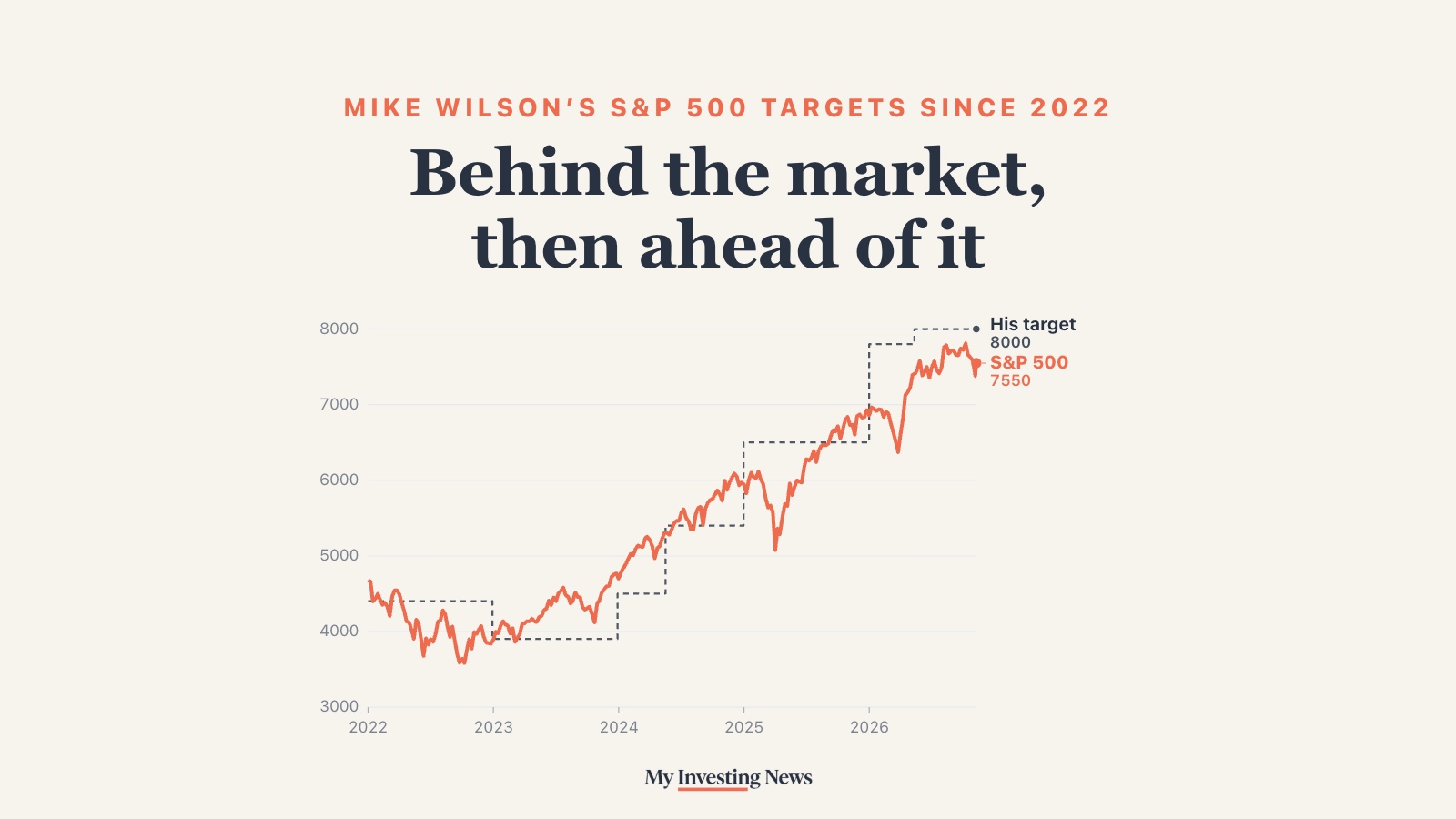
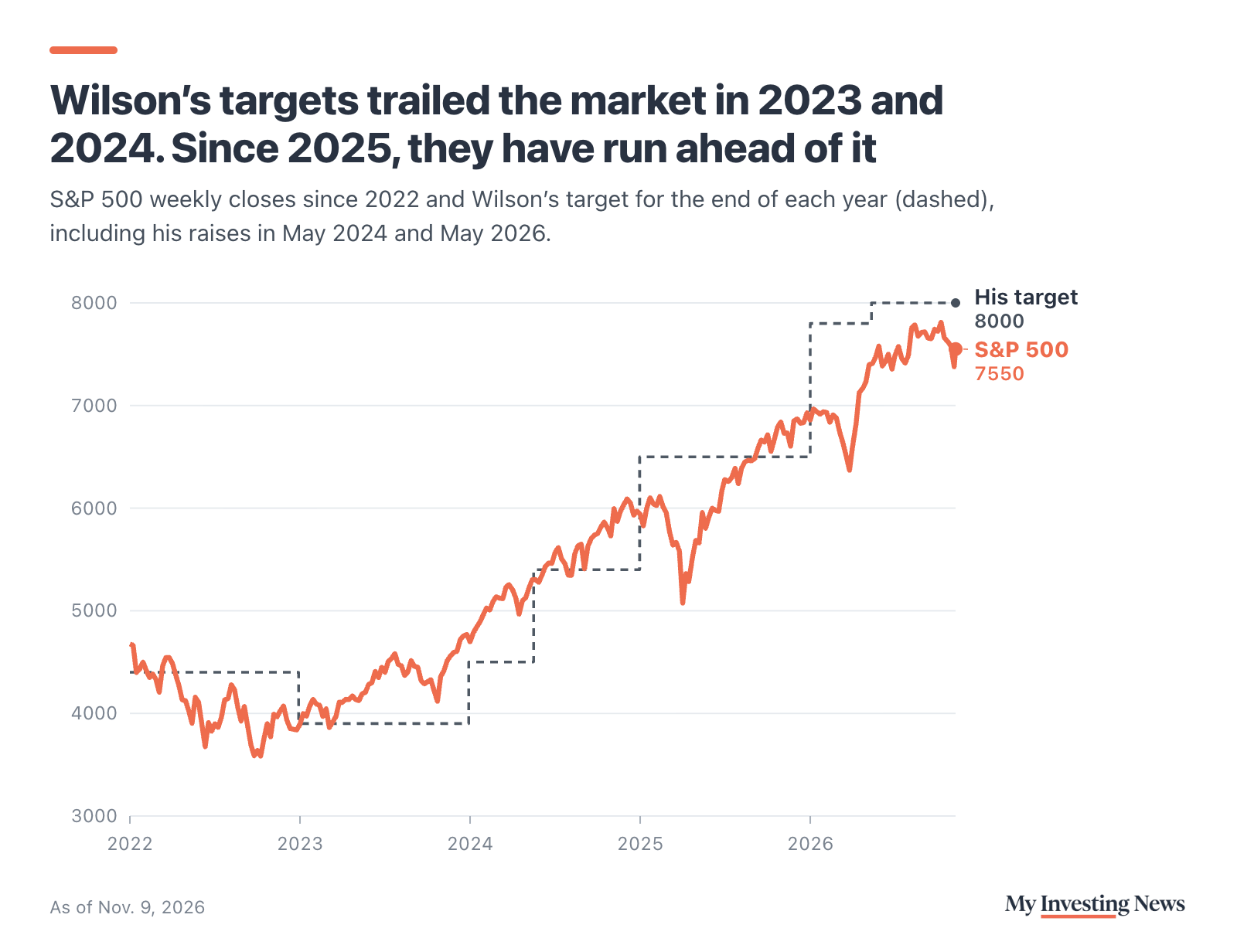
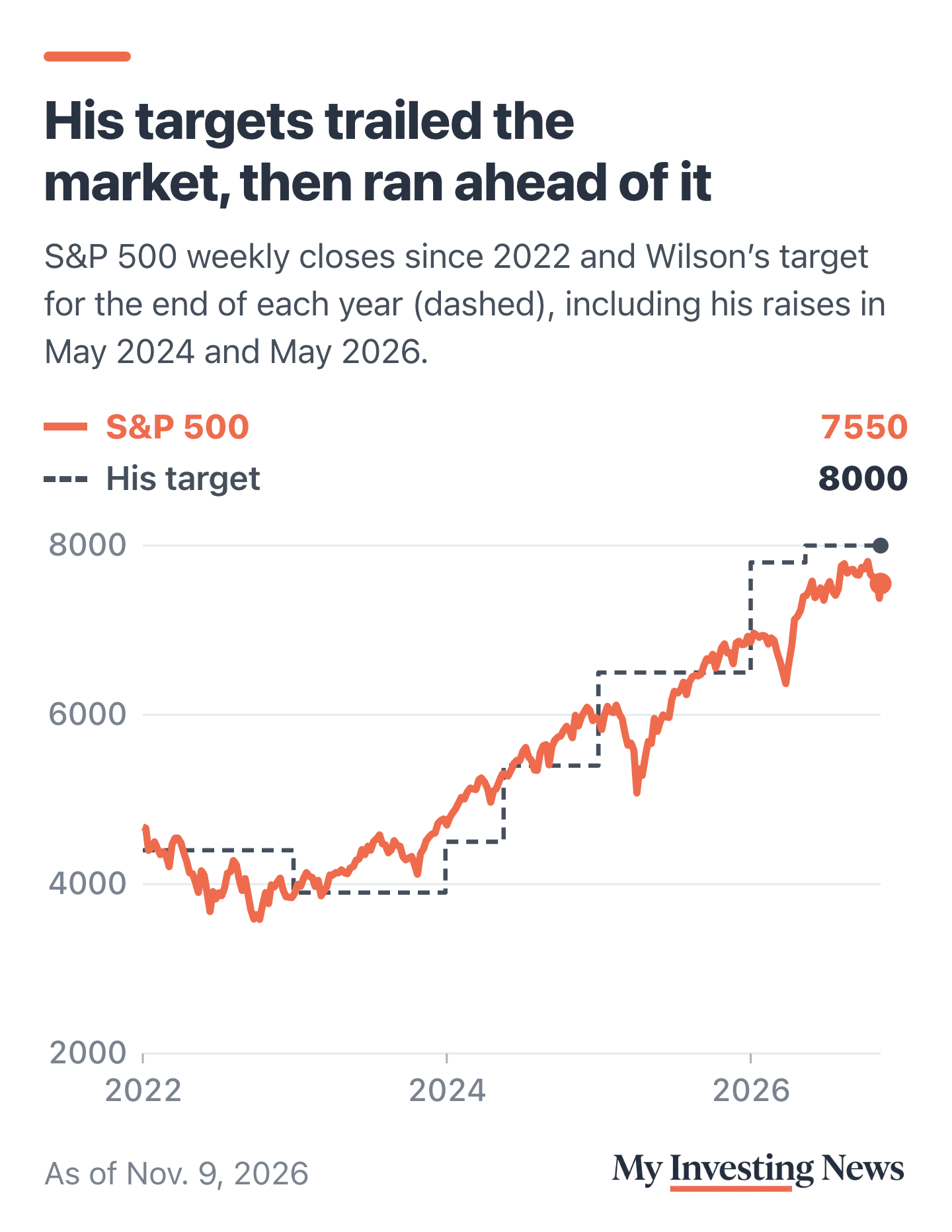
Wilson’s 2022 forecast, set in November 2021, put the S&P 500 at 4,400 by year-end, below where it traded. He was right about the direction, but the index fell further, ending the year at 3,839.50, 12.7% below his target, so it misses our 10% test. His October 2022 calls were his best: he said stocks would defend about 3,600, and the index held at 3,577.03 on Oct. 12, then rallied to 4,080.11 by Nov. 30, past the 4,000 he called “a good guess.”
After that he stayed bearish too long. He told CNBC in November 2022 to expect the S&P 500 between 3,000 and 3,300 “some time in probably the first four months” of 2023. Its lowest close in that stretch was 3,808.10. The index ended 2023 22.3% above his 3,900 target and ended 2024 30.7% above his starting 4,500 target. He raised that one to 5,400 in May 2024, still well short of the year’s close.
The Turn
His record since his November 2024 outlook is much better. The S&P 500 ended 2025 at 6,845.50, 5.3% above his 6,500 target. His 12-month target of 7,800 from November 2025 was reached on Oct. 6. In March 2026, he said the S&P 500 could trade toward 6,300 by early April; it closed at 6,343.72 on March 30, still the low of the year.
Both misses in that stretch were near-term calls. In February 2025, he expected 5,500 to 6,100 for three to six months, and the index broke below that in early April. In July 2026, he said not to be surprised by a drop to 7,000 within a month. The low close was 7,316.15 on July 29. His latest scored call was on chips: on Oct. 26, he saw the semiconductor index falling another 10% to 15% by mid-November, and it fell 18.7% by Nov. 5.
What to Watch
His current words have a recent match. On March 16, he said “we are closer to the end of this correction rather than the beginning.” The S&P 500 then fell another 5.3% before bottoming on March 30, and it went on to gain 23.3% to its October record. The same 5.3% drop from the Nov. 9 close would take the index to about 7,150, inside his support range.
The range itself is the first test: a close below 7,100 would break his support. His year-end target of 8,000 needs a 6.0% gain from the Nov. 9 close, and his 12-month target is 8,300 by mid-2027. He also said a more hawkish Fed “could stretch the bottoming process into December.” Carson Group’s Ryan Detrick said in October that he still expected record highs by year-end.
Wilson leans on the calendar, too. “Remember, markets tend to trade poorly into midterms and much better afterward,” he said. The S&P 500 has been higher a year after every midterm since 1950.
Wilson says the correction is nearly over and wants to buy weakness rather than wait for a perfect low. His record is mixed, 7 of 16 dated calls by our count, but his calls since his November 2024 outlook have mostly held up. The risk is the retest he expects himself: in March, the low came 5.3% below where the index stood when he said the end was closer.