Where we heard itCNBC’s Closing Bell, Oct. 16 and Oct. 22, 2026: Tom Lee, head of research at Fundstrat. Watch the Oct. 22 segment
Fundstrat’s Tom Lee has spent the past two weeks telling investors he is buying the AI selloff. His template is Cisco SystemsCSCO in the 1990s. His reasoning deserves a close look now. Chip stocks fell harder after his first remarks before bouncing back, and the largest cloud spenders report results within days. We also checked his template against Cisco’s full price record, including the part of the story that came after the 1990s.
Lee’s Case, Call by Call
On CNBC’s Closing Bell on Friday, Oct. 16, as stocks sold off, Lee called the drop a buying setup. He named memory chips, semiconductors, AI cloud providers, tech broadly and crypto. He acknowledged that AI debt markets “may not be that confident” and argued that the drivers of AI remain intact. He made a similar call on bitcoin earlier this month, when he said Oct. 6 was the crypto cycle bottom.
Dow Jones reported that in a video bulletin to clients late on Oct. 19, Lee called the drop panic about AI. He pointed to Korea’s KOSPI falling below its July lows and to talk of an AI debt problem, and he described the decline as a normal correction.
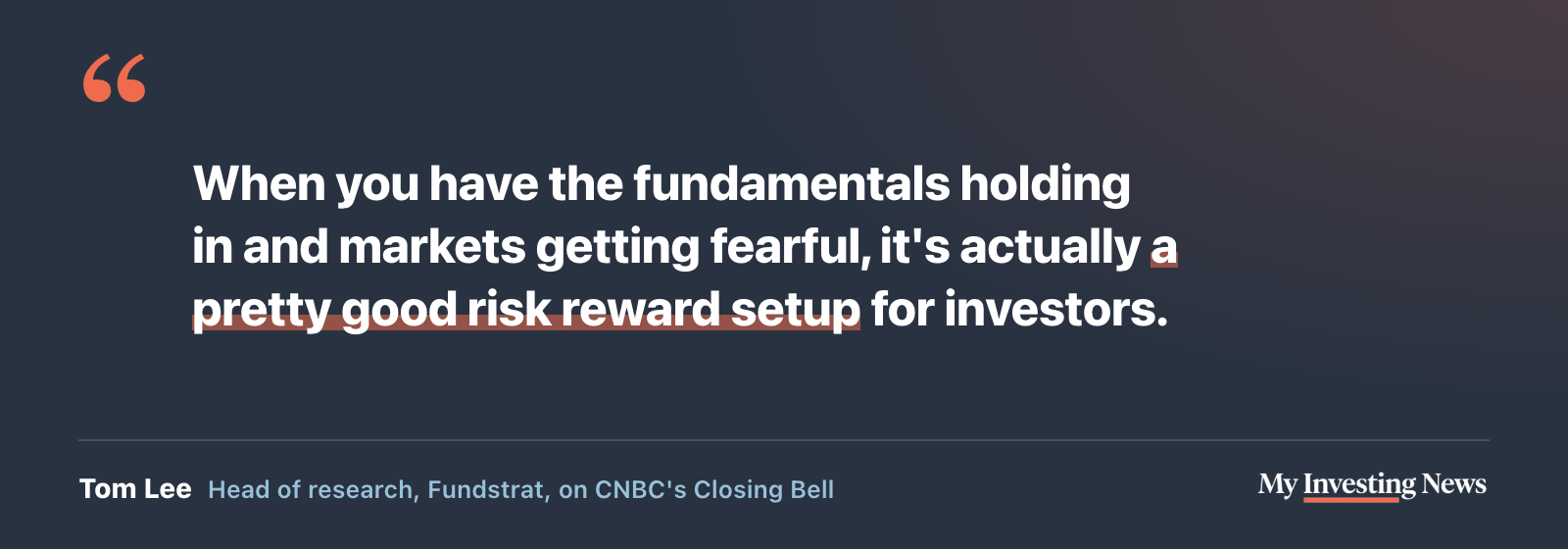
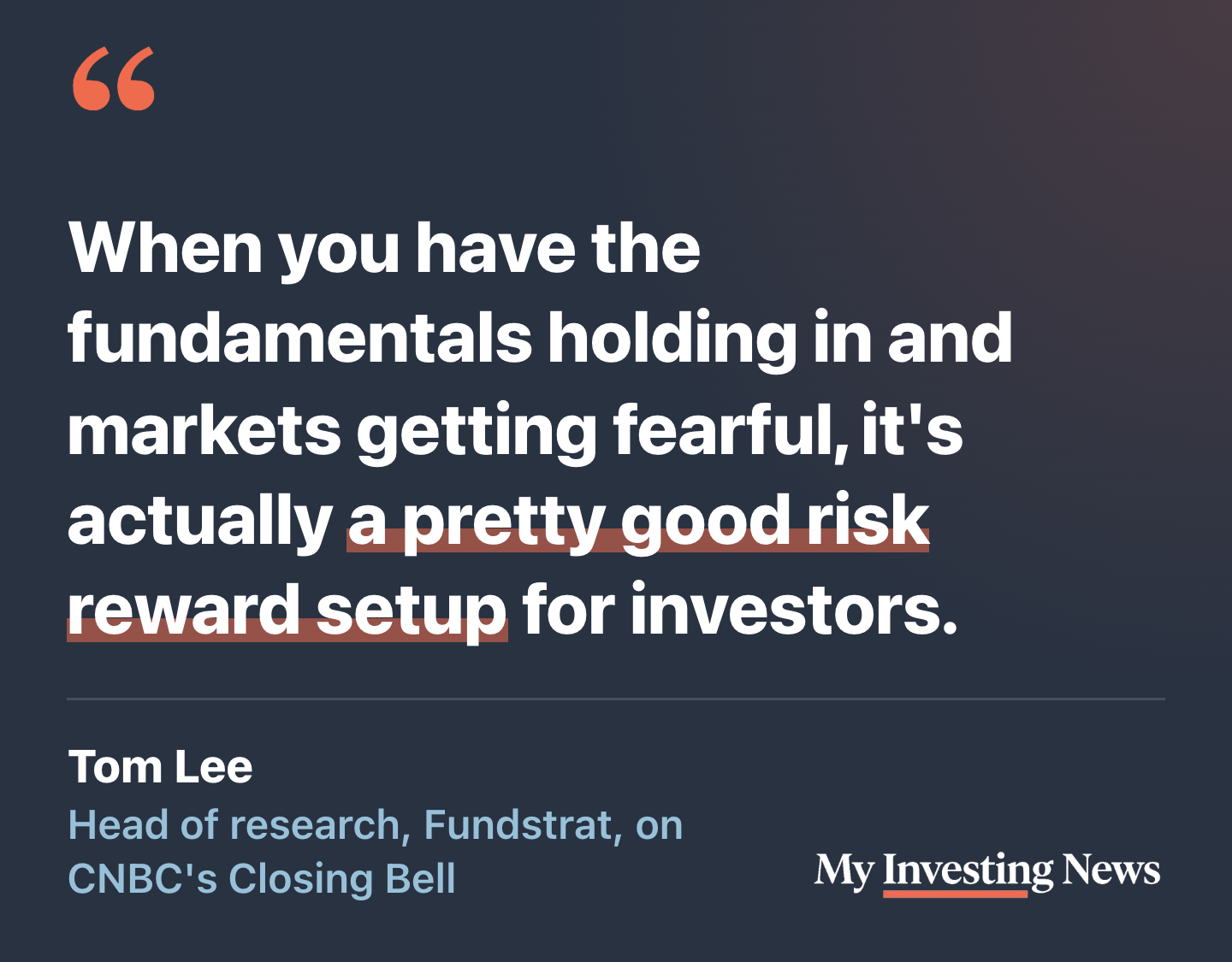
Back on Closing Bell on Oct. 22, Lee said “we’re near the end stages of the sell-off because it’s become a consensus short” to be shorting tech. He argued that debt-market scrutiny is healthy because it keeps AI from turning into a runaway speculative boom, and that AI is a bigger infrastructure build than mobile was, at about the same cost. He cited a Fundstrat estimate of $30 trillion in AI spending over the next 25 years. He also said the Fed was “flipping potentially dovish” and that rates, “which were touching five, people fearing 6%, are now back below 5%.” The 10-year Treasury yield was 4.96% that day and 5.00% on Oct. 23. It was 4.99% on Oct. 27.
Cisco Template Lee Keeps Citing
In Lee’s account, as reported by Dow Jones, Cisco traded around 80 cents in the early 1990s and reached a split-adjusted $9 by early 1997. It fell to $5 later that year and was back at $18 about a year after that low. It dropped again in 1998, then reached $80 by 2000. On CNBC on Oct. 22 he gave the short version: in 1997 Cisco “had a 50% correction, went down to five, a year later was 18,” and “the setup is similar.” It is a historical analogy and gives no guarantee about today’s AI stocks.
What Cisco’s Record Actually Shows
Cisco’s own price history backs the direction of that story, with smaller numbers. On Yahoo’s split-adjusted closes, the stock fell 38.1% from $8.32 on Jan. 21, 1997, to $5.15 on April 25, 1997. A year later it was near $12, up 133% from the low. It first closed above $18 on Nov. 18, 1998, about 19 months after the low.
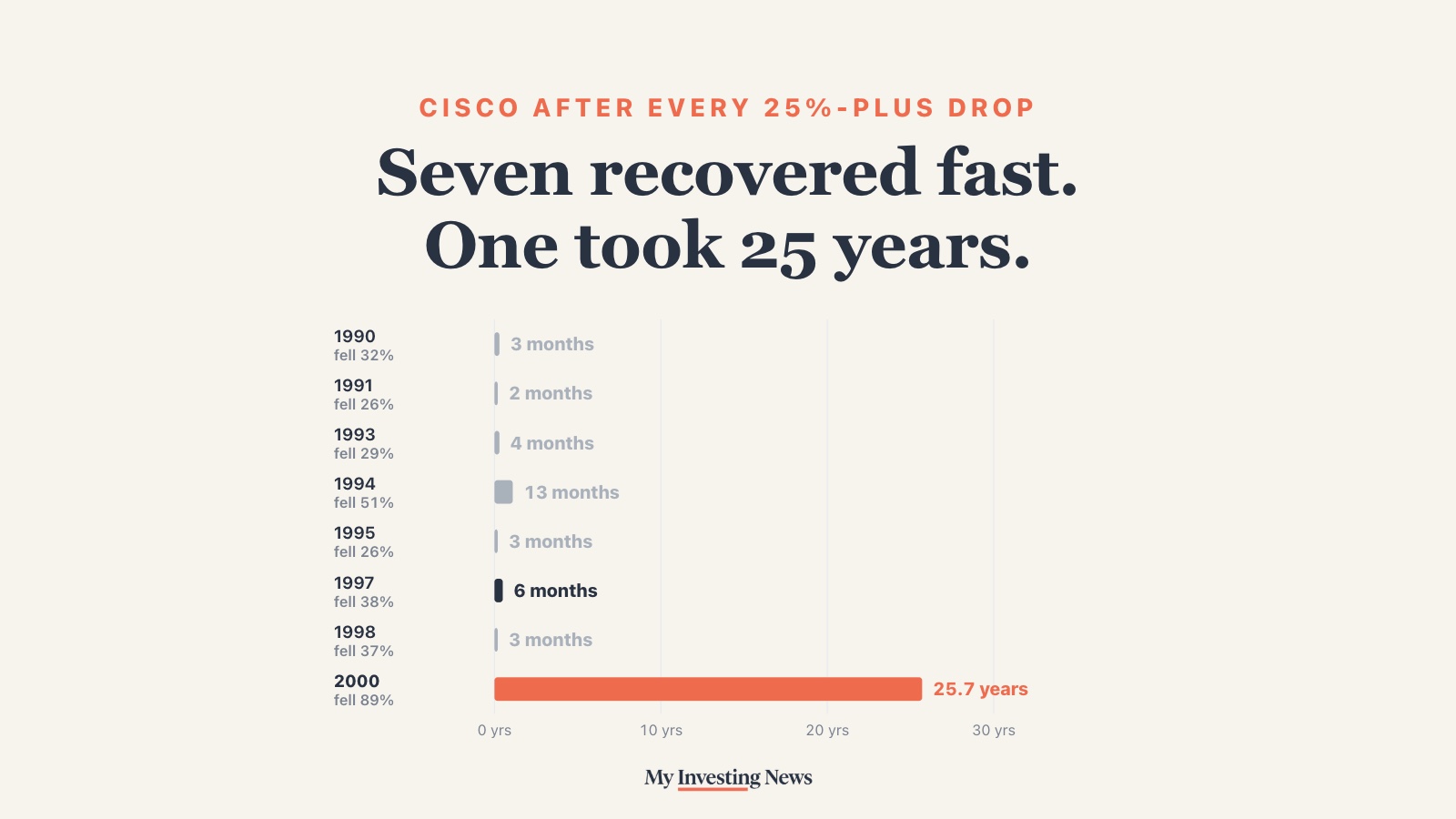
The bigger test is what happened when the run ended. Cisco has fallen 25% or more from a record close eight times since its 1990 listing. The first seven drops, including the ones in 1997 and 1998, were erased within 14 months. The eighth began at the $80.06 close on March 27, 2000. Cisco fell 89.3% to $8.60 by Oct. 8, 2002, and did not close above its 2000 record again until Dec. 10, 2025, 25.7 years later. With dividends reinvested, the wait ended in August 2021. Cisco closed at $111.38 on Oct. 27.
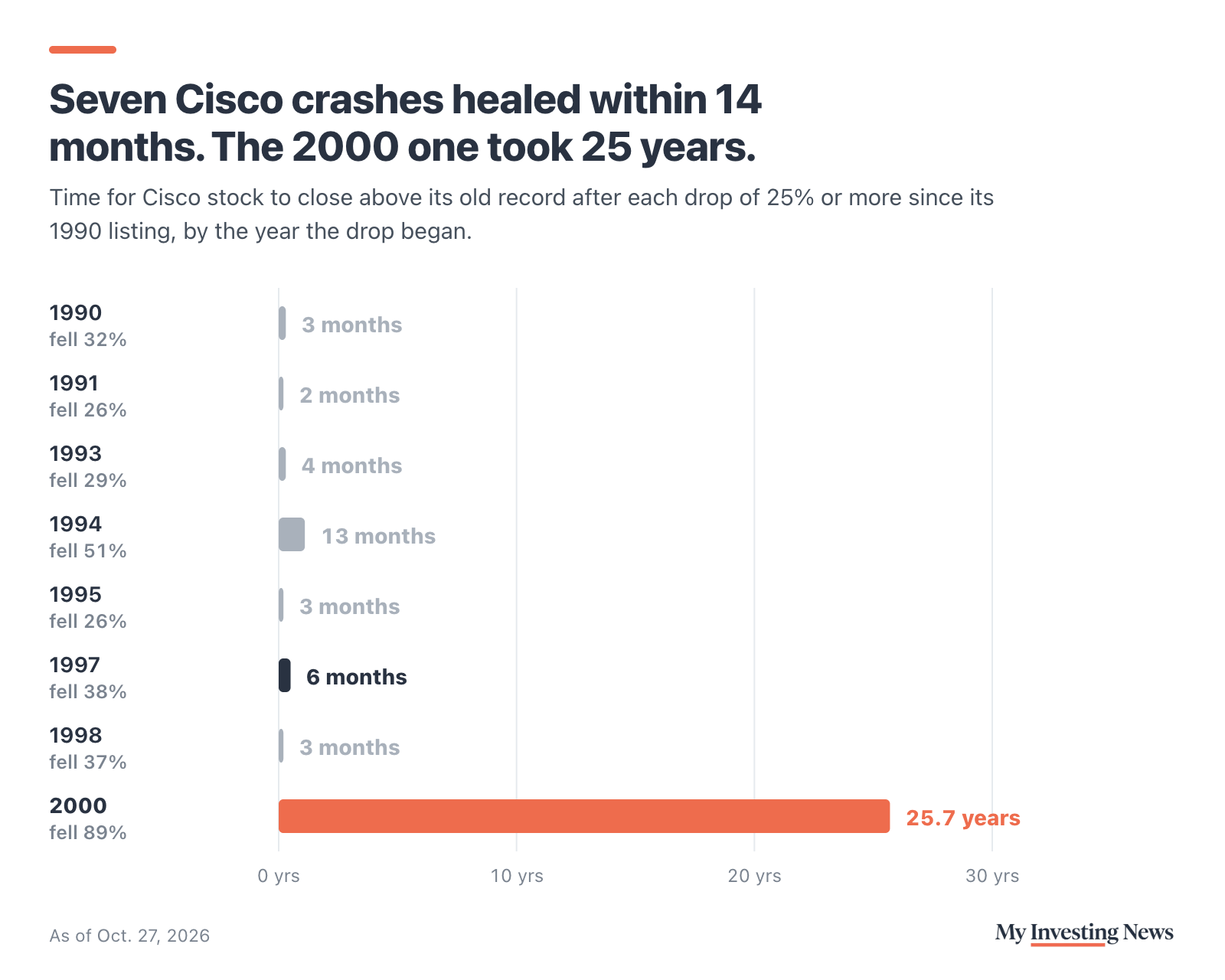
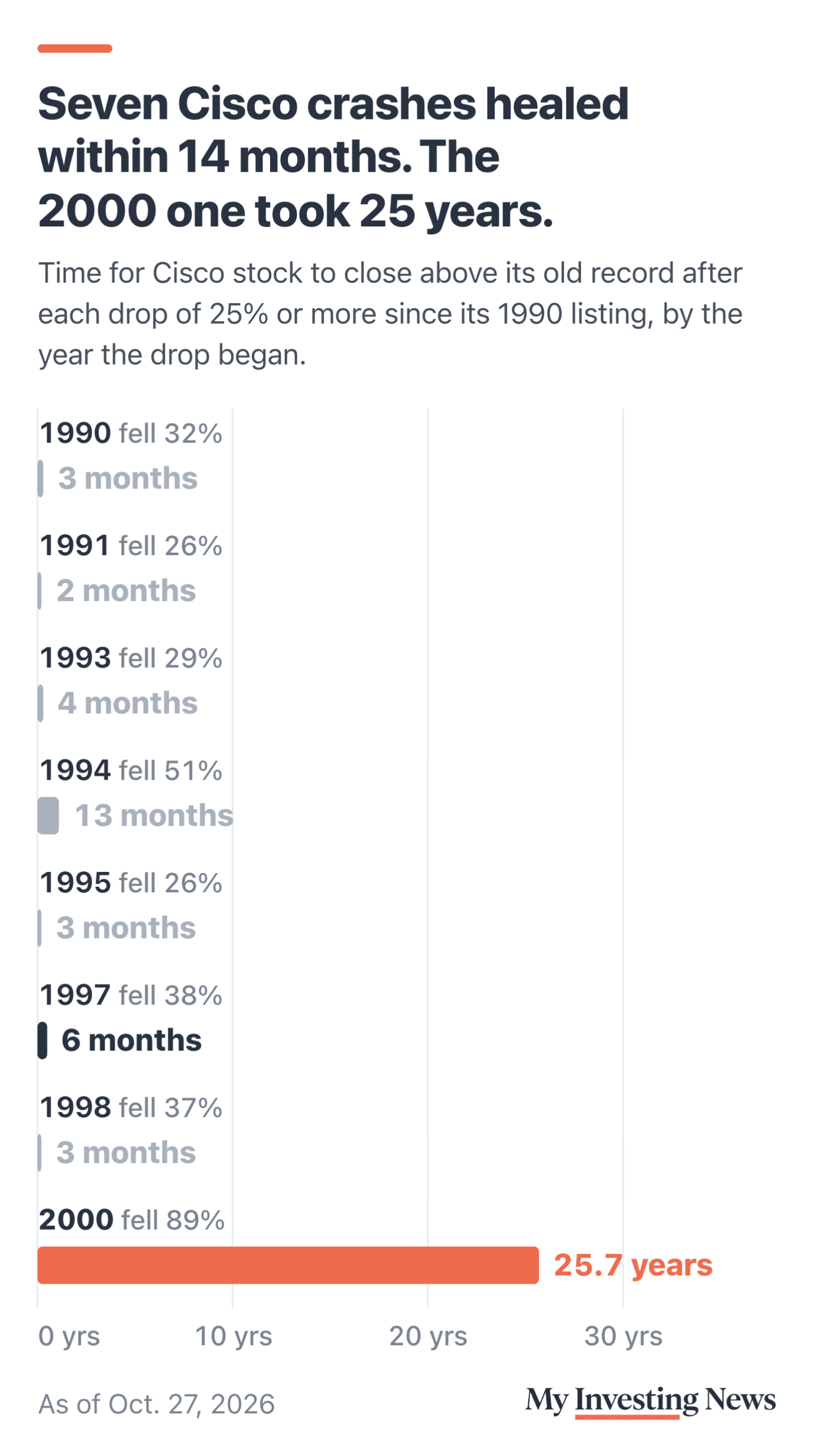
That is the risk inside Lee’s analogy. In 1997, every Cisco dip turned out to be a buying chance. The same playbook applied in 2000 meant a quarter century of waiting. Lee places today in the early innings, saying ChatGPT is “basically crossing its third anniversary.” ChatGPT launched on Nov. 30, 2022, so it turns four next month.
Lee’s Year-End Record
Lee is known for bullish year-end S&P 500 targets, and the past four years mostly went his way. He missed badly in 2022, when he called for 5,100 and the index ended at 3,839.50. He hit 2023 almost exactly, and the index finished above his targets in 2024 and 2025. His 2026 target is 8,000, raised from 7,700 in June. The S&P 500 closed at 7,722.60 on Oct. 27.
Lee’s year-end S&P 500 targets vs. the close
Chip Stocks Fell Harder After His First Call
On Oct. 22, the iShares Semiconductor ETFSOXX fell 6.79% and the Nasdaq-100, tracked by the Invesco QQQ TrustQQQ, dropped 2.86%. Lam ResearchLRCX fell 11.76%, NVIDIANVDA 4.4%, AMDAMD 8.1%, IntelINTC 8.04%, Meta PlatformsMETA 6.98% and CoreWeaveCRWV 10.06%.
Two reports from the evening before weighed on the group. Lam posted record September-quarter revenue of $8.22 billion and guided December-quarter revenue to about $8.60B +/- $400M. Management said the number “would have been a bit higher if not for some near-term supply chain constraints.” Meta reported negative third-quarter free cash flow of $2.12 billion and narrowed its 2026 capital spending forecast to $135 billion to $145 billion, raising the low end from $130 billion.
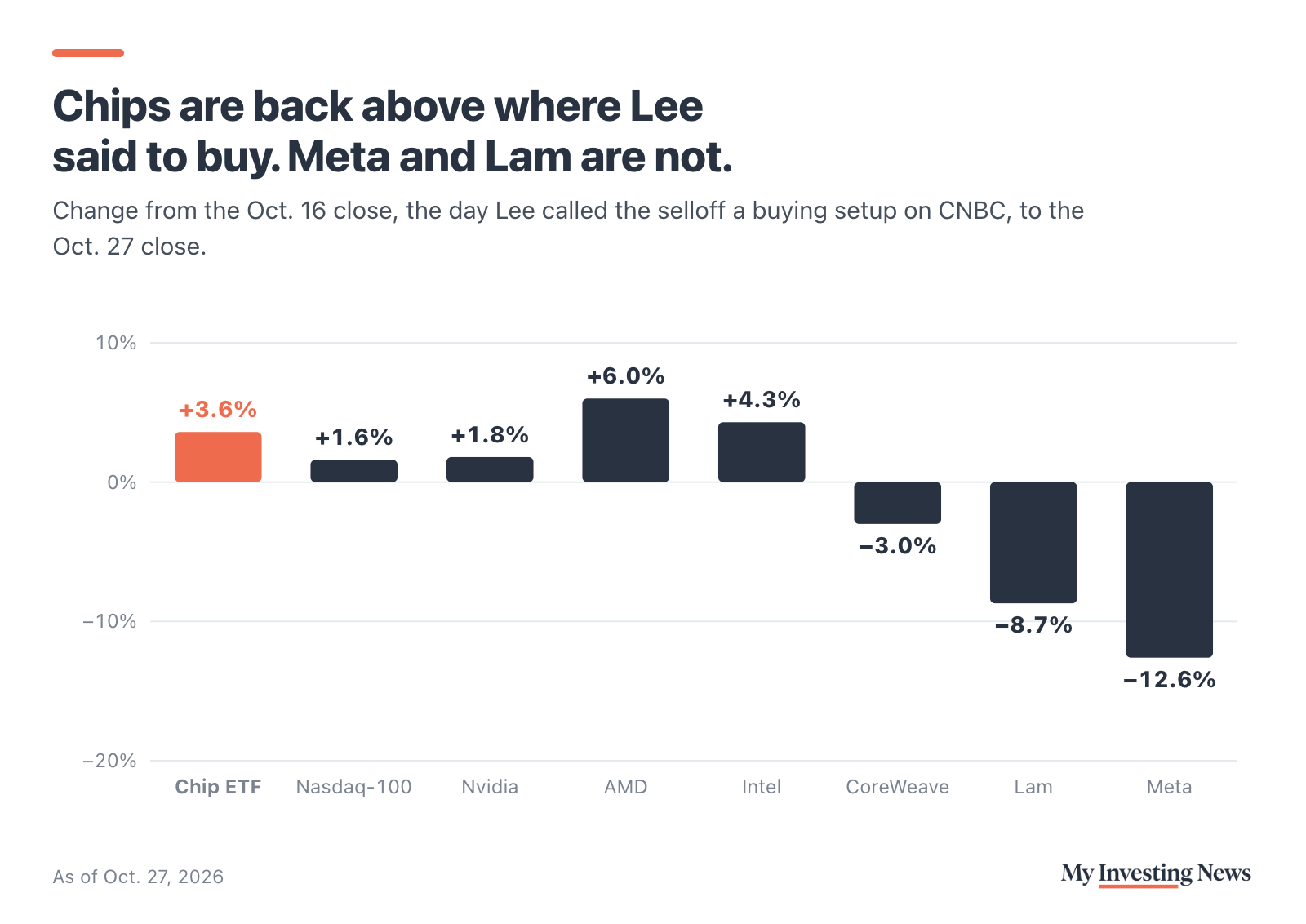
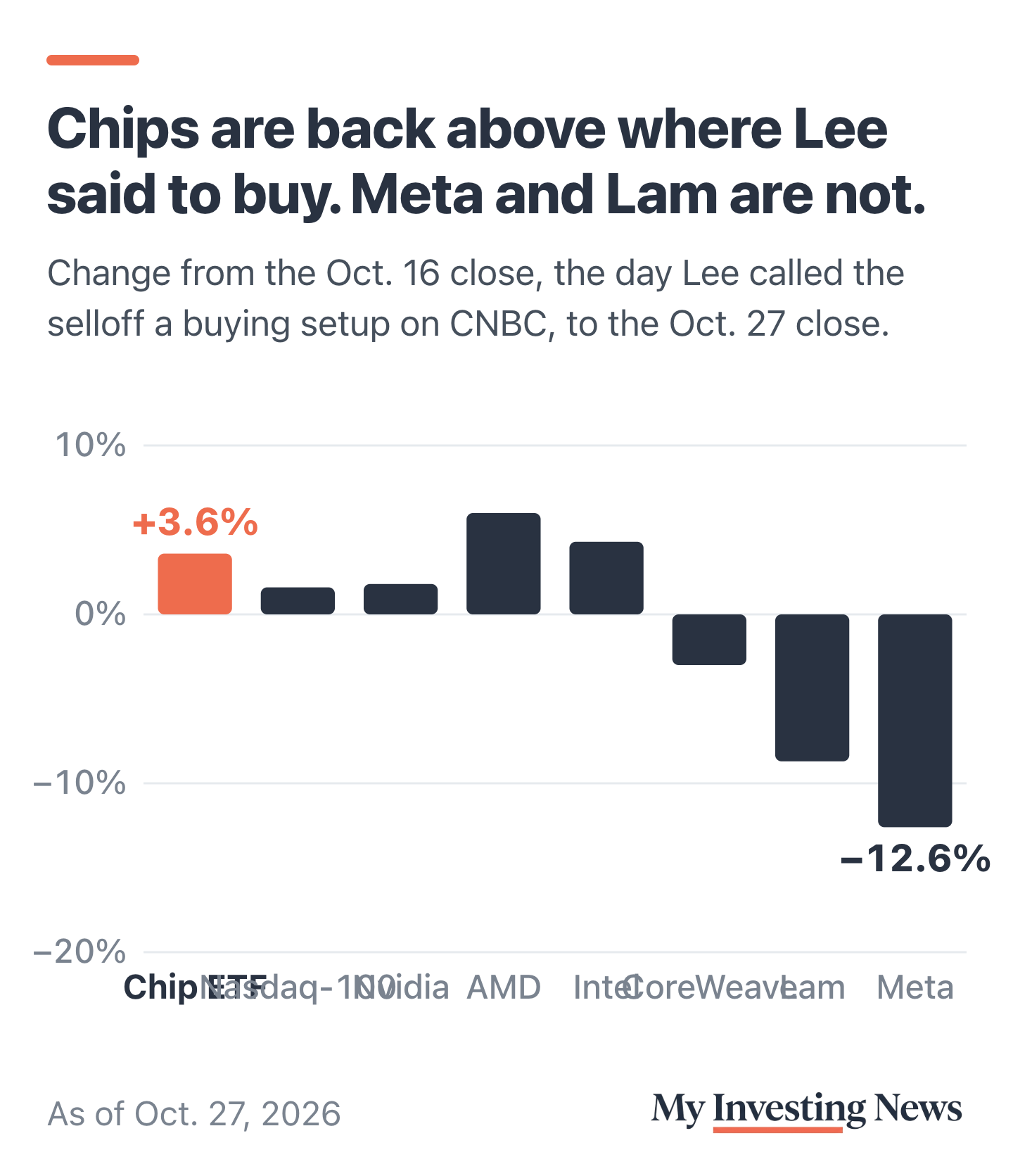
The bounce came quickly. On Oct. 26, the S&P 500 ETF rose 0.71% and QQQ gained 1.11%. By the Oct. 27 close, the chip ETF had climbed 7.4% from its Oct. 22 close and stood 3.6% above its Oct. 16 close, the day Lee first said to buy. AMD, Intel and Nvidia were also above their Oct. 16 levels. Lam was still 8.7% lower, CoreWeave 3.0% lower and Meta 12.6% lower.
Skeptics Focus on the Cost of Capital
On the same Oct. 16 Closing Bell panel, Solus’s Dan Greenhaus blamed higher rates for the pressure on speculative AI builders such as CoreWeave, where the market was “knocking off the unsecured debt,” but he cautioned against reading that as a signal for the whole market. Ned Davis Research’s Ed Clissold said “capital has a price” that the market is still working out, so the build-out could slow even with strong demand. At an Oct. 20 conference, Citadel’s Ken Griffin said investors are almost certainly in an AI bubble. He compared GPUs to airline seats and warned that prices could collapse if supply outruns demand. CoreWeave fell 36.65% from Sept. 30 through Oct. 26, and its bonds now yield about 15%.
Earnings Support Lee’s Demand Argument
Dow Jones reported that third-quarter earnings growth so far stands at 23.8%. NVIDIA’s latest quarterly revenue rose 106% to $96.2 billion, and CEO Jensen Huang said on the Aug. 26 call that “compute directly translates into increased revenues.” AMD’s Data Center revenue grew 107% to $6.7 billion in the second quarter, and Intel’s Data Center and AI unit grew 59%. CoreWeave’s backlog reached about $104 billion as of June 30, and Lam’s management sees “more than $200 billion” of 2027 wafer equipment spending.
What To Watch This Week
Microsoft and Alphabet report on Oct. 28 and Amazon on Oct. 29, and their capital spending guidance will test whether Meta’s spending plans reassure or concern investors. At this week’s Fed meeting, TheStreet said markets priced only about a 10% chance of a hike from the current 4.00% upper bound, and analysts are looking for clues about December. Credit spreads on AI-linked debt matter too. Lee says AI credit concerns are near a bottom, and CoreWeave’s bonds are the clearest place to check that claim.
Lee says the AI selloff is a 1997-style dip in a long build-out, and Cisco’s record backs him on the 1990s: seven drops of 25% or more all healed within 14 months. The risk is that his analogy also contains 2000, when Cisco lost 89% and took 25.7 years to regain its high. Chips have recovered since his Oct. 16 call while Meta and Lam have not, and this week’s cloud earnings are the next test.