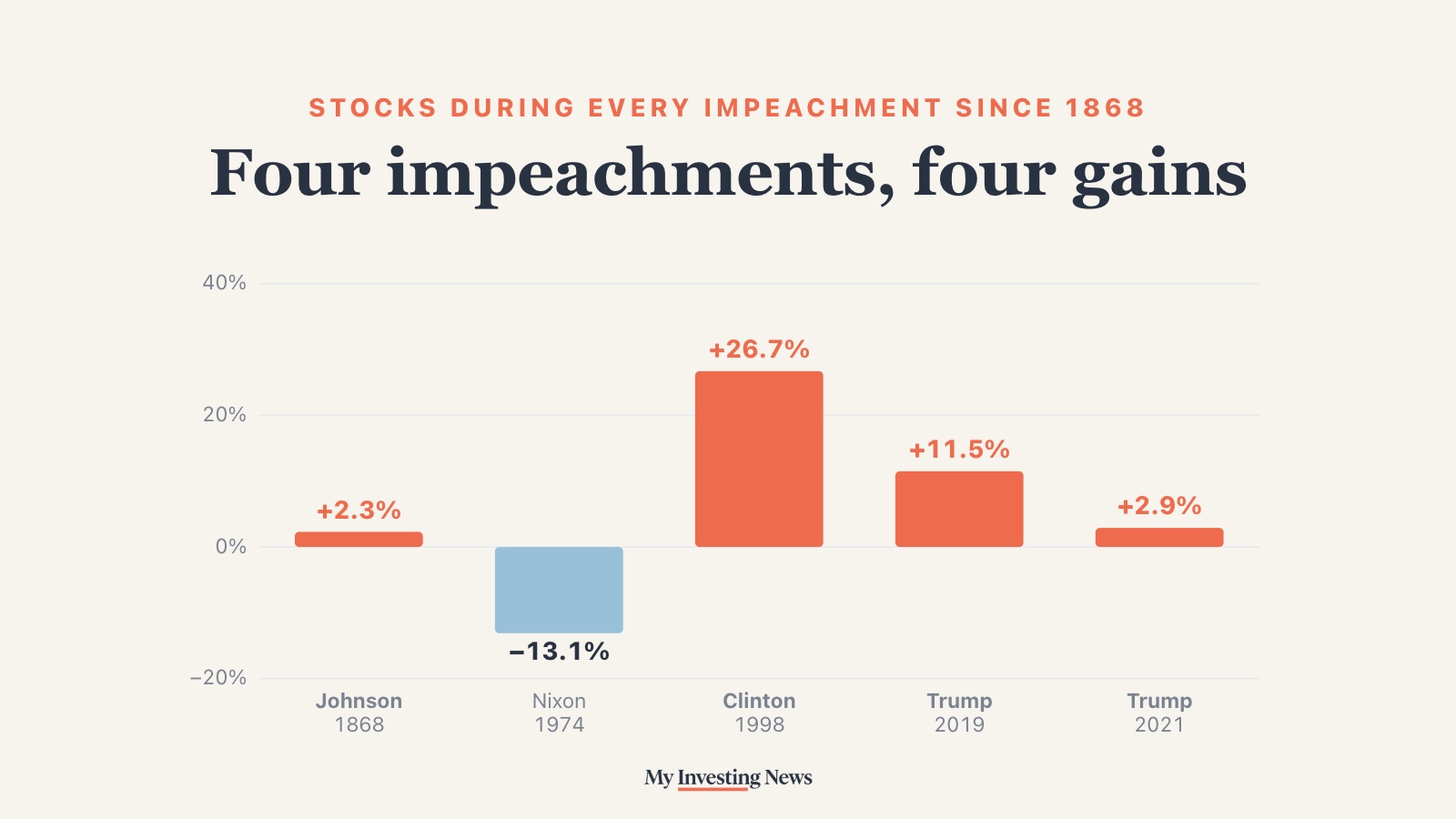
Where we heard itNathan Dean, senior government analyst at Bloomberg Intelligence, on the Bloomberg Businessweek podcast, “Data Center Boom Set for Upheaval After Midterms,” Nov. 4, 2026.
The day after Democrats won control of the House and the Senate, Nathan Dean was asked who should worry about the new majority. His answer was companies. Bloomberg Intelligence has “identified about 300 companies that the Democrats could go after,” he said on Bloomberg Businessweek, and about 200 of them have already gotten letters of inquiry from Democrats over the last two years. “The running joke in Washington is if your CEO’s been in the White House and taken a picture with the president, be prepared for that subpoena.”
Democrats describe that as “our idea of investigating corporate corruption instead of investigating the president,” Dean said. Then he explained why:
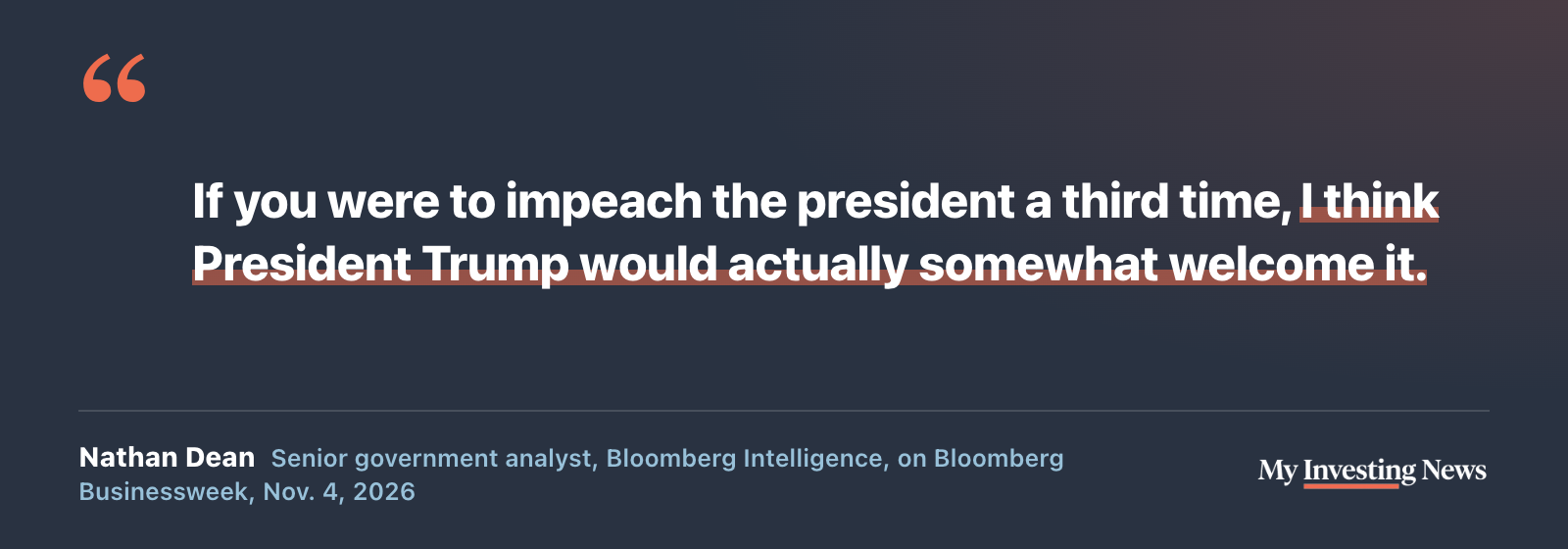
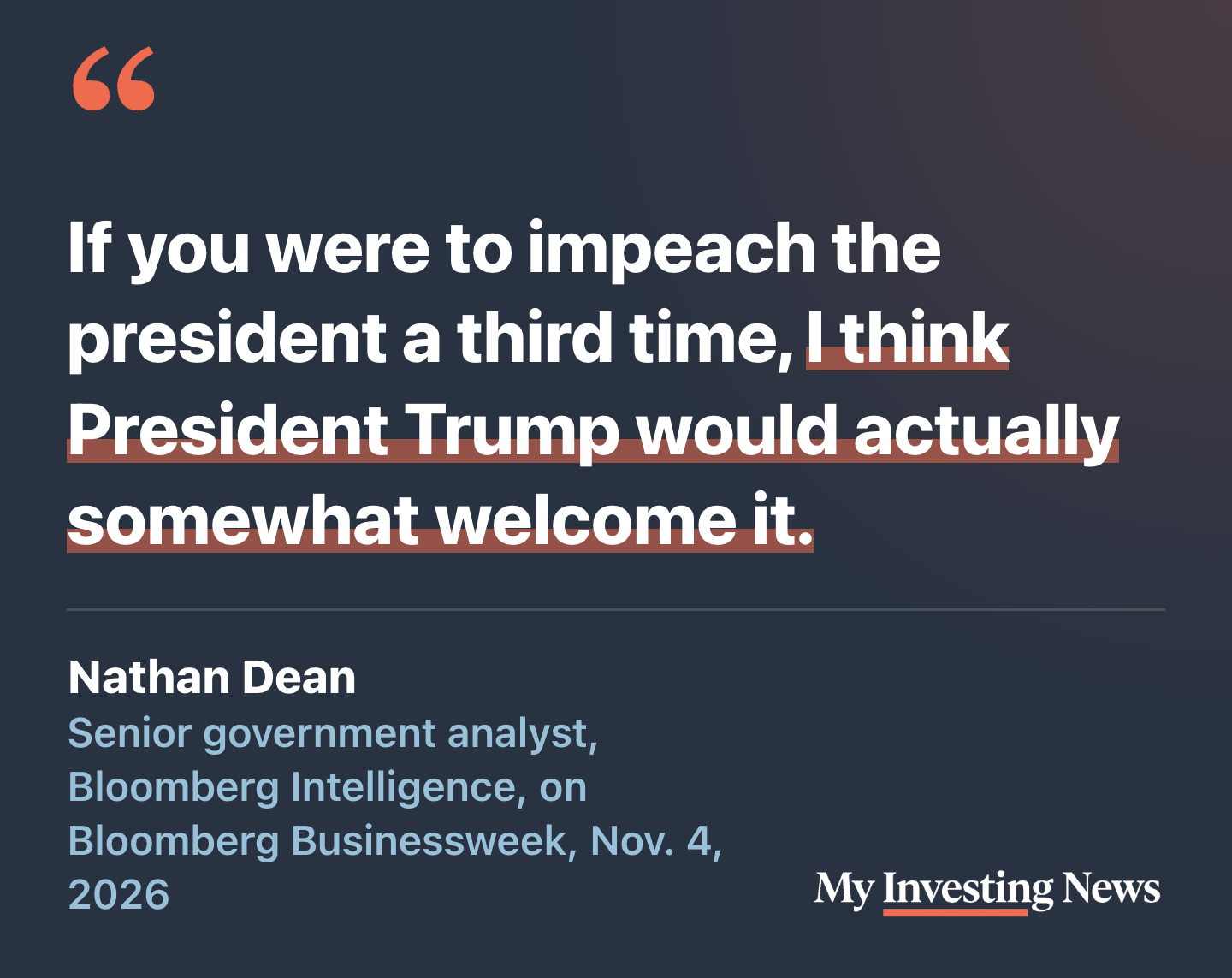
“It’s something that’s happened before and he hasn’t paid much of a political price here,” he added. Trump made a similar case to reporters the same day, saying an impeachment “would destroy the Democrat Party.” For investors, the useful question is narrower: what have stocks done while a president was on trial? There are only four impeachments and one near miss to go on, so we checked all of them.
Bettors Have Cooled on a Third Impeachment
Prediction markets moved Dean’s way after the election. On Polymarket, the odds that the House impeaches Trump before his term ends stood at 66% as of Nov. 10, down from 78.5% on Election Day. Bettors put the chance of an impeachment by the end of 2027 at 57.5%. These markets are thin: about $134K has traded on the first one, so treat the numbers as a mood reading.
The new Congress isn’t seated until January, and the House has already turned impeachment down this year: in September it tabled Rep. Al Green’s latest articles against Trump. Impeachment is on the floor in another form, though. Rep. Thomas Massie, a Kentucky Republican, filed articles against Defense Secretary Pete Hegseth on Nov. 9, and Hegseth called the effort “a political spectacle” the next day.
Stocks Rose Through All Four Impeachments
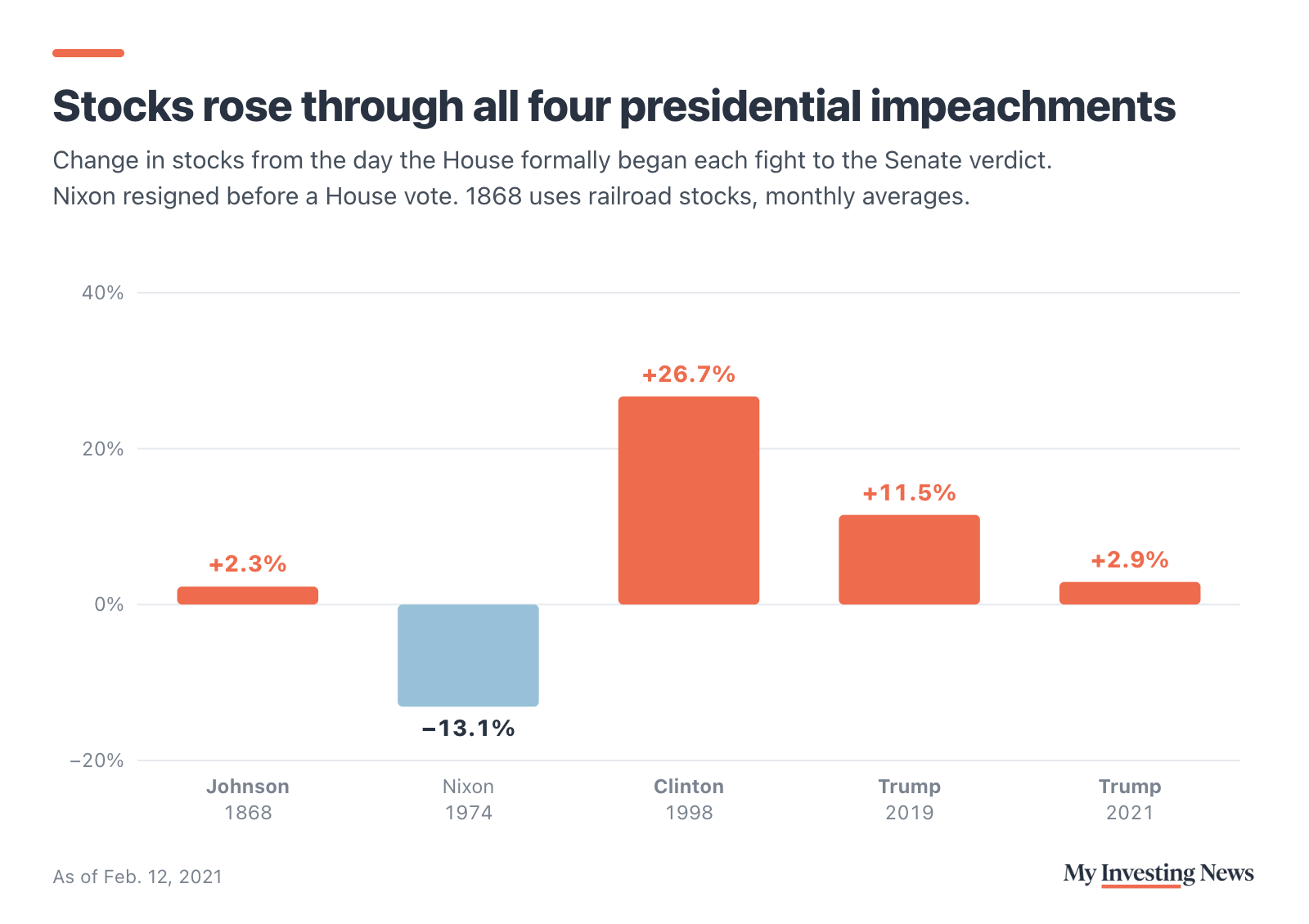
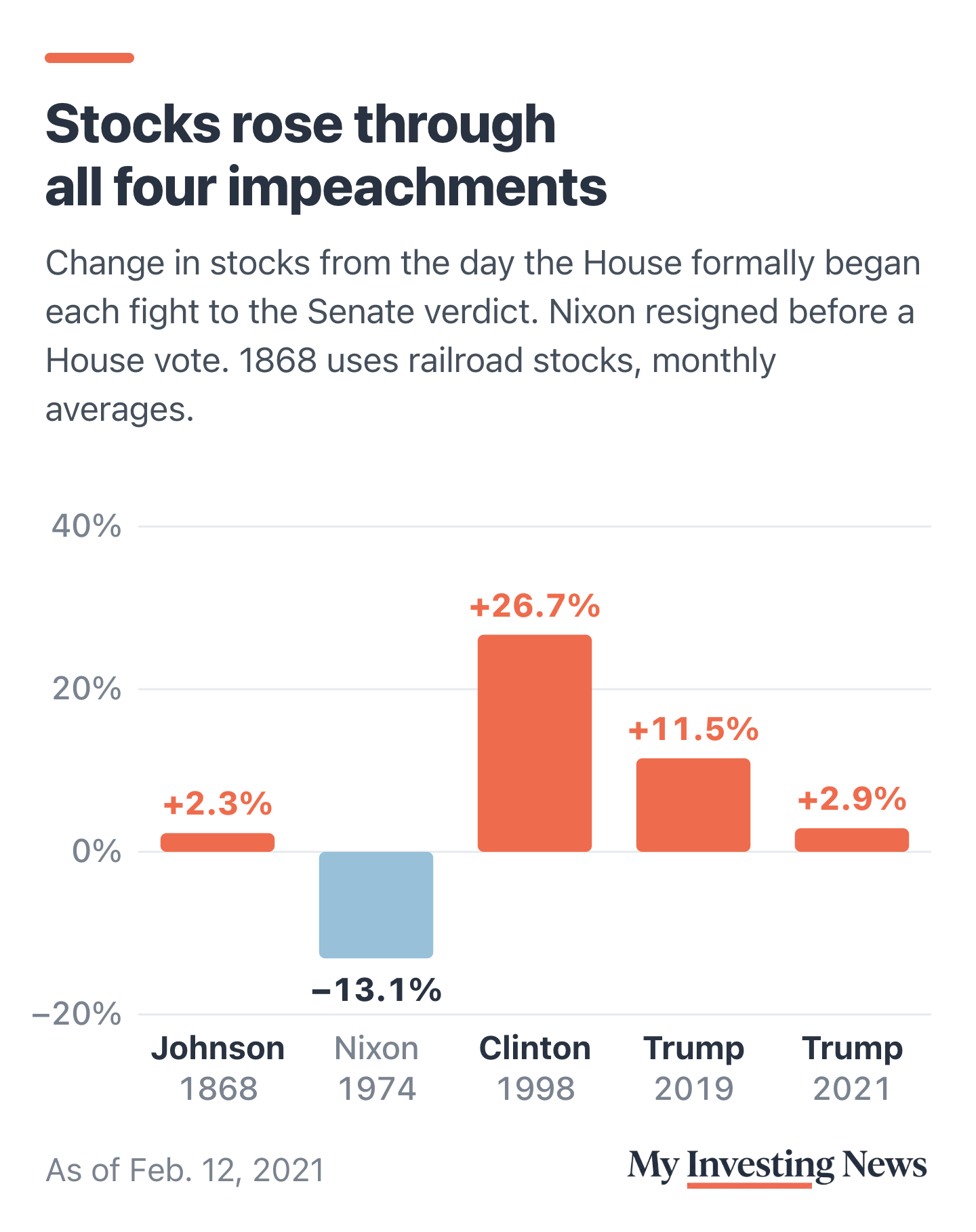
The record is short and consistent. When the House impeached Andrew Johnson in February 1868, railroad shares, most of the traded market then, rose 2.3% from February to May, when the Senate acquitted him, based on the monthly averages in Frederick Macaulay’s index kept by the National Bureau of Economic Research.
The S&P 500 rose 26.7% from the day before the House opened its Clinton inquiry on Oct. 8, 1998, to his acquittal on Feb. 12, 1999. That number flatters the case: the inquiry began days before the low of the 1998 sell-off over the hedge fund Long-Term Capital Management, with the VIX at 43.5. From the House vote to the Senate verdict, stocks gained a quieter 3.5%.
Trump’s first impeachment ran from Speaker Nancy Pelosi’s announcement on Sept. 24, 2019, to his acquittal on Feb. 5, 2020, and the index rose 11.5%. The second took five weeks in early 2021, and stocks rose 2.9%. No fight since 1998 saw stocks fall more than about 5% from a high along the way.
The Exception Was Nixon
The one fight that lined up with a bad market never reached an impeachment vote. The House voted 410 to 4 on Feb. 6, 1974, to authorize its inquiry into Richard Nixon, and by his resignation on Aug. 9 the S&P 500 was down 13.1%. Measured from late October 1973, when the House Judiciary Committee started its work, the drop was 27.3%.
Watergate had company. The Arab oil embargo began in October 1973 and inflation reached double digits in 1974. Nixon’s exit didn’t end the slide either: the bear market bottomed on Oct. 3, 1974, 23% below the day he left. David Sacks compared this year’s midterm loss with the 1974 Watergate election, the last time a scandal and a market slump ran together.
Stocks and impeachment, by the numbers
A Year Later, Stocks Were Higher Every Time
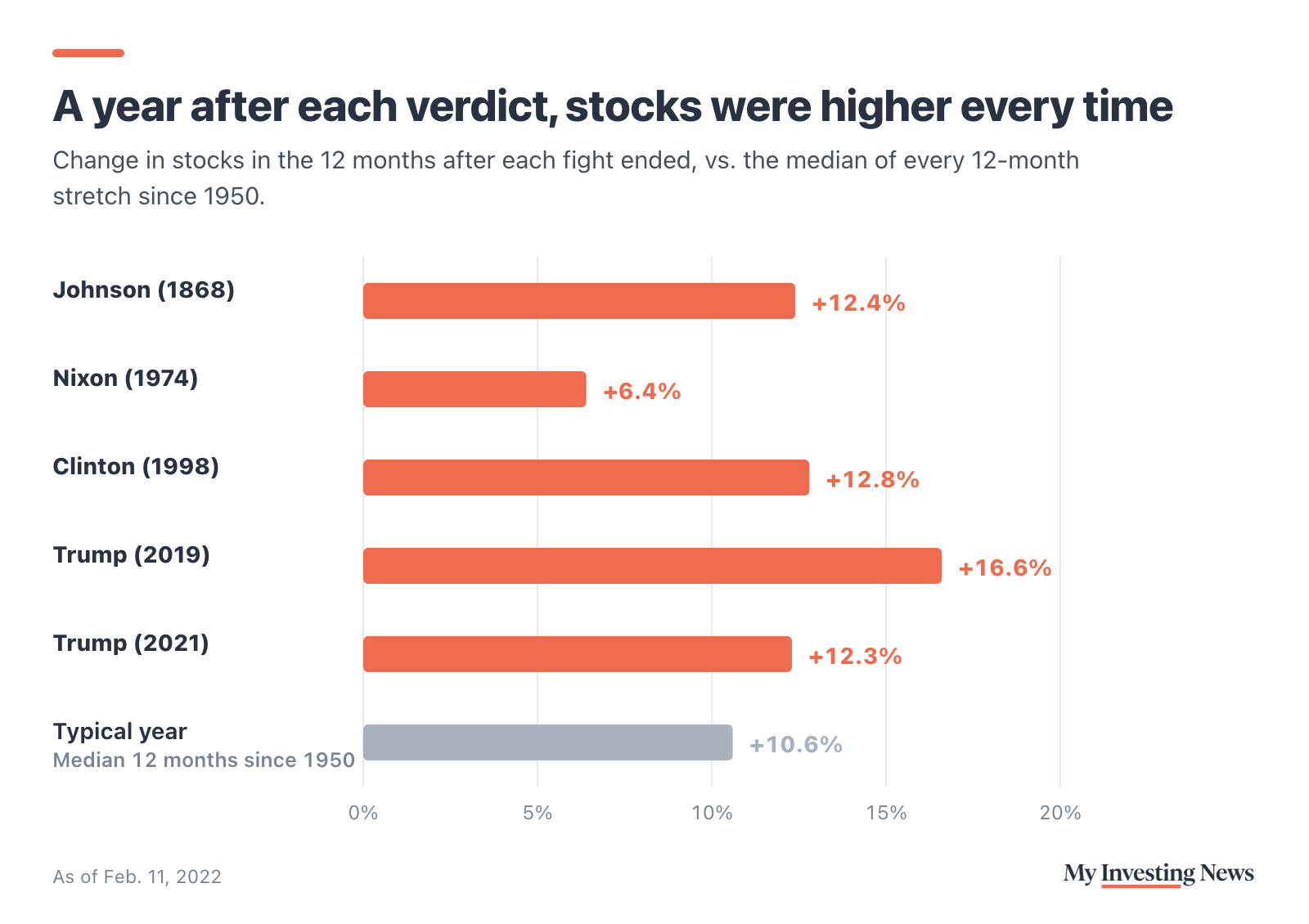
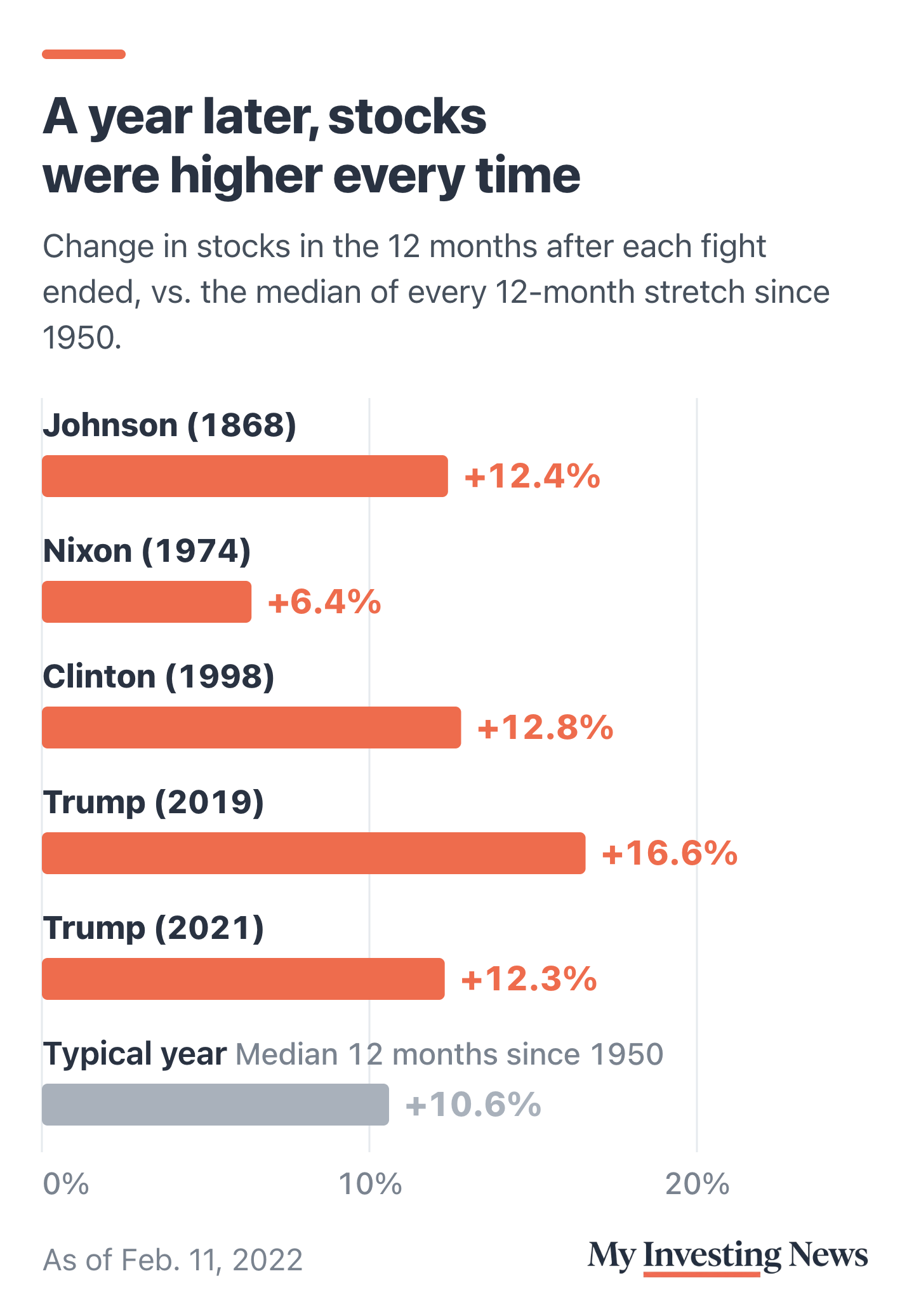
In the 12 months after each fight ended, stocks rose all five times, by an average of 12.1%. That is close to normal: the median 12-month gain for the S&P 500 since 1950 is 10.6%, and about 75% of all 12-month stretches end higher. The year after Trump’s 2020 acquittal included the pandemic crash and the rebound that followed.
Five cases can’t prove that impeachment helps or hurts. Interest rates, earnings and the economy did more to move each of these markets than the trials did. What the record does show is that a president on trial has not, by itself, been a reason for stocks to fall. Conviction is a different matter: removal takes two-thirds of the Senate, and it has never happened to a president. Stocks tend to do well after midterm elections, too, though that pattern has its own exceptions.
What to Watch
Dean’s point is that the market risk sits with companies more than the president. Watch the committee chairs the new majority names in January and their first subpoenas: Dean expects Judiciary and Oversight to look at crypto companies, businesses linked to the president’s investments and donors to the White House ballroom, and he noted that Sen. Elizabeth Warren has already written to the largest banks. Watch the prediction markets for a jump in impeachment odds, and the veto fights that will test how far a narrow majority can go; Congress has overridden 112 of 1,533 regular vetoes since 1789.
Nathan Dean thinks Democrats will chase companies before they chase a third impeachment, and Polymarket bettors have cut their odds since Election Day. If the House does impeach, history is calm: stocks rose through all four presidential impeachments and were higher a year after every fight. The loss came in 1974, when Watergate ran into an oil shock and inflation.